

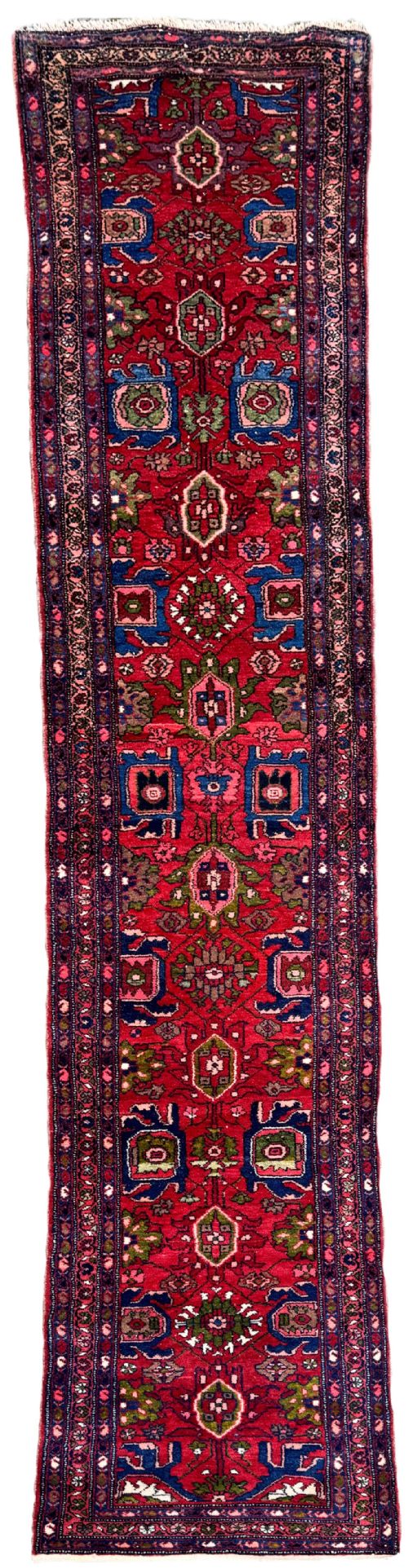


Hamadan Hallway Carpet
A hamadan hallway carpet brings enduring Persian tribal character and robust wool construction to long spaces.
Hamadan Hallway Carpet
A hamadan hallway carpet is typically encountered as an antique runner rug woven in the villages and towns of West Persia. These pieces span production from the late nineteenth century through to the 1930s, displaying traditional Persian designs suited for long corridors and halls.
The selections available here emphasise narrow formats and long rug proportions, including specific regional types such as Sanjan and Serab variants. Buyers find pieces ranging from modest lengths to substantial country house proportions exceeding ten metres in length.
The visual vocabulary relies on established Persian tribal and traditional motifs executed in practical formats. These floor coverings are selected specifically to anchor extended domestic walkways with authentic regional craftsmanship.
Materials and construction
Construction relies upon durable wool pile hand-knotted onto sturdy cotton foundations. This pairing provides the structural resilience necessary for high-traffic hallway placement.
Weavers utilised traditional Persian knotting techniques, producing dense, hard-wearing surfaces designed to withstand generations of daily use. Natural materials form the basis of both the pile and the underlying warp and weft threads.
Hamadan Hallway Carpet Retail Price Guide 2026
Typical asking prices for hamadan hallway carpet among the pieces listed under this phrase on Sellingantiques today, from the lower quarter to the upper quarter. They describe what is for sale here now, not the wider market.
Listings feature pieces dated between 1880 and 1930, utilising wool and cotton across traditional Persian styles.
What separates the grades
Quality in these runners rests upon the fineness of the knotting and the crispness of the geometric or floral pattern execution. Tighter pile density directly correlates with greater longevity under foot traffic.
The handling of wool quality and the balance of regional proportions also dictate the standing of an individual piece. Better examples maintain structural integrity across exceptional lengths while preserving clear, saturated colour work.
The Hamadan Hallway Carpet Glossary
- Runner
- A long, narrow carpet format specifically proportioned for corridors, hallways, and stairs. These pieces measure significantly longer than they are wide.
- Warp
- The vertical foundation threads stretched lengthwise on the loom before knotting begins. Cotton is standard for these structural elements.
- Weft
- The horizontal threads passed across the warp threads after each row of knots is secured. They bind the structure together firmly.
- Pile
- The upright surface of knotted wool that forms the visible and tactile layer of the carpet. Its density determines how well the textile wears over time.
- Serab
- A West Persian weaving centre known for producing runners with distinctive tribal aesthetics often associated with the wider Hamadan region.
Hamadan Hallway Carpet: Frequently Asked Questions
How do I measure for a hallway runner?
Measure the clear floor space of your corridor, leaving an equal margin of exposed wood or stone around the perimeter of the rug. Ensure doors can swing freely over the pile thickness.
Account for any radiators, skirting boards, or architectural obstructions so the runner sits centred without bunching against walls.
Are these runners suitable for heavy traffic?
Traditional village runners utilise dense wool pile on cotton foundations built specifically to withstand continuous foot movement. Their robust construction handles hallway use reliably.
Pairing the carpet with a quality underlay prevents slipping and cushions the fibres against hard subfloors, extending the life of the textile.
How do I date an antique runner?
Dating relies on stylistic markers, structural analysis, and material consistency observed across comparable pieces from the same weaving regions. Characteristics of the wool and dye palette offer further clues.
Most examples date from the late nineteenth century through to the early decades of the twentieth century, reflecting traditional village production methods.
How should I clean a wool runner?
Regular gentle vacuuming without a rotating brush roll removes surface grit before it settles deep into the pile. Professional specialist cleaning is recommended for periodic deep washing.
Avoid chemical spot treatments that can strip natural lanolin from the wool or cause dyes to bleed into the cotton foundation.