

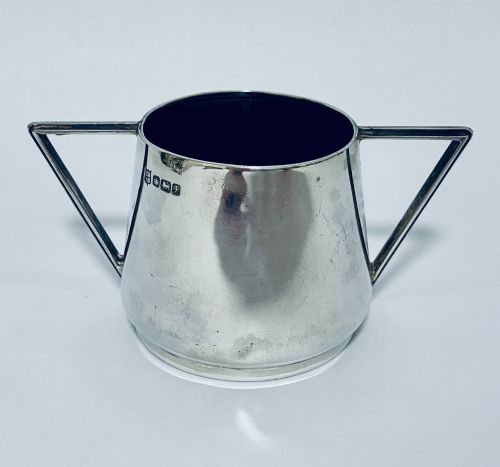
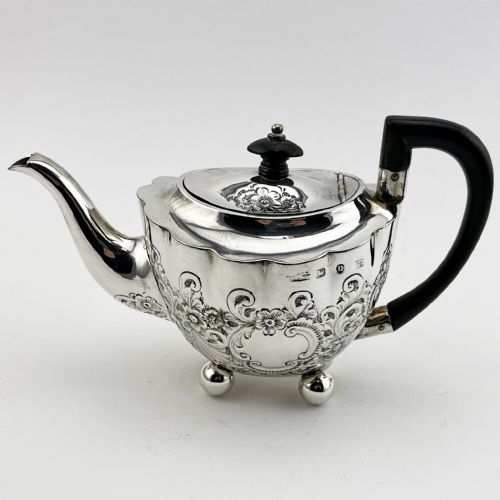
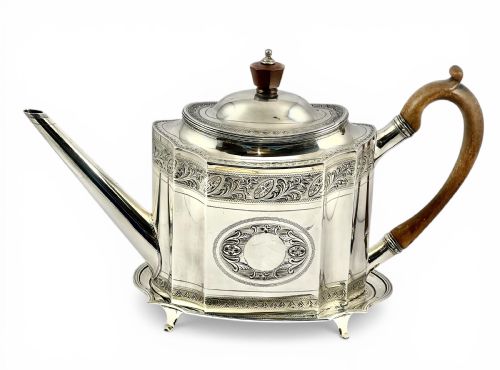


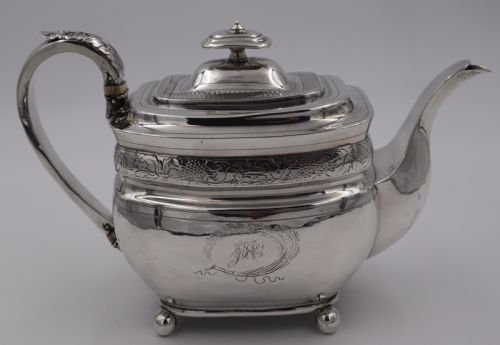


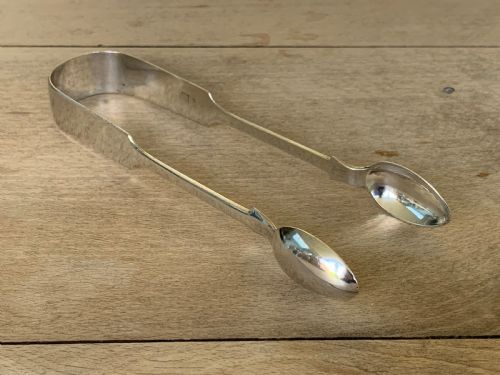
Hallmarked Silver Tea Service
These hallmarked silver tea service pieces are solid sterling vessels and sets shaped for social ritual.
Hallmarked Silver Tea Service
A hallmarked silver tea service brings together matched or paired vessels designed for the formal serving of tea and coffee. Buyers searching this phrase encounter complete services spanning four or five pieces alongside individual cream jugs, teapots, sugar bowls, and sugar tongs.
The offerings on this page date from the eighteenth century through to the early twentieth century, taking in Georgian, Victorian, Regency, William IV, and Art Deco styles. Pieces range from modest bachelor teapots and footed ewers to substantial services housed in original fitted cases.
Materials and construction
Silversmiths shaped these items from solid sterling silver, frequently applying internal gilding known as silver-gilt to interior surfaces of bowls and jugs to protect the metal from acidic contents. Handles and finials incorporate contrasting materials such as wood and ebonised wood to provide insulation against heat.
Maker mark stamps, date letters, and assay office hallmarks were struck directly into the metal to certify the sterling standard. Craftspeople employed techniques including casting, raising, and chasing to achieve both plain classical profiles and ornate Victorian decoration.
Hallmarked Silver Tea Service Retail Price Guide 2026
Typical asking prices for hallmarked silver tea service among the pieces listed under this phrase on Sellingantiques today, from the lower quarter to the upper quarter. They describe what is for sale here now, not the wider market.
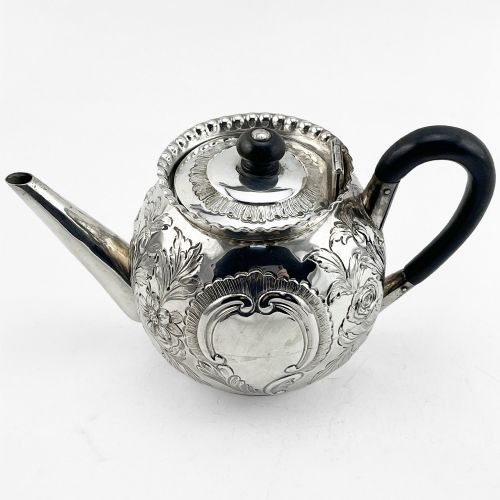
Bachelor teapots were thoughtfully proportioned for solitary tea drinkers who preferred not to summon staff for a single cup.
Distinctions in quality
The standard of a service depends upon the crispness of the maker marks, the clarity of chased ornament, and whether the set remains together in its original fitted case. Complete multi-piece services matched by a single maker hold greater cohesion than assembled groups gathered over time.
Weight, gauge of silver, and structural integrity of handles and spouts determine the durability and caliber of each vessel. Finer examples retain balanced proportions, secure hinges, and unblemished silver-gilt interiors.
Nathaniel Appleton And Ann Smith·Robert Hennell I·John Rawlings·Joseph Craddock·Benjamin Smith·Josiah Williams And Co·Harry Atkin
The Hallmarked Silver Tea Service Glossary
- Hallmark
- Official stamps struck into precious metal indicating the standard of purity, the assay office, and the year of manufacture. These marks provide the primary evidence for dating antique silver.
- Silver-Gilt
- A layer of gold applied to the surface of sterling silver objects, often seen inside cream jugs and sugar bowls. This technique prevents discoloration from food acids.
- Ebonised Wood
- Wood treated to imitate ebony, commonly used for handles and insulators on teapots to prevent heat transfer. It provides a dark contrast against polished sterling silver.
- Bachelor Teapot
- A smaller teapot scaled for individual use or small gatherings, popular during the Victorian period. These vessels mirror the form of full-size teapots in miniature.
- Assay Office
- The statutory body responsible for testing the purity of precious metals and applying hallmark stamps. Towns such as London, Sheffield, and Exeter maintained distinct offices.
Hallmarked Silver Tea Service: Frequently Asked Questions
How do I date a silver tea set?
Dating relies on the assay office hallmarks and date letters stamped directly onto the silver surface by the maker. Comparing these punch marks against historical registers reveals the exact year of production.
Secondary clues include the stylistic period, such as Georgian neoclassical lines or Art Deco geometry, which narrow down the manufacturing era.
Can I use antique silver for tea?
These vessels were engineered for hot liquids and remain functional for serving tea today. Normal usage requires gentle hand washing and avoiding abrasive cleaners to protect the metal.
Internal silver-gilt linings help protect the silver from tea tannins and other acidic beverages during service.
Why do some teapots have wooden handles?
Wood and ebonised wood act as thermal insulators to prevent heat from transferring from the boiling water to the handle. Silversmiths integrated these materials into the metal framework for practical handling.
Pins and sockets secure the wooden insulators firmly to the silver body.
What is the difference between a tea service and a set?
A service typically comprises multiple matching vessels designed to function together, such as teapots, coffee pots, cream jugs, and sugar basins. They often share a uniform decorative theme and maker.
Smaller gatherings of items accumulated over time may be described as sets but lack the strict uniformity of a single commission.