

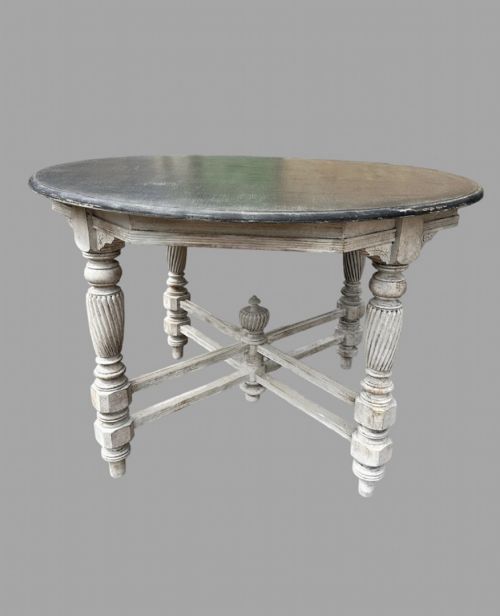


Gustavian Style Hall Tables
These gustavian style hall tables bring calm restraint and painted elegance to an entrance, offering surface space built for narrow spaces.
Gustavian Style Hall Tables
When you search for gustavian style hall tables, you encounter narrow furnishings designed for corridors and entranceways, drawing on Scandinavian country aesthetics and neoclassical proportions. The pieces listed on this page span several periods, reaching from the eighteenth century through the nineteenth century and into Edwardian and later twentieth-century interpretations.
You meet various forms on this page, including console tables, side tables, centre tables, occasional tables, lamp tables, and bedside tables. Many examples appear as pairs, alongside individual demi-lune consoles and D-end formats tailored for tight spots against a wall.
How they were made
Carpenters built these tables primarily using pine and oak as a structural base, applying layers of paint, lime wash, and gesso to achieve the characteristic pale surface finish. Giltwood highlights appear on select pieces to catch the light, echoing French neoclassical and Swedish empire influences.
Surfaces often feature marble tops, pairing stone with painted wood frames to provide durability in busy entrance areas.
Half-moon tables were originally built so polite guests wouldn't bruise their shins on sharp corners in narrow candlelit corridors.
What varies in quality
The standard of these tables rests on the execution of the painted finish and the integrity of the underlying timber framework. Older pieces from the eighteenth century or early nineteenth century display hand-worked surfaces and structural joinery that differ from later Edwardian or twentieth-century interpretations.
Proportion and form dictate the appeal of a console or side table, particularly in demi-lune and D-end shapes where the curve meets the wall. The integration of stone elements, such as marble inserts, introduces another layer of distinction across the range.
The Gustavian Style Hall Tables Glossary
- Console table
- A table designed to be fixed against a wall, often supported by two front legs and relying on the wall for balance. These pieces suit narrow hallways where floor space is limited.
- Demi-lune
- A half-moon shape used for tabletops and console formats. This design allows the furniture to sit flush against a wall while projecting outward into the room.
- Gesso
- A plaster-like mixture applied to wood surfaces as a base for paint or gilding. It provides a smooth ground for decorative finishes.
- Giltwood
- Timber coated with gold leaf or a gold-coloured metallic finish. It highlights carved details on neoclassical and empire pieces.
Gustavian Style Hall Tables: Frequently Asked Questions
Where should I place a console table?
These tables find their natural home in hallways, entrance passages, and narrow corridors where floor space remains at a premium. Their shallow depth allows them to sit against walls without blocking movement.
Pairs of these tables work well flanking a doorway or placed beneath a mirror to create a balanced focal point upon entering a home.
How do I identify a painted Swedish table?
Swedish tables often feature pale painted finishes, lime wash, and restrained neoclassical carving derived from French inspiration adapted in Scandinavia. The forms prioritise clean lines and functional elegance.
Materials typically include pine and oak beneath layers of historic paint, distinguishing them from heavier, darker Victorian furniture.
Are these tables suitable for everyday use?
These tables provide practical surface space for everyday items such as keys, correspondence, and lamps. Their robust pine and oak construction handles daily routines in busy hallways.
Tables with marble tops offer additional resistance to everyday wear, providing a durable surface for high-traffic entryways.