

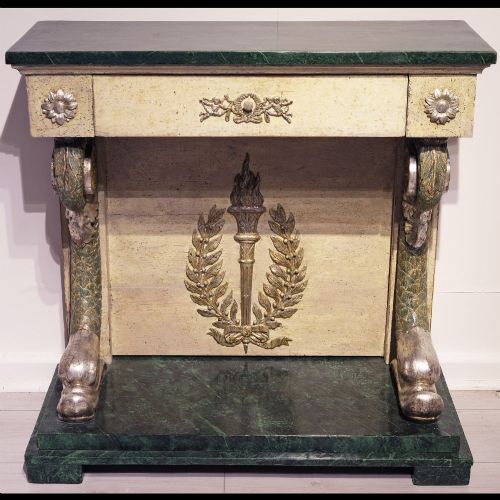
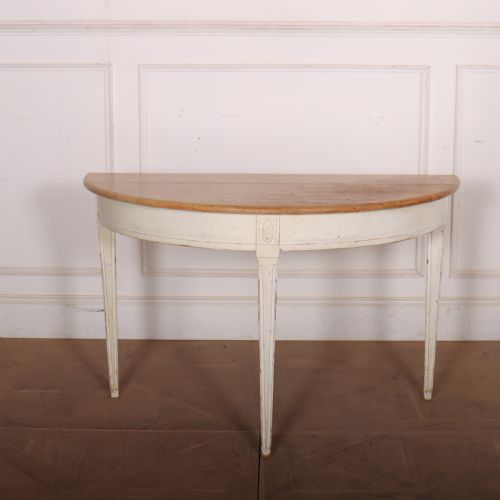


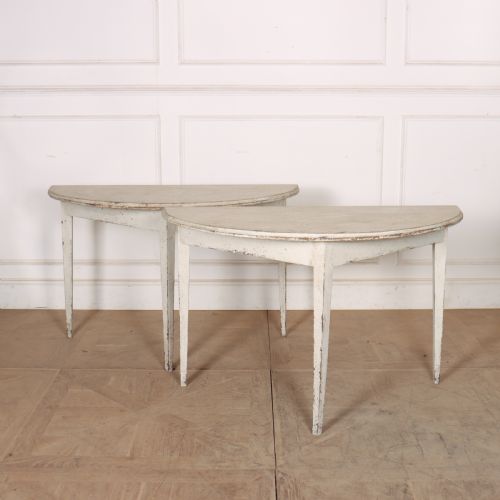


Gustavian Painted Console Table
A gustavian painted console table brings restrained Nordic elegance to a hallway, combining neoclassical proportion with pale painted finishes.
Gustavian Painted Console Table
When you search for a gustavian painted console table, you are looking at pieces that range from late eighteenth-century origins through to the nineteenth century, Edwardian era, and the early twentieth century. These tables appear in forms such as demi-lune consoles, side tables, narrow consoles, and occasional lamp tables, often originating from Sweden.
The pieces on this page reflect both Swedish Gustavian and Scandinavian Country styles, alongside French neoclassical and Georgian influences. You will frequently encounter demi-lune shapes designed to sit flush against a wall, sometimes accompanied by matching mirrors or formed as pairs.
Judging quality in painted tables
Quality in a painted console table rests on the integrity of the timber frame and the character of the surface finish. Original or early paint layers that have aged naturally carry more distinction than heavy modern repainting.
The refinement of the carving and the precision of the demi-lune or D-end proportions separate standard utility furniture from finer cabinet-making. Balanced proportions and crisp neoclassical details indicate superior workshop origin.
Object types include writing desks, centre tables, and console tables paired with matching mirrors.
The Gustavian Painted Console Table Glossary
- Demi-lune
- A half-moon shape used frequently for console tables designed to stand flat against a wall. This format saves floor space while providing a decorative surface.
- Gustavian
- The Swedish interpretation of French neoclassical style, spanning the late eighteenth century and influencing later design. It is characterised by restraint, symmetry, and pale finishes.
- Console table
- A table supported by wall brackets or legs, historically placed in hallways or beneath mirrors. These tables prioritise decorative presence over heavy storage.
- Bleached wood
- Timber treated to lighten its natural tone, appearing in select eighteenth-century pieces. This process creates a pale surface that complements painted finishes.
Gustavian Painted Console Table: Frequently Asked Questions
Where should I place a console table?
These tables suit narrow entrance halls, living rooms, or beneath wall mirrors where floor space is limited. Their shallow depth allows them to sit comfortably without obstructing walkways.
The demi-lune shape fits neatly against flat walls while offering a display surface for lamps or decorative objects.
Are these tables from the eighteenth century?
The selection includes pieces dating from the late eighteenth century through the nineteenth century and into the Edwardian and early twentieth periods. Each era brings subtle shifts in proportion and painted finish.
Examining the construction and paint layers helps distinguish original eighteenth-century work from later nineteenth-century interpretations.
What is the difference between a console and a side table?
Console tables traditionally fasten to or sit flush against a wall, often featuring a half-round or rectangular top designed for display. Side tables are freestanding pieces meant to be viewed from multiple angles.
Many listings blur this distinction by using the terms interchangeably for tables of similar size and form.
How do I care for a painted wooden surface?
Painted antique surfaces require gentle cleaning with a dry or lightly dampened cloth, avoiding harsh chemical cleaners that can damage the finish. Keeping them away from direct sunlight protects the paint from fading.
Wax is occasionally used on varnished or waxed painted surfaces to maintain the sheen without softening the underlying paint.