


Grey Upholstered Stool
These grey upholstered stool options bring period form and tactile fabric together for daily seating, footrest use and decorative placement.
Grey Upholstered Stool
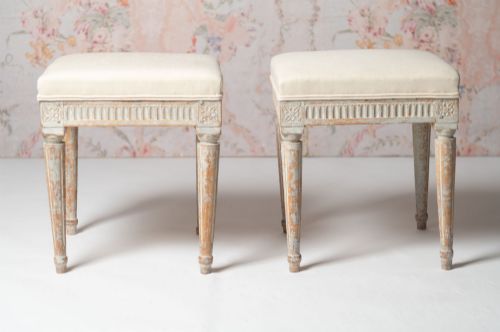
A grey upholstered stool combines period wooden frames with fabric seating, spanning forms such as footstools, ottomans, window seats and dressing table stools. The selection ranges from compact 19th Century music stools to large French decorative pieces and Swedish Gustavian examples.
Makers and designers from the Regency and Victorian eras applied this upholstery to mahogany, walnut, rosewood and carved wood bases. Buyers frequently encounter French Provincial and Louis XVI style influences alongside traditional British seating forms.
Materials and construction methods
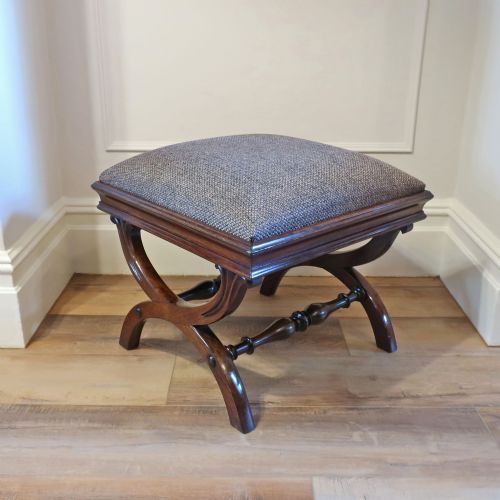
Frames are constructed from solid timber such as mahogany, walnut, rosewood, ebonised wood or painted wood, often shaped with hand carving or cabriole legs. Wood surfaces feature original finishes, paint or gilding.
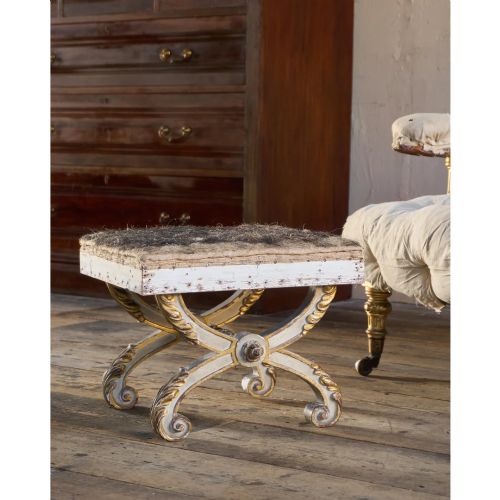
Seating areas utilise fabric and linen upholstery applied over traditional internal stuffing and framing methods. Specific examples incorporate decorative elements like lions paw feet or X frame curule designs.
Materials recorded across the inventory include mahogany, walnut, rosewood, ebonised wood, painted wood and linen fabric.
Assessing quality and craftsmanship
Quality rests in the crispness of the wood carving, the integrity of the frame joints and the choice of timber species. Walnut and mahogany examples demonstrate superior cabinetmaking compared to simpler painted pine or secondary woods.
Finer pieces display sophisticated stylistic detailing, such as French hand-carved ornamentation, distinct period proportions and high-grade textile selection. The harmony between the original wooden structure and the current upholstery dictates the overall standard.
Miles & Edwards
The Grey Upholstered Stool Glossary
- Cabriole leg
- A furniture leg that curves outward at the knee and tapers inward to an ankle, found on many Victorian stools.
- Curule
- An X-shaped frame structure derived from ancient Roman seats, utilised in antique footstool designs.
- Gustavian
- The Swedish interpretation of French neoclassical design, characterised by restrained carved detail and painted wood.
- Ottoman
- A low upholstered seat or footstool without a back or arms, often built with internal storage or large proportions.
Grey Upholstered Stool: Frequently Asked Questions
How do I clean the fabric?
Maintenance depends entirely on the specific textile chosen for the upholstery, whether linen or heavier woven fabric. Professional specialist cleaning is recommended for antique and period textiles to preserve the fibres.
Vacuuming gently with a soft brush attachment removes surface dust without stressing the historic frame or stuffing underneath.
Where should I place an ottoman?
These pieces function effectively at the foot of a bed, beneath a window seat, or paired with armchairs in a living space. Their compact or long proportions allow them to fit into hallways and dressing rooms.
Consider the height of surrounding furniture to ensure comfortable use as either a seat or a footrest.
How do I identify a French style stool?
French provincial and Louis XVI pieces typically display hand-carved decorative woodwork, gilded surfaces, or painted finishes. Their silhouettes often incorporate elegant curves and exposed wooden frames.
British Victorian and Regency equivalents tend to rely on dark hardwoods like mahogany and walnut with simpler or more robust turning.
Can these stools be used daily?
Solid wood frames built in the 19th or early 20th century offer robust structural integrity for regular domestic seating. Routine use as footrests or dressing table seats is well within their capacity.
Checking the stability of the joints periodically ensures the historic timber remains secure under daily weight.