
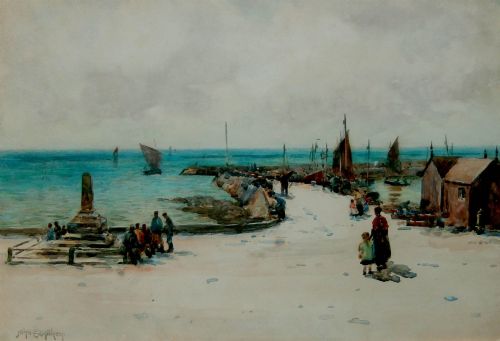


Grey Sea Watercolour
A grey sea watercolour captures the raw atmosphere of coastal weather through fluid washes of pigment on paper.
Grey Sea Watercolour
A grey sea watercolour presents marine views and coastal landscapes rendered in restrained tones during the nineteenth and twentieth centuries. These paintings focus on harbours, rocky shores, and tall masted ships tossed in choppy waters.
The pieces on this page span from Victorian marine art and Edwardian marine realisms to British Impressionism and Modern British styles. Viewers frequently encounter depictions of specific locations such as Whitby, Polperro, and Scarborough alongside distant lighthouses.
Works originate across the nineteenth and twentieth centuries, encompassing specific dates like 1890, 1900, 1910, 1920, and 1950. Common formats include single sheets and paired framed marine paintings.
Materials and methods
Artists painted using watercolour pigment and watercolour paint applied directly to paper substrates. These water-soluble materials allowed creators to build luminous washes that mimic the translucent quality of seawater and overcast skies.
Finished works received protective mountings behind glass and were typically housed within gilded wood frames. The combination of paper, pigment, and framing preserved the delicate watercolours across successive decades.
Several artists braved stormy British coasts just to paint choppy water and bobbing harbour rocks.
Judging quality in marine watercolours
Quality rests upon the artist's ability to manipulate fluid pigment to convey the weight of water and atmospheric mood. Superior works demonstrate confident brushwork that defines the movement of choppy waves without overworking the paper.
The handling of light against dark grey tones distinguishes accomplished marine realisms from simpler topographical sketches. Framing choices and the preservation state of the underlying paper further separate standard examples from finer collector pieces.
John E. Aitken·Frederick Stuart Richardson·Thomas Bush Hardy·Percy Brooke·William Kay Blacklock·Joseph Newington Carter·William Boyce·Edward Wesson
The Grey Sea Watercolour Glossary
- Watercolour pigment
- Finely ground colour particles mixed with a binder for use on paper. This medium produces transparent washes ideal for capturing shifting coastal light.
- Gilded wood
- Timber frames finished with a thin layer of gold leaf or metallic gilt. These surrounds provide a traditional contrast to muted marine palettes.
- British Impressionism
- A painting approach focusing on light and spontaneous brushstrokes rather than rigid detail. This style appears frequently in coastal scenes from the late nineteenth and early twentieth centuries.
- Victorian marine
- Artwork depicting ships, ports, and coastal weather created during the reign of Queen Victoria. These pieces often emphasise realistic detail in rigging and vessel construction.
Grey Sea Watercolour: Frequently Asked Questions
How do I care for a watercolour painting?
Keep the framed work away from direct sunlight to prevent the pigments from fading over time. Maintaining stable indoor humidity protects the paper and prevents mould growth.
Ensure the glass is clean and check that the backing seal remains intact to keep out dust and atmospheric pollutants.
What subjects appear in these coastal watercolours?
Artists painted working harbours, rocky coastlines, lighthouses, and tall masted ships navigating choppy waters. Many scenes record specific British fishing ports and coastal hotels.
Compositions range from calm harbour anchorages to turbulent seas under heavy grey skies.
How do I date a nineteenth century marine watercolour?
Examine the costume of any figures, the rigging of the ships, and the style of the frame for period clues. Victorian and Edwardian works often feature handwritten titles or signatures on the front or reverse.
Paper types and framing construction methods also offer reliable indicators of the period of production.
Can I hang marine watercolours in a hallway?
Hallways make suitable locations provided the wall does not experience dampness or direct sunlight. Using appropriate glass protection safeguards the delicate paper from accidental bumps.
Ensure the hanging wire and fixings match the weight of the gilded wood frame securely.