


Grey Painted Fauteuil Chair
A grey painted fauteuil chair brings refined French seating into a room, offering exposed wooden frames and upholstered comfort.
Grey Painted Fauteuil Chair
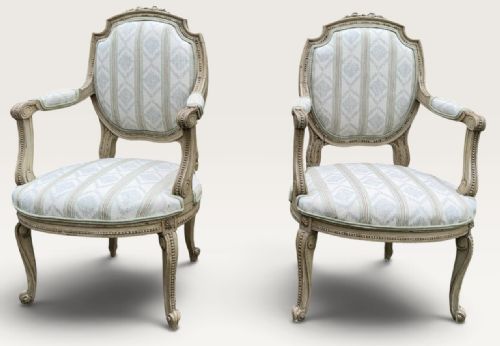
When you search for a grey painted fauteuil chair, you are looking at open-arm upholstered seats originating largely from French and continental traditions. These chairs emerge across the eighteenth, nineteenth, and early twentieth centuries, spanning periods from original eighteenth-century craftsmanship to later Edwardian and twentieth-century revivals.
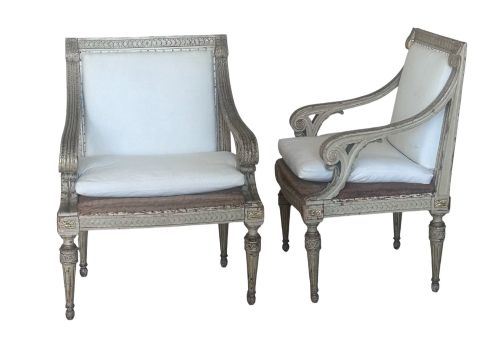
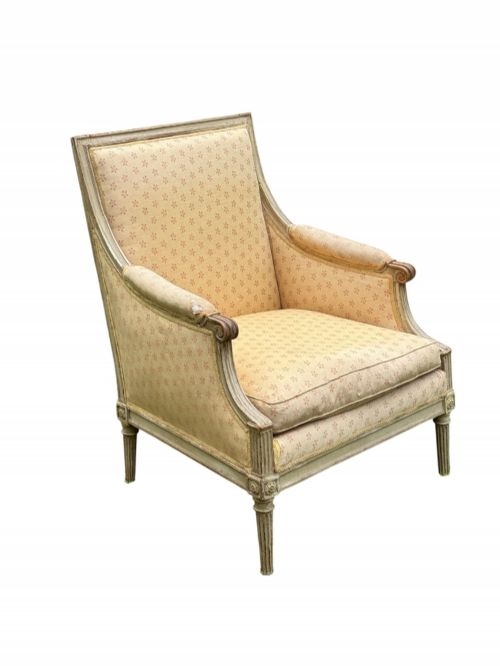
The selections on this page predominantly present as French armchairs, salon chairs, and small settees. You will frequently encounter pairs dating from around nineteen hundred, alongside items exhibiting Louis XV, Louis XVI, and neoclassical styling.
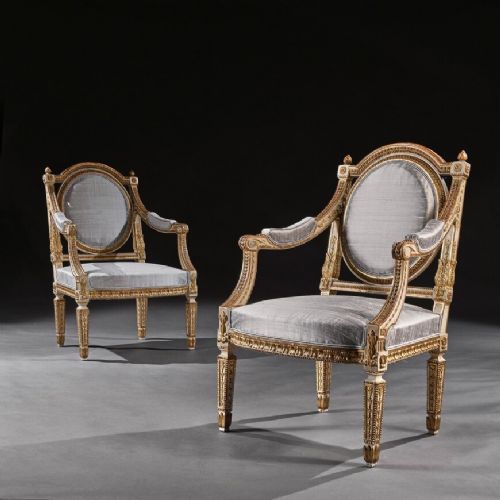
Makers and regional workshops from Italy and England also appear, working in painted wood and parcel gilt with needlepoint panels or cane inserts. The forms remain consistent in providing low, wide seating designed for formal domestic interiors.
Materials and Construction
The structural framework relies on beech and walnut, shaped through traditional joinery to form the classic curved lines of the armchairs. Artisans applied layers of gesso and paint directly to the wooden frames, occasionally incorporating parcel gilt highlights to accentuate carved floral and architectural motifs.
Upholstery techniques combined traditional webbing and stuffing with decorative textiles, including contemporary fabric, needlepoint panels, and woven cane inserts. Surviving pieces often display original paint finishes that have aged over the centuries to develop a distinct surface texture.
Many pairs survived centuries of redecorating simply because someone loved the chair too much to throw it out.
Assessing Craftsmanship and Age
The distinction between standard and superior pieces rests in the crispness of the wood carving and the integrity of the painted surface. Chairs featuring period-correct gesso and authentic original paint demonstrate a depth of finish that later decorative applications simply do not replicate.
Structural refinement also separates the output, visible in the hand-carved details of fluted legs, balanced arm supports, and the precise execution of Louis-style proportions. Pieces attributed to recorded makers or specific regional schools command attention through superior joinery and harmonious proportions.
Henri Jacob
The Grey Painted Fauteuil Chair Glossary
- Gesso
- A plaster-like mixture applied to wood surfaces as a base for painting or gilding. It provides a smooth ground that accepts fine decorative carving.
- Parcel Gilt
- A decorative technique where specific carved details of an object are partially gilded with gold leaf while the remaining surface is painted.
- Cane
- Woven rattan material used for chair seats and backs. It offers a lightweight, flexible surface popular in period seating.
- Needlepoint
- Hand-stitched textile work executed on canvas. It provides durable and ornate upholstery panels for historic armchairs.
Grey Painted Fauteuil Chair: Frequently Asked Questions
What defines a fauteuil chair?
A fauteuil is an open-arm upholstered seat with exposed wooden framing around the back and sides. The design distinguishes itself from fully upholstered armchairs by showing the carved and painted structure.
These chairs originated in formal French interiors to accommodate voluminous period dress while offering comfortable seating for social gatherings.
How do I spot original paint?
Original paint surfaces show natural wear, fine craquelure, and subtle tonal variations built up over decades of gentle use. Modern decorative overpainting often appears uniform and lacks the integrated relationship with the underlying gesso.
Examining the edges and recesses reveals how the finish has aged alongside the wooden frame beneath.
Where were these chairs used?
Historically, these seating pieces occupied formal salons, withdrawing rooms, and parlours within grand residences. They were arranged in conversation groups around fireplaces or against panelled walls.
Today, their compact proportions allow them to function effectively as accent seating in modern living spaces and bedrooms.
How do I tell Louis XV from Louis XVI?
Louis XV furniture relies on asymmetrical curves, cabriole legs, and flowing rococo ornamentation. The overall aesthetic feels organic and fluid.
Louis XVI design introduces neoclassical symmetry, straight fluted legs, and geometric motifs inspired by classical architecture.