
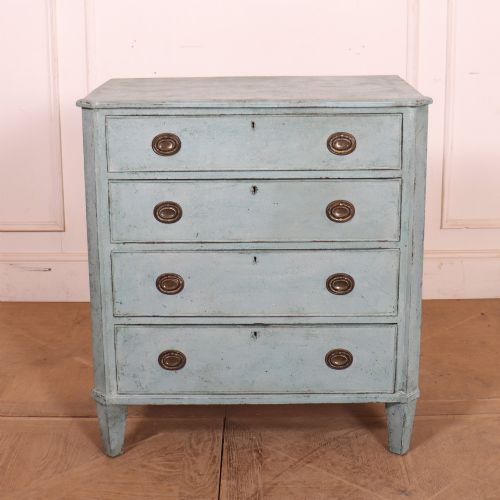
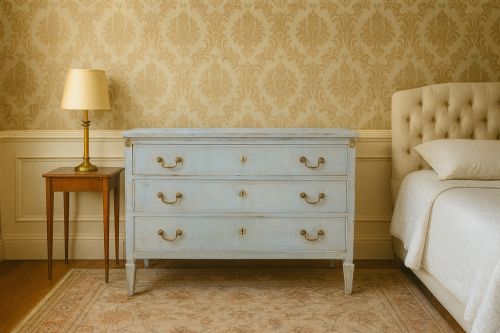


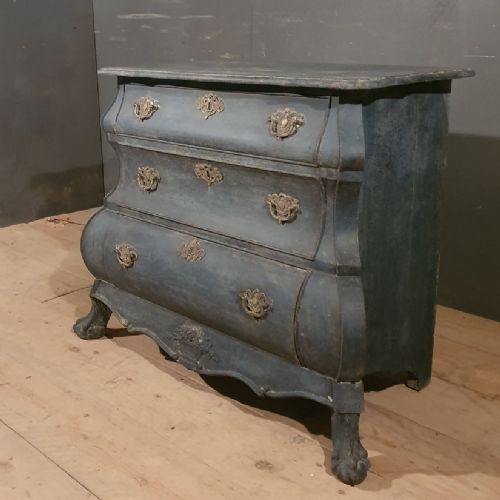


Grey Blue Painted Drawers
Grey blue painted drawers bring a restrained, cool tone to an interior, offering practical storage through provincial and neoclassical chests.
Grey Blue Painted Drawers
Grey blue painted drawers comprise chests of drawers and commodes spanning the eighteenth and nineteenth centuries. These pieces emerge chiefly from Swedish Gustavian, French Provincial, and Dutch traditions, bringing painted timber surfaces into domestic spaces.
The version most commonly met on this page is the nineteenth-century Swedish or Dutch chest of drawers. These examples utilise soft pine or timber carcasses finished in muted painted schemes that echo earlier neoclassical and baroque styles.
How they were made
Makers constructed these chests of drawers primarily from pine, softwood, and timber. Surfaces received layers of paint, often applied to build up depth and texture over the underlying wood.
Hardware details typically include brass fixtures to complement the painted timber bodies. Certain pieces incorporate faux marble tops to emulate more costly stone surfaces.
Some nineteenth-century makers painted timber to impersonate marble, proving that faux finishes have comforted budget-conscious homeowners for centuries.
What varies in quality
The sophistication of the painted finish dictates much of the visual character across these chests of drawers. Earlier eighteenth-century examples display more complex regional carving and bombe shaping, whereas later nineteenth-century pieces lean towards simpler revival forms.
The integrity of the timber carcass and the survival of original painted surfaces influence the overall appeal. Construction methods reflect the provincial origins, ranging from refined Swedish neoclassical proportions to heavier Dutch provincial execution.
The Grey Blue Painted Drawers Glossary
- Commode
- A low chest of drawers, often of continental origin and standing on legs. These pieces serve as both decorative furniture and functional storage.
- Gustavian
- The Swedish neoclassical style spanning the late eighteenth century, characterised by restrained ornamentation and pale painted finishes. This aesthetic draws inspiration from French and Italian design.
- Bombe
- A swelling, convex contour found on the front and sides of furniture fronts. This technique requires considerable skill in timber shaping.
- Serpentine
- A curved line with a convex centre flanked by concave curves, frequently seen on drawer fronts and commode edges. The profile adds fluid movement to case pieces.
- Softwood
- Timber derived from conifers, such as pine, commonly utilised for carcass construction in painted provincial furniture. This material takes paint readily.
Grey Blue Painted Drawers: Frequently Asked Questions
Where did grey blue painted drawers originate?
These chests of drawers stem primarily from continental workshops in Sweden, France, and the Netherlands. Provincial makers adapted metropolitan styles to local materials.
Swedish Gustavian and Dutch provincial pieces form the bulk of the examples encountered, reflecting distinct regional tastes in painted furniture.
How do I care for painted timber furniture?
Maintain painted surfaces by dusting with a dry, soft cloth and avoiding harsh chemical cleaners. Keep pieces away from direct sunlight and excessive moisture.
Stable indoor humidity preserves both the timber carcass and the integrity of the historic paint layers over time.
What is a commode compared to a chest?
A commode typically refers to a decorative low chest of drawers of continental European manufacture. These pieces often feature more elaborate shaping than standard British chests.
Many examples stand on visible legs and incorporate serpentine or bombe contours into their facade.
How can I identify a Gustavian piece?
Gustavian pieces display restrained neoclassical symmetry, fluted columns, and pale painted surfaces. The style developed in Sweden during the late eighteenth century.
Proportions remain elegant yet functional, distinguishing these items from heavier baroque revival designs.