


Green Wool Floor Carpet
A green wool floor carpet brings natural botanical tones and historical warmth to a room, drawing on centuries of Anatolian, Persian and European weaving traditions.
Green Wool Floor Carpet
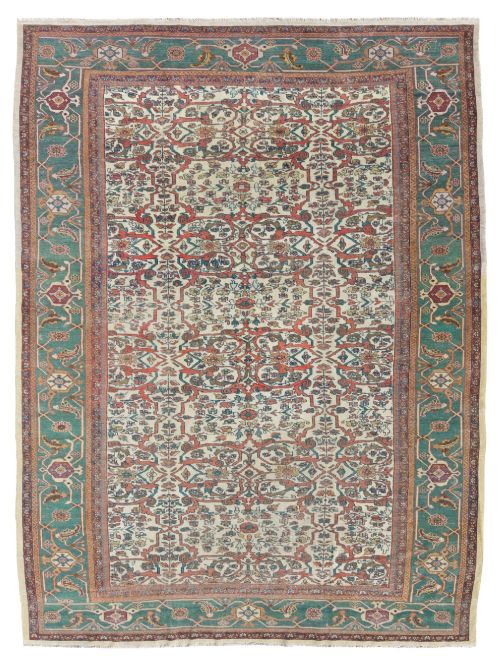
When searching for a green wool floor carpet, you encounter room-sized carpets, gallery runners and smaller area rugs originating from diverse weaving traditions. These pieces span the nineteenth and early twentieth centuries, encompassing Anatolian, Persian, French and British designs.
The green wool floor carpet most frequently encountered on this page is the Turkish Ushak or Oushak carpet, often dating from the late nineteenth or early twentieth century. These are complemented by Persian Sultanabad, Serapi and Mahal carpets, alongside village rugs from regions such as Bergama, Milas, Dazkiri and Kirsehir.
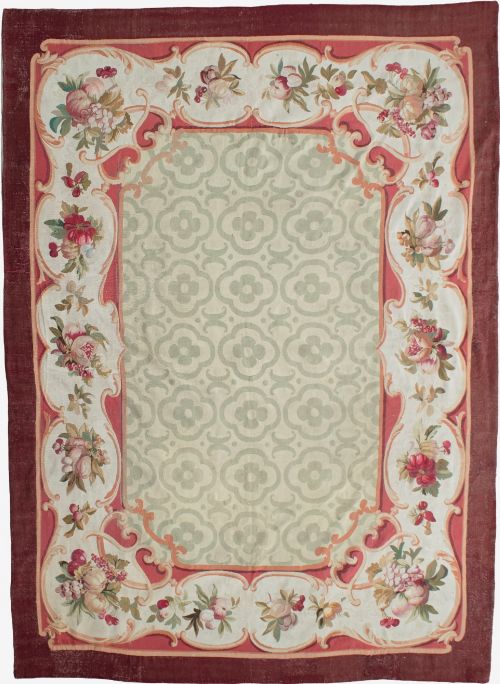
Makers and workshops range from traditional village weavers in Anatolia and the Caucasus to larger production centres in Persia and commercial enterprises in India and Europe, such as Donegal and Aubusson.
How they were made
These floor coverings rely primarily on wool, cotton and angora wool, spun by hand and knotted or woven on traditional vertical and horizontal looms. Wool serves as the principal material for the pile, providing resilience and depth of colour, whilst cotton is frequently utilised for the foundation warps and wefts.
Natural and early aniline dyes achieve the distinct green fields and grounds recorded in these examples, varying from soft sage and olive to deeper botanical shades. The structural integrity depends upon the tightness of the knotting or flatweave technique, whether in village kilims or grand room-sized carpets.
The selection includes Anatolian Ushak, Persian Serapi, French Rococo Aubusson, and Arts and Crafts Donegal styles.
What varies in quality
Quality in these carpets rests upon the fineness of the wool, the clarity and saturation of the green dye, and the integrity of the weave. Finer materials like angora wool yield a distinct softness, whilst robust village rugs demonstrate coarser, heavier structures intended for daily wear.
Design execution and regional authenticity distinguish the pieces, with certain examples exhibiting scarce green fields or specific historic motifs such as the Holbein design. The balance between structural preservation and the natural softening of age ultimately defines the standing of each piece.
The Green Wool Floor Carpet Glossary
- Wool
- A natural textile fibre obtained from sheep and other animals, forming the resilient pile of traditional carpets.
- Kilim
- A flatwoven carpet or rug produced without a pile, traditionally associated with Anatolian and wider Middle Eastern weaving.
- Warp
- The vertical threads stretched upon a loom that form the structural skeleton of a woven carpet.
- Weft
- The horizontal threads passed through the warps to bind the knotting and secure the structure of the rug.
- Ground
- The main background colour field of a carpet, which in these pieces frequently appears in distinct green shades.
Green Wool Floor Carpet: Frequently Asked Questions
How do I care for a wool carpet?
Vacuum gently without a rotating brush roll to protect the historic wool fibres and foundation. Professional cleaning by a specialist in antique textiles ensures the preservation of natural dyes.
Keep the carpet away from direct, prolonged sunlight to prevent fading of the green ground. Rotate the piece periodically to distribute foot traffic evenly across the surface.
How do I date an antique carpet?
Dating relies on stylistic analysis, material composition, and structural characteristics observed in the weave and foundation. Evidence typically spans the nineteenth and early twentieth centuries, incorporating specific regional motifs and dye types.
Comparison with documented examples from known periods helps narrow the approximate decade of production. Subtle variations in wool preparation and knot density further assist in placing the carpet within its historical era.
Can I use an antique rug in a high traffic room?
Many of these wool carpets were built for domestic utility and handle moderate foot traffic well when placed with a quality underlay. Thicker village rugs and room-sized carpets offer substantial durability for everyday living spaces.
Placing the rug away from excessive moisture and abrasive grit preserves the integrity of the pile. Regular, gentle maintenance ensures the textile remains a functional element in the home.