
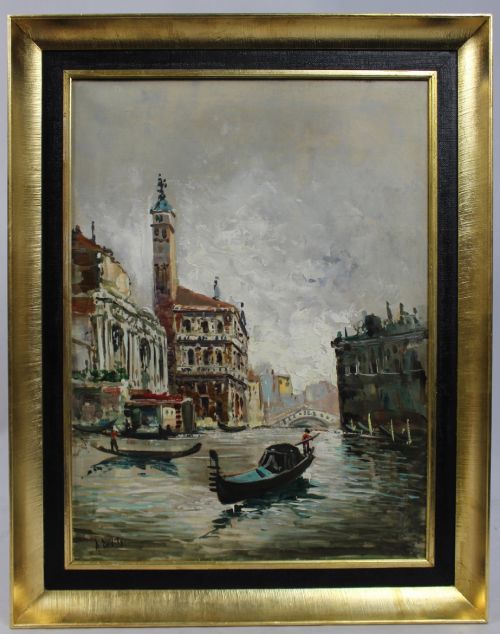


Green Water Canvas Artwork
Green water canvas artwork brings together marine scenes, river landscapes and tranquil rural waterways rendered in oil paint.
Green Water Canvas Artwork
Green water canvas artwork encompasses oil paintings on canvas depicting rivers, canals, lakes, and choppy marine waters, spanning the nineteenth and twentieth centuries.
Buyers encounter French Impressionism, Mid-Century Impressionism, Victorian British School, and nineteenth-century realist styles depicting scenes such as Venetian canals, French islands, and English bridges.
The subjects range from tranquil waterside figures and watering troughs to industrial mills and frigate ships off the coast.
Materials and construction
These works utilise oil paint applied to canvas substrates, often framed in wood and gilt or giltwood settings.
Artists built up the oil paint to capture light on water, movement in rivers, and atmospheric conditions across different periods.
Periods represented span from the 19th century through the 1950s and 1960s.
Assessing quality and execution
Quality rests in the handling of light and water, where skilled brushwork distinguishes dynamic marine movement and tranquil river reflections from static rendering.
The articulation of canvas surfaces and the integrity of period wooden and gilt frames contribute to the overall standard of each piece.
Antonio DeVity·Mario Pinetti·Frederick Waters Watts·Fred Stead·Marie-Edouard Adam·William Mellor·Adolphe Gumery·Charles Edmund Rene His
The Green Water Canvas Artwork Glossary
- Oil on Canvas
- Pigment mixed with drying oil applied to a woven fabric support stretched over a wooden frame. This primary medium allows for rich texture and depth of colour.
- Giltwood
- Wood carved and coated with gold leaf or a gold-coloured metallic finish. It frames and complements the tones of the oil painting.
- Impressionism
- A style of painting emphasising light, visible brushstrokes, and ordinary subject matter. It emerged in nineteenth-century France and continued into the twentieth century.
- Marine Art
- Works depicting ships, coastal views, and the sea. This genre captures naval history, coastal weather, and maritime activity.
Green Water Canvas Artwork: Frequently Asked Questions
What periods do these paintings cover?
The works span from the nineteenth century through the mid-twentieth century, including pieces from the 1870s, 1890s, 1910s, 1920s, 1950s, and 1960s.
Different eras bring distinct approaches, moving from nineteenth-century realism and marine traditions towards mid-century impressionist interpretations of light and water.
How should I clean a canvas painting?
Dust accumulation should be gently removed with a soft, dry brush, avoiding any moisture or abrasive pressure on the oil paint.
Professional conservators should handle deeper cleaning or varnish removal to protect the fragile surface of the canvas.
Where were these artists trained?
The creators studied within various European traditions, including British schools and French impressionist circles.
Their geographical origins range across England, France, and Italy, influencing their choice of rivers, coastal waters, and rural scenes.
How do I identify a marine painting?
Marine paintings feature nautical subjects such as frigates, barques, and coastal waters, often highlighting ships in motion or choppy conditions.
These works focus heavily on maritime environments rather than inland rivers or domestic landscapes.