

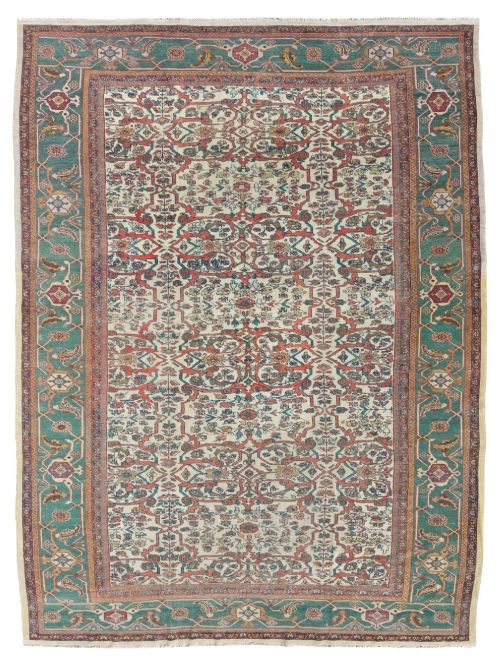


Green Persian Carpet
These green persian carpet pieces bring distinct regional weaving traditions and rich botanical dyed grounds into your home.
Green Persian Carpet
A green persian carpet brings traditional woven artistry into domestic spaces through distinct regional forms including Sultanabad, Mahal, Kashan, Serapi, Ziegler, and Fereghan styles. These pieces date from the late nineteenth century and early twentieth century, specifically covering the years 1880, 1890, 1900, and 1920. Collectors and home decorators encounter these historic floor coverings categorized primarily as rugs and carpets, area rugs, and gallery carpets.
The selection centres on authentic historical examples woven in wool, cotton, and silk. Particular regional aesthetics emerge in the listings, such as the golden field Fereghan and carpets featuring scarce blue or green grounds. Specific dimensions vary from smaller area rugs measuring over two metres by one metre up to expansive gallery and floor carpets exceeding four metres in length.
How they were made
Weavers constructed these historic floor coverings using natural materials, predominantly employing wool for the pile alongside cotton and silk foundations. These organic fibres provided the durable structure necessary for large formats such as gallery carpets and room-sized pieces.
Makers utilised traditional regional knotting techniques and botanical dyeing methods to achieve the characteristic green, blue, and golden grounds seen across the Sultanabad, Mahal, Kashan, Serapi, Ziegler, and Fereghan styles.
Green Persian Carpet Retail Price Guide 2026
Typical asking prices for green persian carpet among the pieces listed under this phrase on Sellingantiques today, from the lower quarter to the upper quarter. They describe what is for sale here now, not the wider market.
Listings feature wool, cotton, and silk across periods spanning from 1880 to 1920.
What varies in quality
Quality differences emerge through the fineness of the weave, the intricacy of the regional design, and the rarity of the ground colour, such as scarce blue or green fields. Master workshops achieved greater precision in knot density and pictorial detail, demonstrated by specialised works like portrait rugs.
The preservation of the original wool pile and structural integrity across cotton or silk foundations distinguishes superior examples. Historical provenance and specific stylistic attributions, such as Mohtasham Kashan or Fereghan attribution, further elevate the standing of individual pieces.
The Green Persian Carpet Glossary
- Sultanabad
- A nineteenth-century carpet style originating from the west-central region of Iran, known for bold, large-scale floral patterns. These pieces typically utilise sturdy wool pile suited for domestic rooms.
- Serapi
- A distinct subgroup of Heriz carpets characterised by geometric medallion designs and spacious compositions. They often employ a balanced palette that complements traditional room layouts.
- Fereghan
- A style associated with fine workshop weaving in the Fereghan district, frequently featuring intricate all-over floral motifs. Golden field variations represent a notable subset within this tradition.
- Ziegler
- A nineteenth-century commercial carpet type produced largely for Western export markets, adapting classical Persian designs for European interiors. These works often feature softened palettes and durable wool construction.
Green Persian Carpet: Frequently Asked Questions
Where were these carpets made?
These historic floor coverings originate from distinct weaving centres across Persia, including Sultanabad, Mahal, Kashan, and Fereghan.
Master weavers in these regions produced specific regional styles like Serapi and Ziegler for both domestic use and export.
What materials compose these rugs?
The pieces consist primarily of wool for the soft upper pile, supported by strong cotton or silk foundations.
These natural organic materials ensure the structural longevity of large gallery and area formats.
How do I date an old carpet?
Dating relies on stylistic attributes, regional weaving structures, and documented periods ranging from 1880 to 1920.
Examining the specific knotting technique and natural dye palette helps place a piece within its historical era.
How should I care for historic wool rugs?
Protect the delicate wool pile and cotton foundations by keeping the carpets out of direct sunlight and avoiding excessive moisture.
Gentle vacuuming without a rotating brush maintains the integrity of nineteenth-century and early twentieth-century weaves.