


Green Pastoral Watercolour Artwork
These pieces of green pastoral watercolour artwork capture nineteenth and early twentieth-century countryside life through traditional pigment on paper.
Green Pastoral Watercolour Artwork
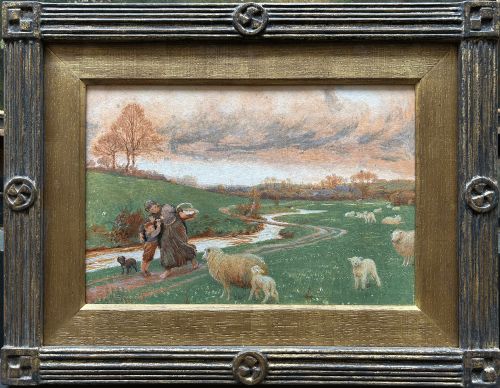
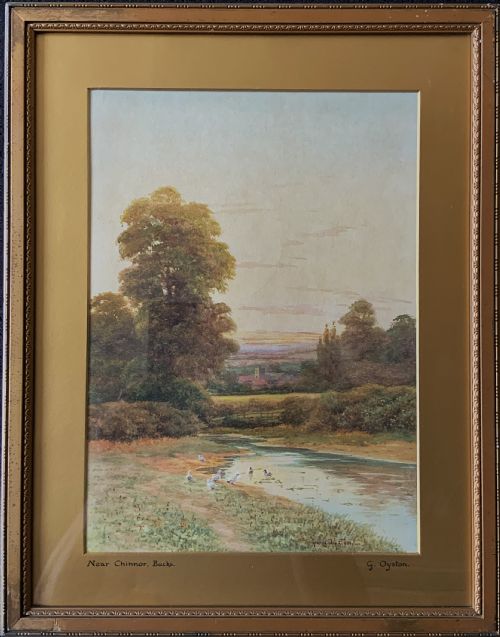
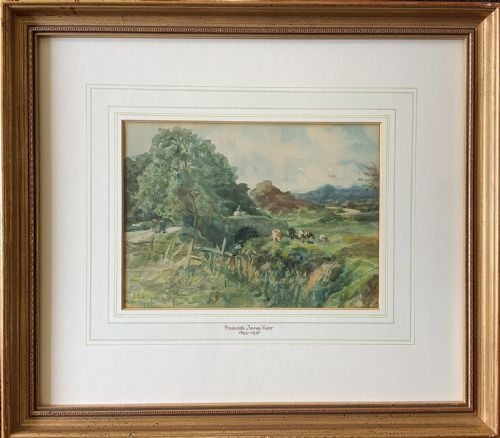
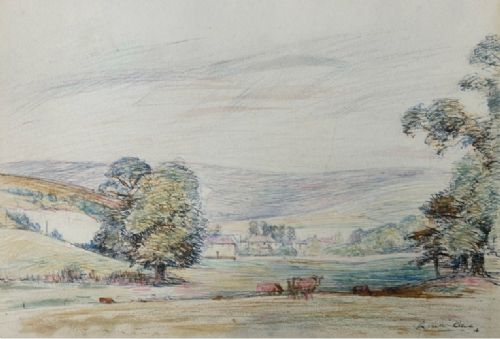
A green pastoral watercolour artwork depicts traditional rural scenes including farmland, riverscapes, farm animals, and country cottages. The majority of these pieces originate from the Victorian and Edwardian periods, stretching into the early twentieth century.
The compositions frequently centre on agricultural labour, shepherds with flocks, cattle grazing by rivers, and thatched cottages nestled within English and Welsh countryside settings. Painters from regional schools and established societies recorded these idyllic working landscapes with careful observation.
Buyers encounter framed paintings mounted under glass, preserving delicate pigment layers on paper supports. These works document a vanished rural rhythm through tranquil compositions dominated by natural earth tones.
Materials and technique
Artists applied watercolour pigment suspended in water onto various grades of paper, often building up translucent washes to achieve atmospheric effects of light and distance. This aqueous medium allowed for spontaneous handling alongside precise detail in foliage, water, and livestock.
Many surviving examples incorporate protective glass and wooden frames, occasionally embellished with gold leaf highlights to enhance the visual depth of the composition. The physical components reflect standard framing practices of the nineteenth and early twentieth centuries.
Listings feature works created between eighteen fifty and nineteen thirty, spanning the Victorian and Edwardian eras using watercolour pigment on paper.
Distinctions in quality
The success of a green pastoral watercolour artwork rests upon the artist's ability to handle light, atmosphere, and natural proportions within an aqueous medium. Stronger examples demonstrate confident brushwork and balanced composition that bring vitality to rural subjects.
Paper stability and pigment preservation also influence overall standard, as prolonged exposure to direct sunlight can fade delicate greens and blues. Superior pieces retain their original tonal contrast and structural integrity within period framing.
George Oyston·Philip Richard Morris·Oswald Garside·Henry John Kinnaird·Thomas Hunn·James Orrock·John Atkinson·Harold Lawes·Bernard Walter Evans·Edmund George Warren·William Stephen Coleman·Harry Sylvester Stannard·Henry Charles Fox·Will Anderson·Robert Hollands Walker·Thomas James Lloyd·Henry Earp Senior·Joseph Kirkpatrick·Henry Sykes·William Lucas·Frederick George Coleridge·Henry Birtles·Walter Duncan·Thomas Mackay·Walter Henry Sweet
The Green Pastoral Watercolour Artwork Glossary
- Watercolour pigment
- Finely ground colour particles mixed with a water-soluble binder, applied in washes to paper supports.
- Pastoral
- A style of art that idealises rural life, featuring shepherds, farm animals, and rustic landscapes.
- Victorian period
- The reign of Queen Victoria from eighteen thirty-seven to nineteen hundred, associated with diverse artistic movements including realism and romanticism.
- Edwardian period
- The era spanning the reign of King Edward the Seventh from nineteen hundred to nineteen ten, noted for refined landscape painting.
- Wash
- A thin, semi-transparent layer of diluted watercolour pigment spread evenly across the paper to create skies or water.
Green Pastoral Watercolour Artwork: Frequently Asked Questions
What subjects appear in these watercolours?
These works display rural English and Welsh scenery, featuring agricultural workers, shepherds with flocks, and cattle near rivers. Cottages and pastoral landscapes form the core subjects of the genre.
Artists focused on recording traditional country life before the expansion of industrial centres. The resulting paintings present an idealised view of nineteenth-century agrarian existence.
How should these watercolours be displayed?
Framed watercolours require placement away from direct sunlight to prevent the fading of delicate pigments on paper. Maintaining stable indoor humidity protects both the paper support and the wooden frame.
Glass fronts protect the delicate painted surface from dust and atmospheric pollutants. Professional framing using acid-free materials ensures the long-term preservation of antique works.
How can I tell the period?
Dating relies on stylistic clues, framing materials, artist biographical dates, and subject matter characteristics. Victorian works often display detailed narrative elements, while Edwardian pieces lean toward broader atmospheric effects.
Examine the back of the frame and paper for artist signatures, dates, or historical gallery labels. Comparative research into recorded exhibition dates helps narrow down the decade of creation.
Where were these artists active?
Painters worked across rural regions of Britain, capturing specific locations in counties such as Berkshire, Buckinghamshire, Sussex, and Somerset. Many exhibited their watercolours through established London societies and regional galleries.
Artists frequently travelled to picturesque countryside spots to sketch en plein air before finishing compositions in the studio. Their output reflects a widespread fascination with scenic rural topography.