


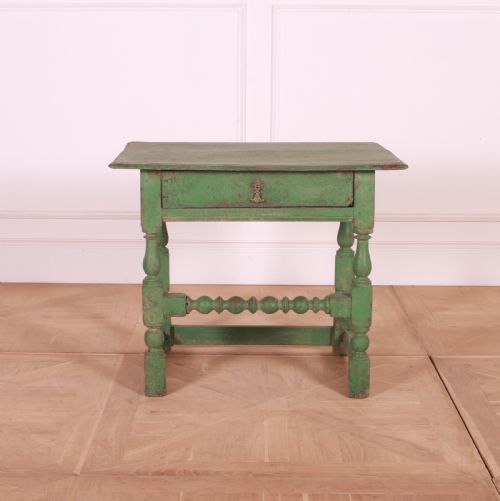

Green Painted End Table
These green painted end table pieces bring subtle colour and utility to a room, offering compact surfaces rooted in country and neoclassical traditions.
Green Painted End Table
A green painted end table provides a compact surface for lamps and small objects, drawing on forms such as lamp tables, cricket tables, and gueridon tables. These pieces span the eighteenth century to the twentieth century, reflecting enduring utility.
The styles range from English country and Georgian country to French provincial, Italian neoclassical, and Scandinavian country. Buyers meet rustic country interpretations alongside more formal Louis XVI and French chateau designs.
Side tables and lamp tables dominate the selection, offering functional proportions suited to domestic spaces. Each piece carries painted finishes upon traditional timbers like oak and pine.
What varies in quality
The depth and character of the painted finish distinguish standard examples from finer works, particularly where historic or original paint remains intact. Surface wear tells a story of age that mechanical repainting cannot replicate.
Timber selection and the crispness of carved details set apart simple country items from sophisticated Italian neoclassical or French chateau pieces. Structural integrity across the joints ultimately governs the longevity of each table.
Listings span the eighteenth, nineteenth, and twentieth centuries, employing materials like pine, oak, marble, and brass.
The Green Painted End Table Glossary
- Cricket table
- A small, light round table traditionally supported on three splayed legs. This form originated in Britain for domestic utility.
- Gueridon table
- A small French occasional table supported by a single central column or figures. The style gained popularity during the neoclassical period.
- Lamp table
- A compact low table designed specifically to hold a lighting fixture. These pieces proliferated from the eighteenth century onwards.
- Neoclassical style
- A decorative movement drawing inspiration from classical antiquity. It favours symmetry, restraint, and classical motifs.
Green Painted End Table: Frequently Asked Questions
Where should I place a green painted end table?
These compact tables fit readily beside seating areas to hold lamps, books, or small decorative objects.
Their restrained proportions allow them to function effectively in both prominent reception rooms and quiet corners.
How do I care for painted wooden surfaces?
Protect the painted finish from excessive moisture and direct sunlight to preserve the pigment and timber beneath.
Dust gently with a dry cloth and avoid harsh chemical cleaners that might degrade the historic surface.
How do I distinguish between periods?
Eighteenth-century examples often display simpler country construction and aged timber patination. Later nineteenth and twentieth-century items incorporate stylistic revivals like Louis XVI or Italian neoclassical motifs.
Examining the underlying wood and joinery methods helps clarify the age of each piece.