
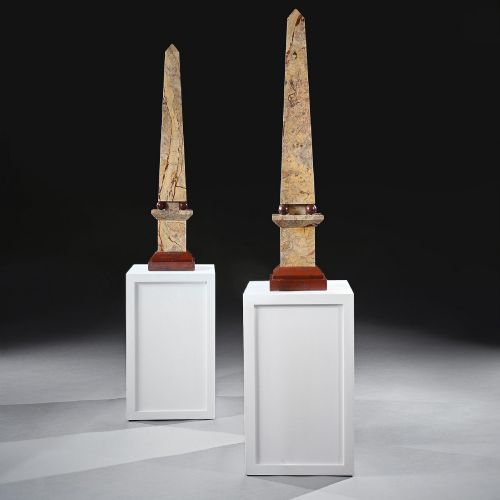

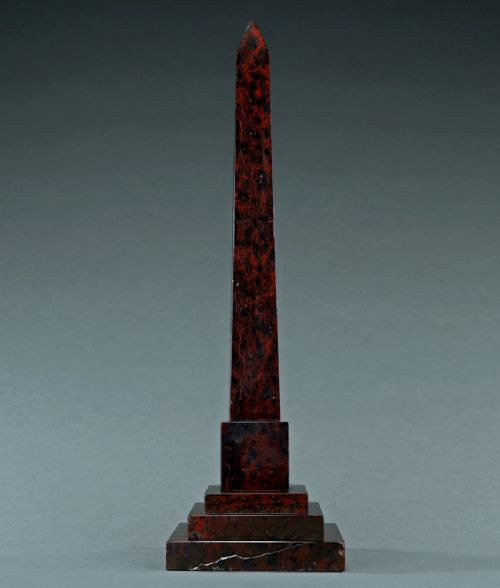

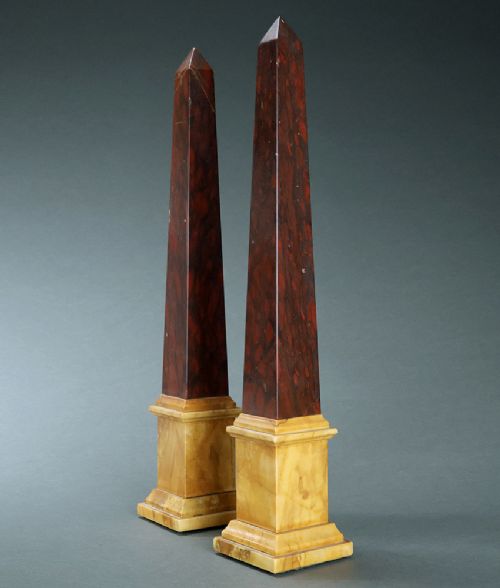


Grand Tour Stone Obelisk
A grand tour stone obelisk brings the monumental scale of ancient Rome directly to a nineteenth-century desk or mantelpiece.
Grand Tour Stone Obelisk
A grand tour stone obelisk represents the classic souvenirs brought home by travellers journeying through Italy during the nineteenth and early twentieth centuries. These decorative objects take the form of miniature architectural monoliths, translating ancient monuments into portable ornaments for the home.
Most examples encountered on this page date from the nineteenth century through the early twentieth century, spanning Victorian and Art Deco tastes. Makers employed specific revival styles, notably Egyptian Revival and Neoclassical, to give these carved shafts their classical authority.
Forms vary from single freestanding monuments to monumental pairs designed for symmetry on a mantel. They function primarily as desk ornaments and decorative sculptures, constructed in standard geometric obelisk proportions with tapering shafts and square bases.
How they were made
Carvers shaped these obelisks from solid blocks of hard decorative stone, utilising marbles such as Portasanta, Rosso Antico, and black marble. The stonemasons turned and polished the tapering shafts by hand to achieve a smooth, reflective surface that highlights the natural veining of the mineral.
Certain pieces incorporate pietra dura work, inlaying precise geometric or floral motifs directly into the marble body. Makers also utilised serpentine, Ashford black marble, and Egyptian onyx, contrasting different coloured stones within a single pair or base.
Listings feature pieces spanning the nineteenth century through the nineteen-thirties, utilising materials including pietra dura, serpentine, and various specimen marbles.
What varies in quality
Precision of line and sharpness of the pyramidal apex dictate the architectural success of the carving. Finely executed pietra dura inlay and substantial weight elevate an obelisk from a simple tourist souvenir to a serious sculptural ornament.
The Grand Tour Stone Obelisk Glossary
- Grand Tour
- A traditional trip through Europe, chiefly Italy, undertaken by upper-class young men in the eighteenth and nineteenth centuries to study arts and antiquity. Souvenirs purchased along the route form the basis of this category.
- Pietra dura
- An artistic technique of using cut and fitted, highly polished coloured stones to create images or geometric patterns. Artisans embed these stone slices flush into a dark marble ground.
- Specimen marble
- A collection of various decorative mineral stones gathered from different quarries and displayed together. These varied geological samples showcase contrasting colours within a single object.
- Portasanta marble
- An ancient ornamental limestone featuring brecciated patterns of red, purple, and white. Roman quarries originally sourced this distinctive stone for architectural columns.
- Rosso Antico
- A deep red antique marble prized by classical sculptors and later revivalists for its rich coloration. It provides a striking contrast when paired with black or white marbles.
Grand Tour Stone Obelisk: Frequently Asked Questions
What is a grand tour stone obelisk?
A grand tour stone obelisk is a decorative architectural model carved from marble or hard stone during the nineteenth or early twentieth centuries. Wealthy travellers collected them as souvenirs of their travels through Italy and Egypt.
These carved shafts emulate the ancient monoliths erected by pharaohs and later re-erected in Roman piazzas. They served as scholarly table ornaments in European libraries and drawing rooms.
How were these obelisks used historically?
Collectors displayed these stone monuments on mantelpieces, library desks, and cabinets alongside other classical antiquities and bronzes. They signalled the owner's education, travel, and refined classical taste.
Pairs were often placed symmetrically to frame a clock or mirror on a grand fireplace. Single taller examples stood alone as focal points on large partner desks.
How do I date a stone obelisk?
Dating relies on the choice of stone, the prevailing style such as Egyptian Revival or Art Deco, and the manufacturing technique of the base. Nineteenth-century examples frequently employ Ashford black marble or specimen pietra dura work.
Early twentieth-century pieces often reflect cleaner modernist lines or precise Italian specimen groupings from the nineteen-twenties and thirties. Examining the underside and polishing marks helps determine the period of manufacture.
Where were grand tour obelisks made?
Workshop production centered primarily in Italy, particularly Rome, Florence, and Naples, where artisans catered directly to foreign travellers. British workshops in Derbyshire also produced comparable items using local Ashford black marble.
French ateliers additionally manufactured luxury decorative objects using imported Egyptian onyx and coloured marbles. Each regional centre utilised the specific stones readily available to their local lapidaries.