


Grand Tour Figural Bronze
These grand tour figural bronze pieces bring classical antiquity straight into the study, cast in metal to mark the travels of earlier centuries.
Grand Tour Figural Bronze
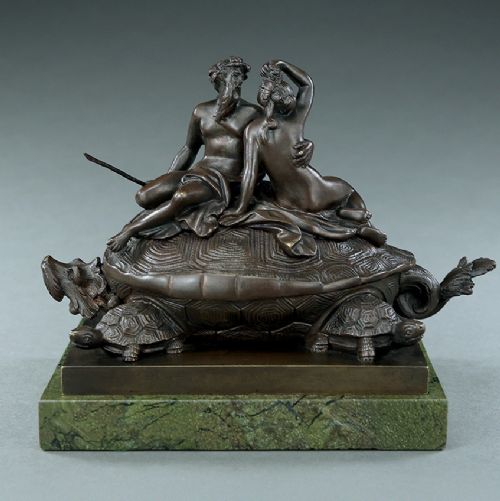
A grand tour figural bronze represents classical subjects, mythological figures and antique architecture collected by travellers in Europe during past centuries. You will find sculptures, inkwells, lamps and candlesticks cast in dark bronze, patinated bronze and gilt bronze, often mounted on marble bases.
The selections span the eighteenth century, the nineteenth century and the Victorian era, frequently echoing Neoclassical, Classical Revival, Mannerist and Egyptian Revival styles. Pieces range from studies of Pan and Bacchus to pairs of putti and reductions of famous statues like the Apollo Belvedere.
Most items on this page date from the nineteenth century, reflecting the peak of European travel when domestic spaces were decorated with miniature monuments of antiquity. These works translate large monuments and archaeological discoveries into portable home ornaments.
What varies in quality
The depth and consistency of the patination contribute significantly to a piece's visual impact, with multi-layered patinas outperforming flat, uniform surfaces. Additionally, the quality of the marble base and the precision of the metal mounting indicate the care taken during assembly.
The documented periods stretch from the eighteenth century through the Victorian era up to the nineteen-twenties.
The Grand Tour Figural Bronze Glossary
- Patinated bronze
- Bronze treated with chemical solutions to produce a specific surface colour, most commonly dark brown or green. This layer protects the metal while enhancing the definition of the figures.
- Grand Tour
- A traditional trip of Europe undertaken by upper-class European young men of sufficient means. Travellers collected small bronzes and antiquities to display upon their return home.
- Ormolu
- Finely ground high-carat gold applied to a bronze object using a mercury amalgamation process. This technique produces a brilliant golden finish seen on French neoclassical pieces.
- Neoclassical
- A style originating in architecture and the arts that draws inspiration from the classical art and culture of ancient Greece or Rome. It emphasises austere dignity, symmetry and mythological themes.
- Putto
- A representation of a human infant, usually naked and winged, frequently seen playing with grapes or seated on rocks in classical sculpture. These figures add a playful narrative to the metalwork.
Grand Tour Figural Bronze: Frequently Asked Questions
What is a grand tour bronze?
A grand tour bronze is a small-scale sculpture or decorative object purchased by travellers visiting historical sites in Italy and Greece during the eighteenth and nineteenth centuries.
These pieces served as portable reminders of classical art, reproducing famous statues, architectural elements and mythological figures for display in European homes.
How were these bronzes used originally?
Many of these objects served practical functions in period interiors, operating as inkwells, candlesticks, oil lamps and andirons while maintaining sculptural decorative qualities.
Others functioned purely as cabinet bronzes or desk ornaments, designed to be handled and admired up close for their artistic merit and classical subject matter.
How do I care for a bronze sculpture?
Bronze requires minimal maintenance, needing only a gentle dusting with a soft, dry cloth to prevent the accumulation of particles on the patinated surface.
Avoid using liquid cleaners, waxes or polishes, as these substances can strip the original patina and damage the historic finish of the metal.
Are these pieces originals or copies?
Most nineteenth-century grand tour pieces are period interpretations or reduction casts of ancient Greek and Roman sculptures rather than archaeological finds.
Foundries produced these works to satisfy the Victorian demand for classical aesthetics, using earlier masterpieces by sculptors like Giambologna and Clodion as their direct models.