


Gothic Revival Library Chairs
Gothic revival library chairs bring heavy medieval proportion and rich timber into a room, offering both seating and architectural presence.
Gothic Revival Library Chairs
When you search for gothic revival library chairs, you find nineteenth-century seating built with pointed arches, heavy frames, and architectural detail. These pieces borrow heavily from medieval church and cathedral design, translating stone motifs into domestic furniture.
The selection leans heavily towards Victorian interpretations of the gothic style, alongside pieces influenced by the Arts and Crafts movement and the Aesthetic Period. You will encounter everything from plain utilitarian seating to elaborately carved throne chairs.
How they were made
Makers constructed these chairs predominantly using solid oak and walnut, selected for their strength and suitability for deep carving. Frames were joined with traditional methods, supporting heavy loads and complex architectural woodwork.
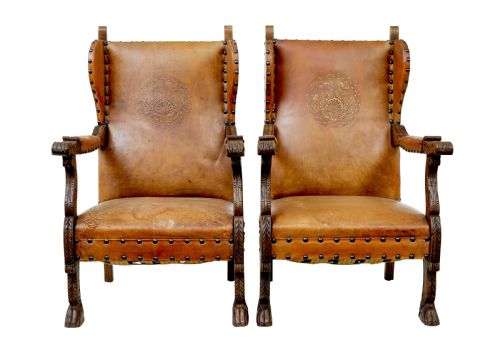
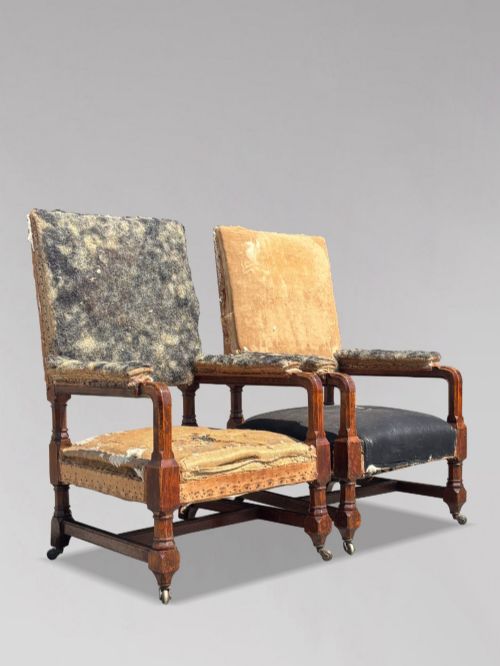
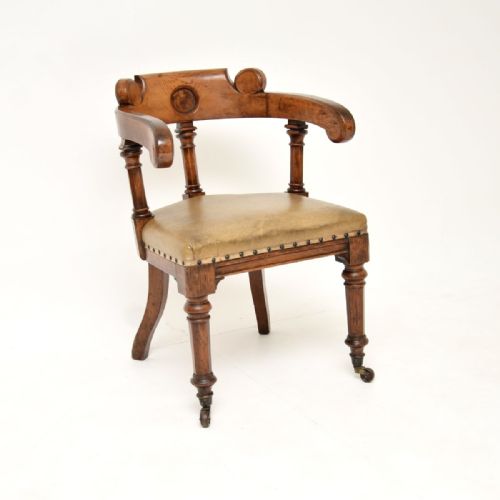
Upholstery typically involved leather, fabric, hessian, or textile, fixed with brass studs or buttons. Leather surfaces were often embossed or plain brown, chosen for durability in a study or library setting.
Decoration relied on hand carving, utilising motifs like tracery, linenfold, green men, and heraldic animals. Metal components such as brass brackets, hinges, and hardware reinforced structural points while adding functional detail.
Keep an eye out for carved hounds keeping watch from the armrests.
What varies in quality
The depth and clarity of the timber carving separate standard production from exceptional pieces. Superior examples display crisp architectural lines, undercut details, and well-executed figures without mechanical shortcuts.
The choice and thickness of the timber dictate longevity and presence. Golden oak or figured walnut handled by skilled cabinet-makers retains its structural integrity far better than lesser woods treated with heavy surface stains.
Attribution to known designers or prominent cabinet-making firms elevates a piece significantly. Chairs associated with makers like Pugin, Talbert, or Bevan command greater attention through their adherence to rigorous design principles.
Gillows·Bruce James Talbert·A.W.N. Pugin·Charles Bevan·Richard Hicks Bridgens
The Gothic Revival Library Chairs Glossary
- Gothic Revival
- An architectural and decorative movement reviving medieval forms, pointed arches, and structural motifs. It dominated nineteenth-century design and heavily influenced domestic seating.
- Tracery
- Openwork stonework patterns translated into woodwork, commonly found on chair backs and panels. It mimics the decorative stonework of gothic cathedral windows.
- Cross-Frame
- A structural form where the legs intersect to form an X shape beneath the seat. This design offers stability and recalls medieval folding chair precedents.
- Green Man
- A sculptural motif representing a human face surrounded by or entwined with leaves and vines. It appears frequently in carved woodwork of this period.
- Metamorphic
- Furniture engineered to transform from one object into another, such as an armchair that unfolds into library steps. These pieces combine utility with mechanical ingenuity.
Gothic Revival Library Chairs: Frequently Asked Questions
What is a gothic revival library chair?
These are nineteenth-century seats influenced by medieval architecture, featuring pointed arches, heavily carved woodwork, and sturdy timber frames.
They were designed for reading rooms and studies, combining formal presence with practical seating for long hours of work.
How were library steps built into chairs?
Some clever library chairs are metamorphic, engineered with hidden hinges and pivoting joints that allow the seat and back to unfold into a small staircase.
This invention allowed scholars to reach high bookshelves in private libraries without needing a separate ladder.
What woods were used for these chairs?
Oak is the predominant timber found in these listings, ranging from dark polished varieties to golden oak.
Walnut and rosewood also appear, particularly in pieces designed for refined parlours and grander libraries.
How do I distinguish Pugin style pieces?
Pugin-influenced chairs emphasise structural honesty, bold chamfering, and geometric tracery that reflect medieval construction methods rather than superficial decoration.
They tend to look architectural, sturdy, and unapologetically heavy in the room.
Are these chairs comfortable for daily use?
Most feature high backs, padded armrests, and supportive leather or fabric upholstery designed for extended periods of reading at a desk.
Their upright proportions encourage good posture, though their solid wooden frames require adequate floor space.