


Gothic Revival Entry Table
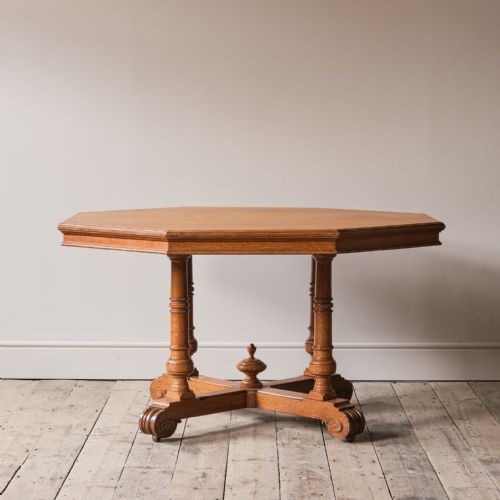
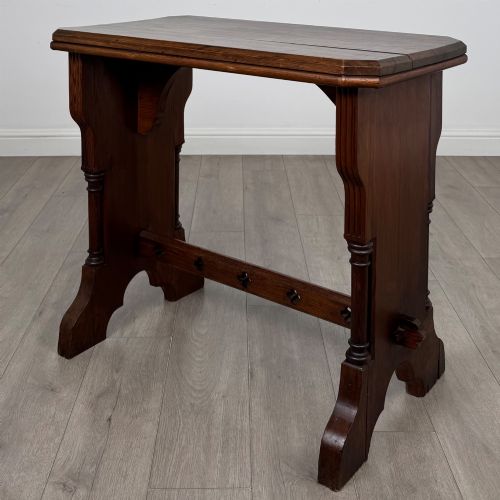
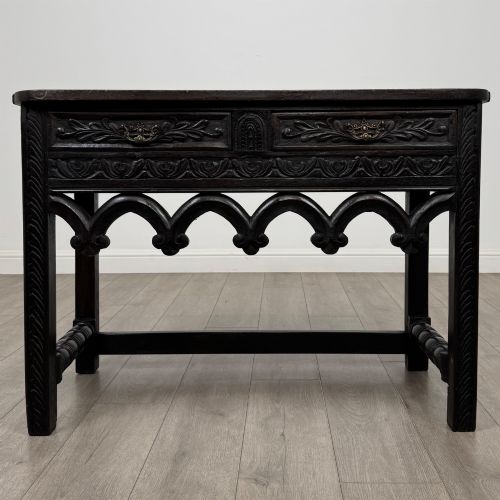
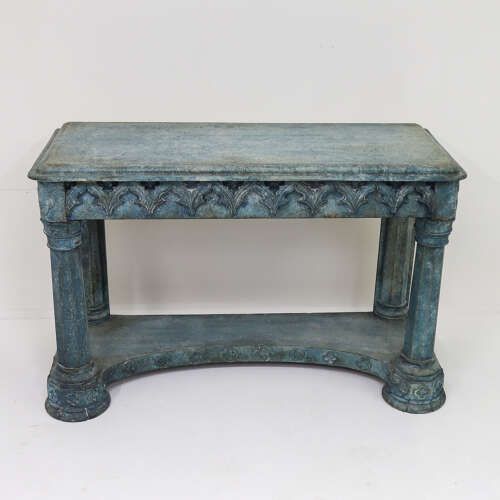
These gothic revival entry table examples bring architectural presence to a hallway, offering heavy timber construction and pointed details.
Gothic Revival Entry Table
A gothic revival entry table sits in a hallway or corridor, providing a surface and a distinct architectural profile rooted in nineteenth-century design. When searching for a gothic revival entry table, buyers encounter forms ranging from console tables and side tables to centre tables, hall tables, and hall stands.
The pieces appearing on this page span the Victorian era, specifically the decades between 1870 and 1900. They draw upon Victorian Gothic, Jacobean Revival, and Victorian Renaissance Revival styles, uniting domestic furniture with ecclesiastical motifs.
What varies in quality
The depth and execution of the carved decoration separate standard examples from finer pieces. Crisp lines in the woodwork and well-proportioned architectural framing indicate superior craftsmanship during the period.
Choice of timber also influences the character of each piece, with selected oak and honey oak finishes providing greater visual weight than simpler painted timbers or secondary woods.
Listings span the Victorian era from 1870 to 1900, constructed predominantly in oak and pitch pine.
The Gothic Revival Entry Table Glossary
- Console table
- A table designed to stand against a wall, frequently fixed or supported by two front legs. These pieces anchor an entrance hall.
- Pitch pine
- A durable softwood with a prominent grain pattern used extensively in nineteenth-century furniture. It takes a smooth finish while maintaining structural strength.
- Centre table
- A freestanding table intended to be viewed from all sides, placed in the middle of a room or a large hallway. Octagonal and round formats are common.
Gothic Revival Entry Table: Frequently Asked Questions
Where should I place a gothic revival entry table?
These tables suit hallways, corridors, and entrance spaces where their architectural lines can be appreciated against a wall. Console and side variants fit narrow spaces particularly well.
Freestanding centre tables require more floor clearance to allow movement around all sides while serving as a focal point.
How do I care for nineteenth-century oak and pine furniture?
Keep wooden surfaces away from direct heat sources and strong sunlight to prevent the timber from drying out or splitting. Regular dusting with a dry cloth maintains the finish.
Avoid liquid polishes that build up residue on carved details and painted wood surfaces over time.
What is the difference between a console and a side table?
Console tables traditionally anchor against a wall and sometimes rely on structural support from the wall itself, though freestanding versions exist. Side tables are fully freestanding and feature four legs.
Both serve similar functional roles in an entrance hall for placing everyday items.
How can I tell the period of these tables?
Dating relies on material selection, construction methods, and stylistic cues associated with the Victorian era between 1870 and 1900. The use of pitch pine and specific revival motifs helps narrow the timeframe.
Details like hand-carved oak panels and original brass hardware further indicate nineteenth-century origin.