
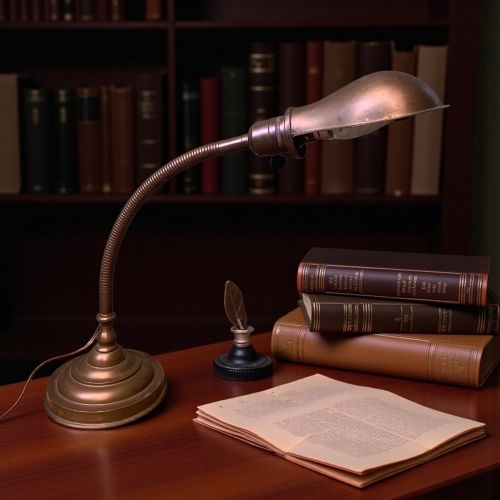


Gooseneck Task Lamp
A gooseneck task lamp brings focused illumination and industrial character to a desk, shaped by the practical demands of the early twentieth century.
Gooseneck Task Lamp
A gooseneck task lamp provides adjustable lighting for reading and writing, utilising flexible arms or pivoting joints to direct the beam precisely where it is needed. These fixtures emerge across the nineteenth century, Edwardian era, 1920s, 1930s and 1940s, reflecting shifts in domestic and office utility.
The versions met most frequently on this page are brass desk lamps from the Edwardian period, alongside French industrial pieces and Art Deco examples featuring shell-shaped shades. Form follows function closely, resulting in robust profiles designed for daily desk work.
Makers and designers applied these flexible mechanisms to reading lamps, notary lamps and student lamps alike. Materials range from cast iron and bronze to copper and brass, often paired with glass or fabric elements.
Materials and Construction
These lamps rely heavily on metalwork, with brass, bronze, cast iron and copper forming the primary structural components for bases, stems and flexible tubing. Metal fabrication involves casting heavy bases for stability and engineering adjustable necks that maintain their position through friction or internal springs.
Shades incorporate blown glass, etched glass, porcelain, fabric or pressed metal to diffuse or direct the light effectively. Wires connect through the flexible channels, often utilising modern fabric flex for safe electrical delivery during rewiring.
Some Edwardian desk lamps feature flexible brass necks that resemble coiled serpents ready to strike at your paperwork.
Assessing Quality and Manufacture
Quality rests in the heft of the cast iron or bronze base and the engineering of the adjustable neck, which should hold its pose firmly without sagging. Superior examples display clean casting lines, substantial metal gauges and well-preserved surface patination.
The refinement of the shade, whether moulded cranberry glass, porcelain or shaped brass, distinguishes standard utility pieces from more decorative Edwardian and Art Deco designs. Original components and intact structural integrity elevate the construction.
Hawkins
The Gooseneck Task Lamp Glossary
- Gooseneck
- A flexible metal tube that bends and holds position, allowing the lamp head to direct light at various angles.
- Swan neck
- A curved rigid or semi-flexible metal arm resembling a swan's neck, common in Edwardian desk lighting.
- Notary lamp
- A specialised desk lamp designed for legal and office work, typically featuring an adjustable brass frame.
- Student reading lamp
- A traditional task light built with an extended stem and adjustable shade to illuminate large reading surfaces.
- Fabric flex
- Flexible electrical cable covered in a woven fabric sheath, often utilised during contemporary rewiring of period lamps.
Gooseneck Task Lamp: Frequently Asked Questions
What is a gooseneck task lamp?
A gooseneck task lamp is an adjustable desk light designed to direct illumination onto a specific work surface.
These pieces utilise flexible metal tubing or pivoting joints, emerging strongly in Edwardian and early twentieth-century designs.
How do I date a task lamp?
Dating relies on observing the materials, manufacturing techniques and stylistic details such as Art Deco shell shades or Edwardian brass bases.
Evidence spans the late nineteenth century through to the 1940s, showing distinct shifts in industrial design.
Were these lamps used on desks?
These fixtures served primarily as practical reading and writing lights for offices, studies and notaries.
Their adjustable arms allowed users to shift the light beam without moving the heavy cast iron or bronze base.
What metals are commonly found?
Brass and bronze appear frequently alongside cast iron and copper in these historical desk lamps.
Heavier metals provided the necessary counterweight to support extended flexible necks and shades made of glass or porcelain.