
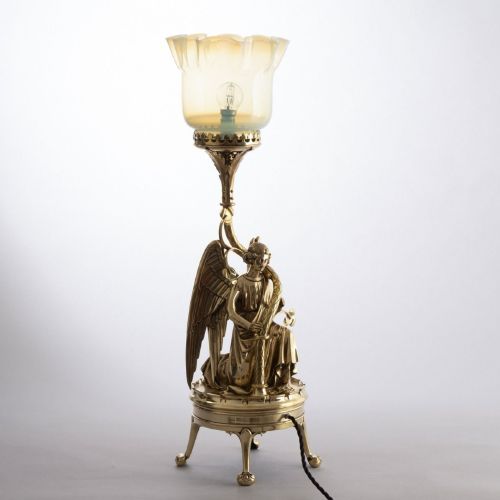
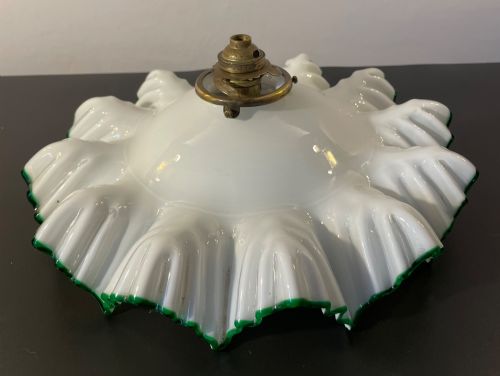


Frilled Glass Lamp
These frilled glass lamps bring textured light and period charm to a room, combining tactile glass shades with sturdy metal stands.
Frilled Glass Lamp
When searching for a frilled glass lamp, buyers encounter lighting fixtures defined by their distinctive fluted or crimped shades, which soften the illumination and create sculptural silhouettes. These pieces span oil lamps, table lamps, floor lamps, and wall sconces originating from the nineteenth and early twentieth centuries.
The most common examples on this page pair brass bases with coloured or etched glass shades, dating from the Victorian and Edwardian eras. Formats range from tall floor and oil lamps to delicate desk lights and ceiling pendants, reflecting the domestic lighting transitions of their respective periods.
How they were made
The construction of these lamps relies on the combination of spun or cast brass, copper, and bronze for the structural bodies, paired with blown glass for the diffusers. Glassmakers achieved the characteristic frills by manipulating the hot rim of the vessel with tools while spinning the molten material.
Colour in the glass was introduced through metallic oxides added to the batch, producing distinct hues such as cranberry, vaseline, green, and pink. Etched and frosted surface patterns were subsequently applied using acid or wheel-cutting techniques before the components were assembled onto metal reservoirs and burners.
Vaseline glass shades contain trace amounts of uranium, causing them to glow an eerie neon green under a blacklight.
What varies in quality
Quality in these lighting pieces rests on the crispness of the brass casting, the weight and clarity of the glass, and the retention of original components. Heavier gauge metalwork and deeply crimped, evenly coloured glass shades distinguish finer examples from standard production.
The degree of hand-finishing on the metal mounts, such as embossing or delicate chasing, separates superior pieces. Matching original glass shades to their correct period bases also elevates the integrity of the object.
Farraday and Son·Meissen Porcelain·W A Benson
The Frilled Glass Lamp Glossary
- Cranberry glass
- A rich red-pink transparent glass produced by adding gold chloride to the molten batch. It is frequently seen in Victorian oil lamp shades.
- Vaseline glass
- A transparent or translucent yellow-green glass containing uranium dioxide, which glows brightly under ultraviolet light. It appears in late nineteenth and early twentieth-century shades.
- Oil lamp
- A lighting device that burns liquid fuel via a wick raised through a metal burner. Many examples from this selection have been subsequently converted for electricity.
- Art Nouveau
- A design style characterised by organic, flowing lines and plant-like motifs. It appears on brass wall sconces and lamp mounts from around nineteen hundred.
- Gothic Revival
- An architectural and decorative style drawing inspiration from medieval forms. In these listings, it influences the heavy brass framing of period lamps.
Frilled Glass Lamp: Frequently Asked Questions
How do I identify a Victorian frilled lamp?
Victorian examples typically feature heavy brass bases, often with embossed or Gothic Revival detailing, paired with deep cranberry or green crimped glass shades.
Proportions tend to be robust, reflecting the functional requirements of nineteenth-century oil lighting.
Can I find matching pairs?
Matching pairs do appear among the wall sconces and oil lamps, though single pieces are more common in the inventory.
Pairing antique glass shades with period-correct metal bases requires attention to fitter ring diameters and proportions.
What is the difference between Edwardian and Victorian styles?
Victorian lighting tends to feature heavier brass casting, ornate embossing, and saturated glass colours like deep cranberry or vaseline.
Edwardian pieces often introduce lighter proportions, simpler lines, and influences from the Arts and Crafts movement or Art Nouveau.