
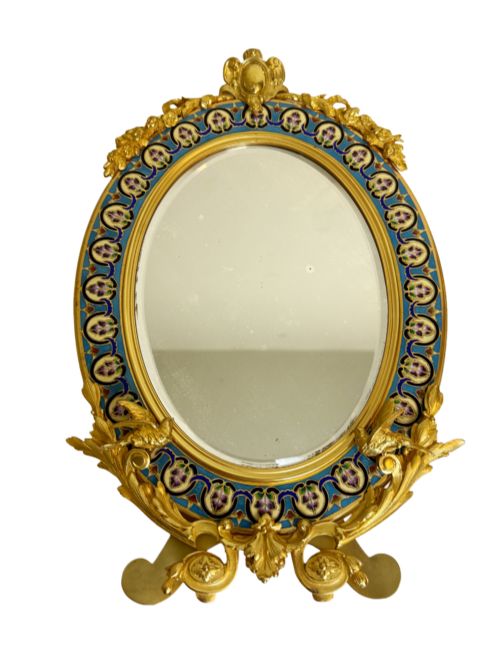
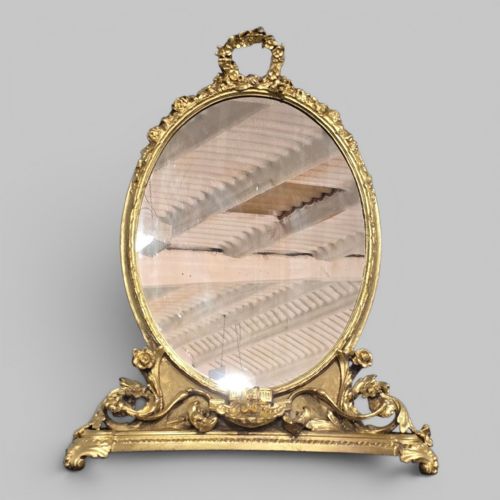
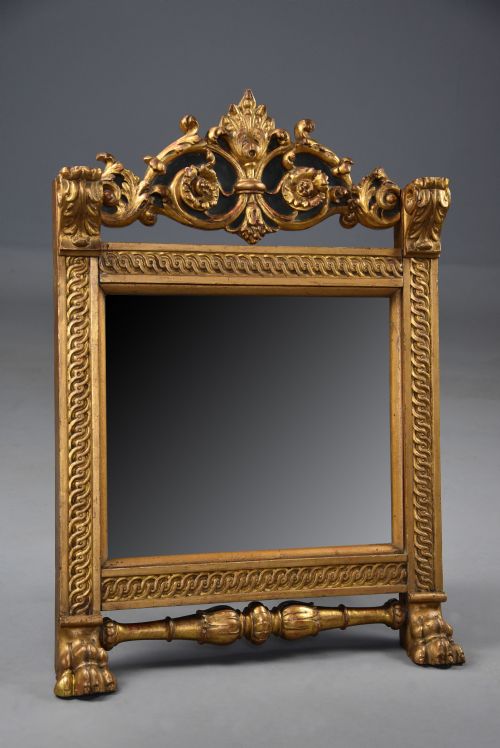


Gold Tabletop Mirror
A gold tabletop mirror sits on a dressing surface to catch the light and frame a reflection.
Gold Tabletop Mirror
A gold tabletop mirror is a portable dressing glass designed for boudoir or vanity use, supported by an easel back or a hinged stand. These pieces range from compact brass frames to large carved wooden designs intended to rest upon a chest or dressing table.
Most examples encountered here span the Victorian era through the early twentieth century, alongside earlier eighteenth-century Italian work. Forms vary from simple ovals and folding triptychs to ornate architectural frames influenced by historic revival styles.
Origins stretch across English workshops and French ateliers, bringing together diverse regional interpretations of decorative metalwork and gilding. Buyers choose these objects both for daily grooming and for the warm reflective accent they bring to a room.
Materials and construction
Giltwood and gesso provide the foundation for carved wooden frames, where plaster is applied over a wooden base before receiving layers of gold leaf or metallic paint. Brass, bronze, and ormolu form the structure of cast metal pieces, often detailed with chased surface ornamentation and bevelled glass plates.
Specialised decorative elements appear on select examples, including champleve enamel and Limoges enamel plaques inset into the metal surrounds. Easel mechanisms, folding hinges, and wooden struts secure the glass at an upright viewing angle.
An eighteenth-century Italian mirror rubs shoulders with twentieth-century folding brass triptychs, proving vanity transcends generations.
Assessing quality and craftsmanship
The refinement of the carving or metal casting dictates the visual depth of the frame, separating mass-produced items from finely hand-tooled pieces. Crisp detail in the floral scrolls of a Rococo revival mount or the hand-carved undercut foliage of a giltwood frame shows the hand of a skilled artisan.
The integrity of the mercury or silvered mirror glass and the stability of the original easel mechanism influence the desirability of the piece. Uniformity in the application of the original gilding and the weight of the cast bronze or brass indicate higher standards of production.
The Gold Tabletop Mirror Glossary
- Ormolu
- Gilded bronze, where a mercury and gold amalgam is fired onto a bronze base to create a rich metallic finish. This technique was widely utilised in French decorative arts.
- Champleve
- An enamelling technique where troughs are dug into a metal surface and filled with vitreous enamel before firing. It creates vibrant coloured patterns across the metal frame.
- Gesso
- A plaster mixture applied to wood frames to provide a smooth surface for gilding. It allows for intricate relief moulding before gold leaf is laid down.
- Easel mirror
- A dressing glass supported by a hinged wooden or metal prop at the back. This allows the mirror to stand upright on a flat surface without mounting to a wall.
- Bevelled glass
- Mirror glass with edges cut and polished at an oblique angle. This process adds a decorative refractive border to the reflection.
Gold Tabletop Mirror: Frequently Asked Questions
Are these mirrors heavy?
Weight depends entirely on the materials used in the construction of the frame. Cast bronze, ormolu, and carved giltwood designs carry substantial weight to anchor the easel support.
Smaller brass or metal frames are lighter and easily repositioned on dressing tables. Ensure the supporting surface is stable enough to bear the weight of heavier metal and glass combinations.
Can I replace the mirror glass?
Original mirror glass often shows foxing, dark spots, and age marks that collectors value as proof of authenticity. Replacing the glass removes historical character and alters the visual integrity of the antique.
If the glass is broken or missing entirely, a specialist glazier can cut a new bevelled plate to fit the rebate. Retain the original backing boards and fixings whenever possible during any conservation work.
How do I date a brass tabletop mirror?
Dating relies on examining the casting quality, the style of the decorative motifs, and the construction of the easel hinges. Victorian and Edwardian pieces often feature machine-stamped backs or heavier sand-cast brass frames with distinct screw fixings.
Later twentieth-century reproductions generally use lighter stamped metals and modern fasteners. Comparing the design characteristics to documented revival periods helps narrow down the decade of manufacture.