
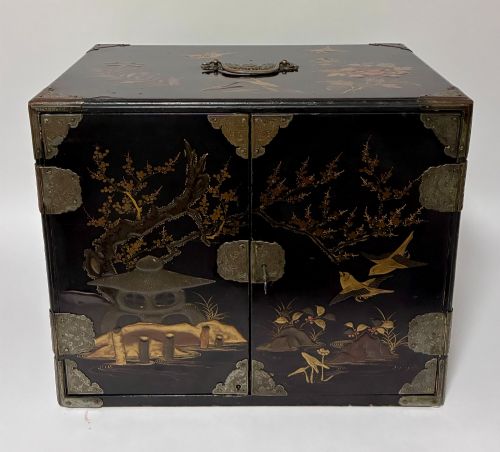
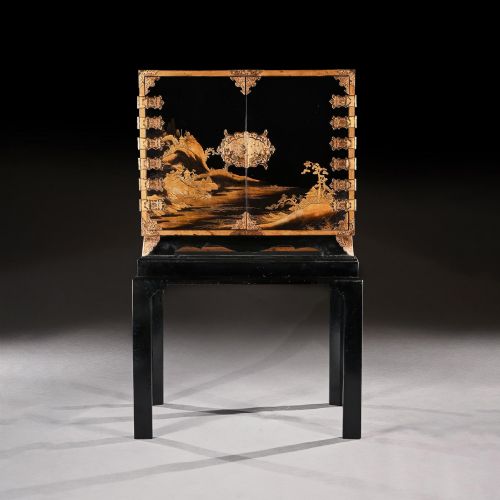
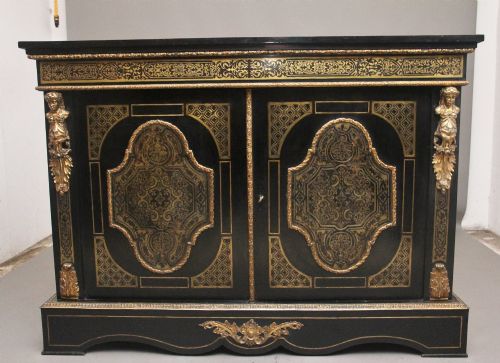


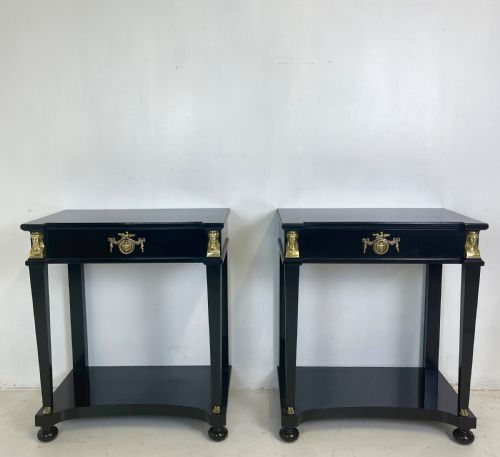


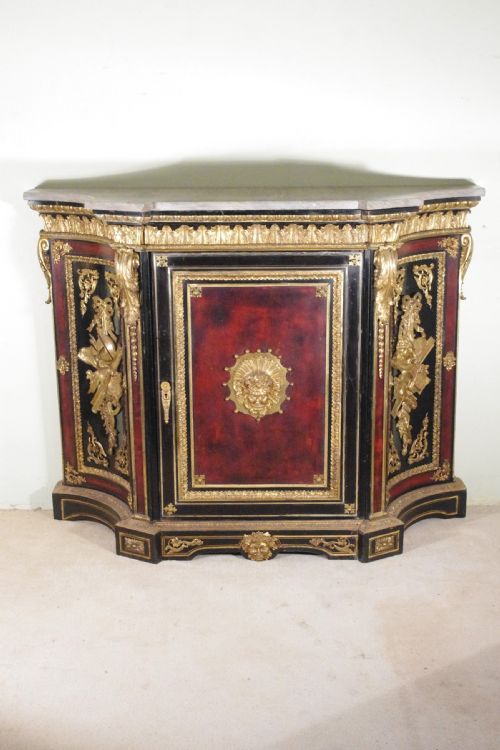


Gold Mounted Black Cabinet
A gold mounted black cabinet brings striking dark surfaces and gleaming metalwork into a room, offering both bold display space and rich historical character.
Gold Mounted Black Cabinet
A gold mounted black cabinet encompasses a range of dark-finished and metallic-trimmed forms designed to anchor a room with visual weight and contrasting brightness. When exploring a gold mounted black cabinet, buyers encounter varied expressions spanning European revival styles and Japanese export traditions.
Ebonised timber frames paired with ormolu, brass, and gilt metal dominate the European items, while traditional lacquer work defines the Asian examples. Each variation serves the dual purpose of practical storage and decorative display.
Materials and construction
The structural foundation of these cabinets relies upon skilled woodworking, utilising timber finished with ebonisation to achieve a deep black surface, or traditional lacquer techniques applied to wooden carcases. Artisans then mounted cast and chased ormolu, brass, or gilt metal mounts onto the corners, panels, and frames to accentuate the dark body.
Many examples incorporate tortoiseshell and engraved brass in intricate boulle marquetry patterns across the doors and friezes. Further decorative depth is achieved through the integration of marble tops and porcelain plaques inset into the cabinetry.
Materials recorded across the selection include ebonised wood, ormolu, tortoiseshell, and marble tops.
Assessing craftsmanship
Quality reveals itself in the precision of the cabinetwork, the sharpness of the cast ormolu mounts, and the intricacy of the surface decoration. Finer examples display meticulous alignment in boulle marquetry and superior finishing on the ebonised wood or lacquer.
The integration of secondary materials, such as heavy marble slabs and hand-painted porcelain plaques, distinguishes standard production from more ambitious workshop output. Preservation of the original metal mounts and the stability of the timber carcase further determine the standing of an individual piece.
The Gold Mounted Black Cabinet Glossary
- Ebonised Wood
- Timber treated to resemble ebony through staining or painting. This process creates a uniform black finish popular in nineteenth-century furniture design.
- Ormolu
- Gilded bronze mounts applied to furniture. The technique involves applying a gold amalgam to bronze before heating to drive off the mercury.
- Boulle Work
- A form of marquetry using tortoiseshell and brass. Named after French cabinetmaker André-Charles Boulle, it creates ornate contrasting patterns on dark surfaces.
- Pier Cabinet
- A narrow cabinet designed to stand against the wall between windows. These pieces often feature glass doors for displaying decorative objects.
- Credenza
- A low cabinet enclosed by doors, traditionally used for serving or display. Nineteenth-century interpretations often feature elaborate gilt mounts and marble tops.
Gold Mounted Black Cabinet: Frequently Asked Questions
How do I care for ebonised wood?
Dust regularly with a soft, dry cloth to prevent the accumulation of abrasive particles on the dark surface.
Avoid placing the cabinet near direct heat sources or strong sunlight, which can fade the finish and dry out the timber.
Where should I place a pier cabinet?
A pier cabinet fits naturally into narrow wall spaces or between architectural openings where standard furniture proves too bulky.
The glazed doors and compact footprint make them suitable for showcasing small collections without dominating the room layout.
What is the difference between boulle and lacquer?
Boulle work utilises inlaid brass and tortoiseshell set into an ebonised wooden carcase to create geometric or floral patterns.
Japanese lacquer relies on multiple layers of processed tree sap applied to a wooden base, often featuring hand-painted gilt scenes.
How do I identify a Napoleon III cabinet?
Napoleon III cabinets frequently combine deep ebonised wood with profuse ormolu mounts, curved serpentine fronts, and inset porcelain plaques.
This mid-to-late nineteenth-century French style draws heavily on earlier Louis XIV and Renaissance aesthetics.