





Gold Metal Candelabrum
A gold metal candelabrum brings unmistakable warmth and period presence to a room, offering both sculptural weight and branching illumination.
Gold Metal Candelabrum
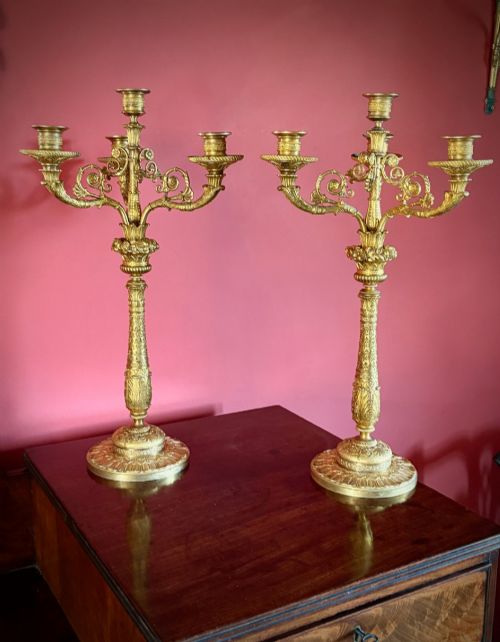
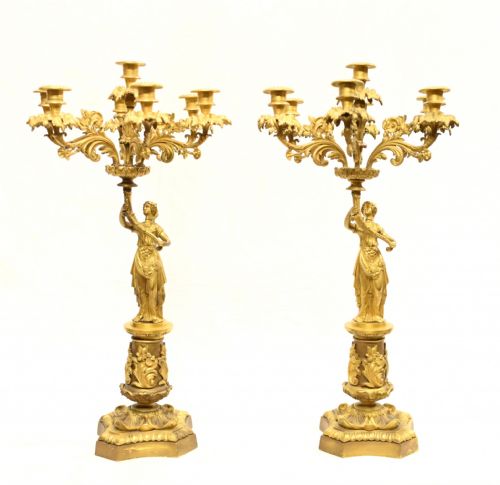
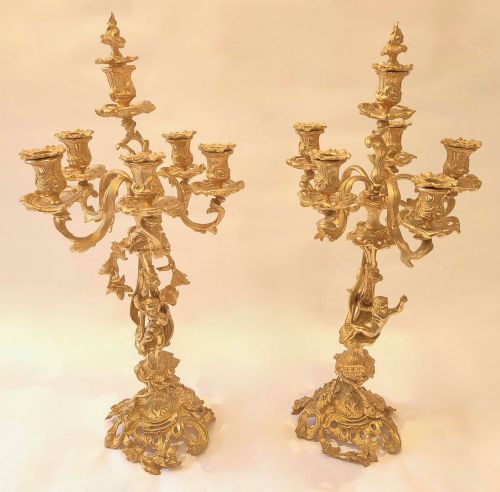
A gold metal candelabrum primarily covers nineteenth century French and English branched candle holders cast in ormolu, gilt bronze, brass, and gilt metal. Buyers encounter pairs dominated by French Rococo Revival, French Neoclassical, Victorian, and Empire styles, often incorporating marble or glass components alongside the metalwork.
Beyond standard tabletop candelabra, the selections span related forms such as wall sconces, chandeliers, and clock garnitures. Many examples feature multiple arms ranging from two up to eight branches, while several pieces show historical conversion into table lamps.
Materials and construction
The primary construction relies on cast bronze or brass treated with mercury gilding or modern electroplating to create the characteristic ormolu and gilt finish. Artisans combined these gilded metals with contrasting solid bases of white or dark marble, slate, and occasional glass elements.
Decoration often involved detailed chasing and applied enamelling, such as Champllevé work, alongside figural casts depicting cherubs or classical figures supporting the branched candle nozzles.
Current listings span the nineteenth and early twentieth centuries, featuring gilt bronze, brass, ormolu, marble, and glass across French and Italian decorative styles.
What separates the finest examples
Quality rests upon the crispness of the metal chasing and the depth of the original gilding, where sharp cast details and retained fire-gilt lustre distinguish superior workshop output from softer, later castings. The integration of secondary materials like heavy veined marble bases also defines the substance and balance of the object.
Proportion and structural integrity across the branching arms and sconces dictate the overall visual harmony, ensuring that multi-light configurations maintain straight alignment and secure joints.
The Gold Metal Candelabrum Glossary
- Ormolu
- Finely chased gilt bronze, widely used in French decorative arts during the eighteenth and nineteenth centuries. It provides a rich gold surface that does not tarnish easily.
- Gilt Metal
- Base metal treated with a gold-coloured finish or thin layer of gold. It appears frequently in nineteenth-century decorative lighting.
- Garniture
- A set of matching decorative objects, typically comprising a central clock flanked by two matching candelabra or vases. These sets were designed to sit harmoniously on a mantelpiece.
- Champlévé Enamel
- An enamelling technique where troughs or cells are hollowed out of a metal surface and filled with vitreous enamel before firing. It adds colourful decorative patterns to the metal body.
- Sconce
- A wall-mounted lighting fixture with multiple branches or arms designed to hold candles or bulbs. They project light outward from vertical surfaces.
Gold Metal Candelabrum: Frequently Asked Questions
Can converted candelabra be changed back to candles?
Many converted pieces retain their original candle sockets alongside the electrical wiring fitted during later twentieth-century updates. Reversal depends entirely on whether internal drilling altered the core structural components.
A qualified conservator can inspect the underside and central column to determine if the wiring can be removed safely without harming the metal.
What is the difference between ormolu and gilt bronze?
Ormolu is simply the English term for gilt bronze, derived from the French phrase or moulu, meaning ground gold. Both terms describe a bronze object coated in a fine layer of gold.
Historical pieces often use mercury gilding, a toxic process banned in the nineteenth century, which produced a particularly deep and durable golden lustre.
How were multi-arm candelabra used historically?
These branched holders stood on dining tables, sideboards, and mantelpieces to provide ambient illumination during evening gatherings. Their reflective gilt surfaces amplified the flickering light of multiple candles.
In grander rooms, matching pairs framed mirrors or centrepieces, doubling the visual impact of the illumination across the interior space.