





Gold Marble Candle Holders
Gold marble candle holders bring French neoclassical elegance to a room through cast bronze and polished stone.
Gold Marble Candle Holders
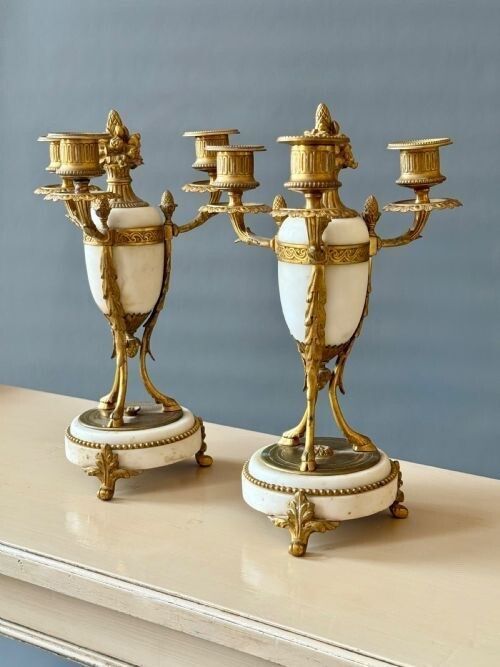
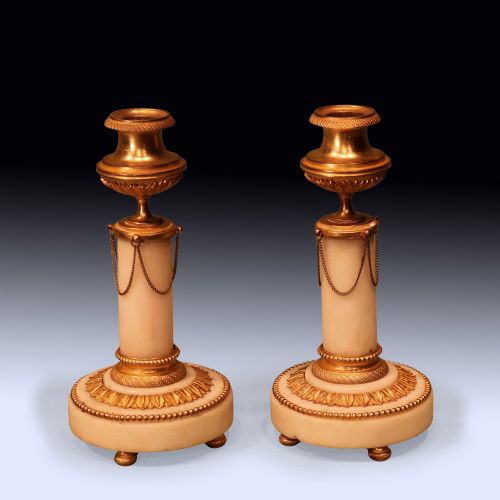
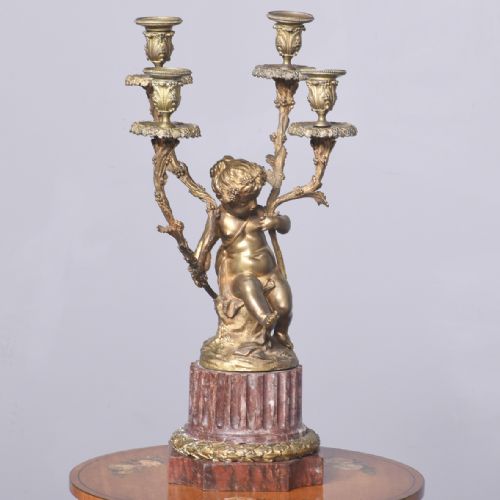
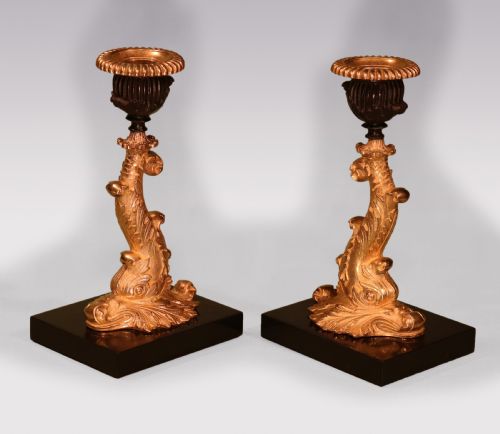
Gold marble candle holders encompass French candelabras, candlesticks, and clock garnitures that combine white marble bases with gilt bronze and ormolu mounts. Buyers seeking gold marble candle holders frequently encounter pairs dating from the nineteenth century, executed in Louis XVI and neoclassical styles.
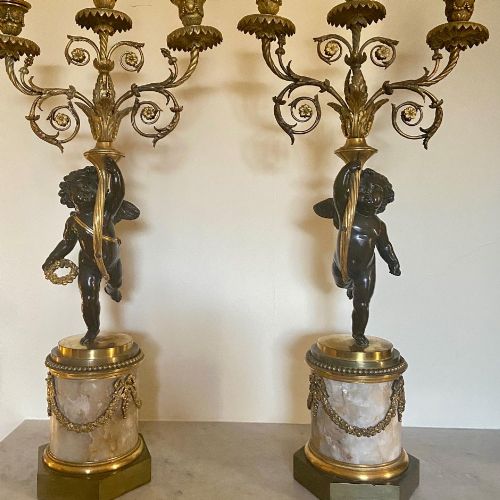
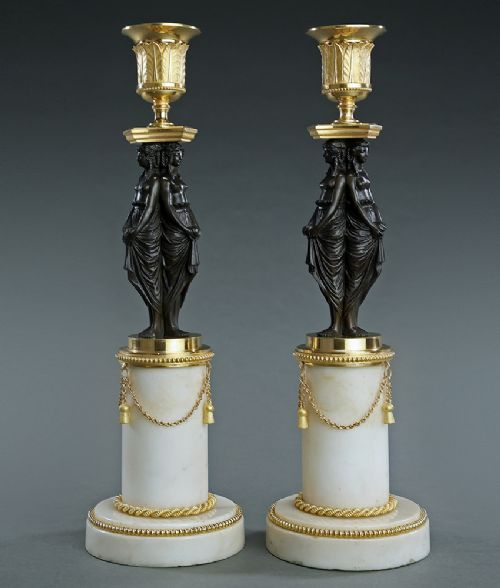
The forms range from single candlesticks to multi-arm candelabras featuring putti, cherubs, and caryatids. Clock garnitures also appear, pairing a central mantel clock with matching side candle holders in the same metallic and stone vocabulary.
How they were made
Maker workshops utilised cast bronze and patinated bronze, finishing metal components with mercurial gilding or ormolu. White marble forms the solid plinths and columns, frequently turned and polished by hand.
Fine secondary elements include carved fluorspar and enamel details integrated into the bronze armature. Individual components were assembled mechanically with threaded pins and nuts concealed within the marble bases.
The object forms span Candelabras, Candlesticks, Clock Garnitures, and Mantel Clocks in Louis XVI, Neoclassical, and Victorian styles.
What varies in quality
The crispness of the bronze chasing dictates the visual success of each piece, distinguishing sharp feather and acanthus leaf work from soft, worn castings. The weight and mineral consistency of the white marble also separate standard production from monumental display examples.
Integration between the metal mounts and stone bases reveals the maker's hand; superior pairs show seamless seating without excess filler. The depth and durability of the original ormolu surface retain their lustre far better than later chemical washes.
The Gold Marble Candle Holders Glossary
- Ormolu
- Gilt bronze produced by applying a mercury and gold amalgam to a bronze base and firing it to drive off the mercury. This technique creates a durable, warm golden finish characteristic of eighteenth and nineteenth-century French metalwork.
- Candelabra
- A branched lighting fixture holding multiple candles upon a central stem and base. They often stand taller than standard candlesticks and incorporate figural bronze work.
- Clock Garniture
- A matching set comprising a central mantel clock flanked by two sidepieces, such as candelabras or urns. They are designed to sit together on a fireplace mantel or console table.
- Fluorspar
- A halide mineral prized for its rich colour banding, occasionally utilised in decorative inserts within fine metal mounts. It provides a striking contrast to white marble and gilt bronze.
- Caryatid
- A sculpted female figure serving as an architectural support in place of a column. In these metalwork pieces, they form the central stems of candlesticks.
Gold Marble Candle Holders: Frequently Asked Questions
How do I clean the marble bases?
Dust white marble surfaces gently with a dry microfibre cloth to remove everyday particles. Avoid abrasive scrubbing or harsh household chemicals that can etch the polished stone finish.
For stubborn marks, use a barely damp cloth with mild neutral soap, drying immediately. Keep moisture away from the gilt bronze mounts to protect the historic ormolu.
Are these pieces wired for electricity?
Most antique examples remain in their original form designed strictly for wax candles. Conversions to electric wiring do occur occasionally but alter the historic fabric.
Inspect the nozzle interiors to determine whether wiring has passed through the central stem. Preserved candle sockets maintain the authentic appearance intended by the maker.
What is a clock garniture set?
A clock garniture is a decorative ensemble consisting of a central clock paired with two matching side objects. In nineteenth-century French interiors, these sets created a balanced display on mantelpieces.
The sidepieces usually take the form of multi-arm candelabras or urns sharing the same marble and gilt bronze materials.
How do I date these metal and stone pieces?
Dating relies on stylistic clues, casting techniques, and material combinations typical of specific periods. Pieces showing Louis XVI revival styles frequently date from the late nineteenth century rather than the eighteenth century.
Examine the construction of the joints and the composition of the bronze beneath the gilding for period indicators.