




Gold Mahogany Mirror
A gold mahogany mirror brings warmth and reflective light to a room through dark timber frames finished with rich leaf gilding.
Gold Mahogany Mirror
A gold mahogany mirror combines deep reddish-brown timber with gleaming gilded accents, creating a striking contrast that defines traditional wall furniture. These pieces serve as both practical looking glasses and decorative focal points within a room.
Buyers encountering this search phrase will find wall mirrors, overmantel mirrors, and pier mirrors spanning Georgian, Victorian, and later periods. The selection includes styles ranging from restrained Chippendale fretwork to elaborate French Empire and Swedish Gustavian designs.
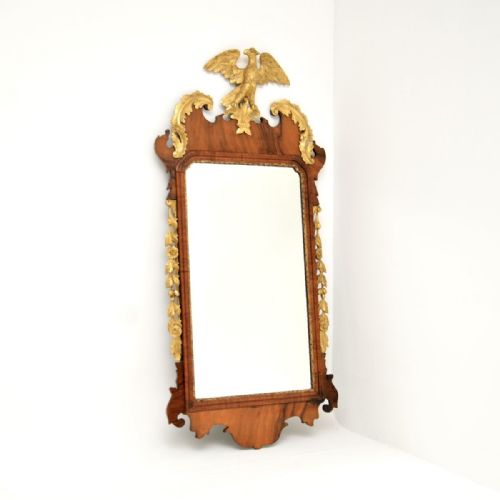
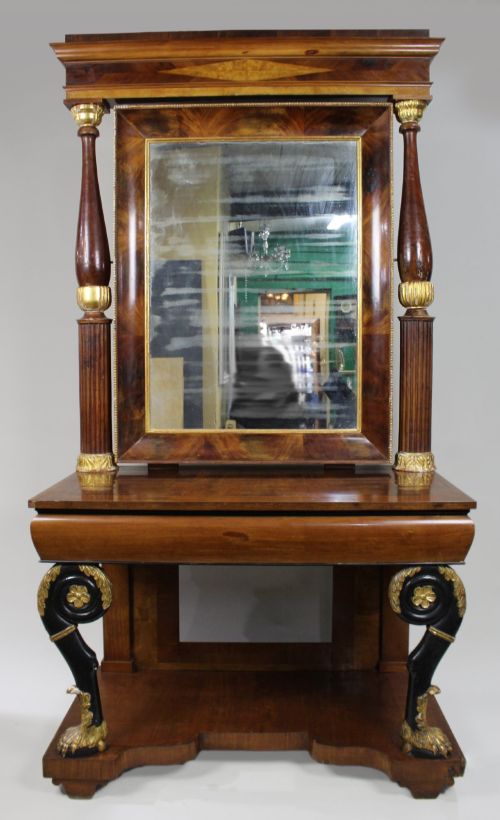
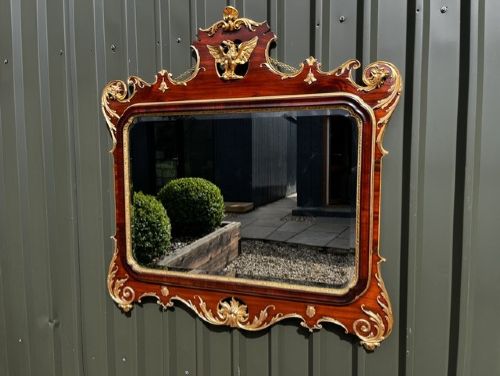
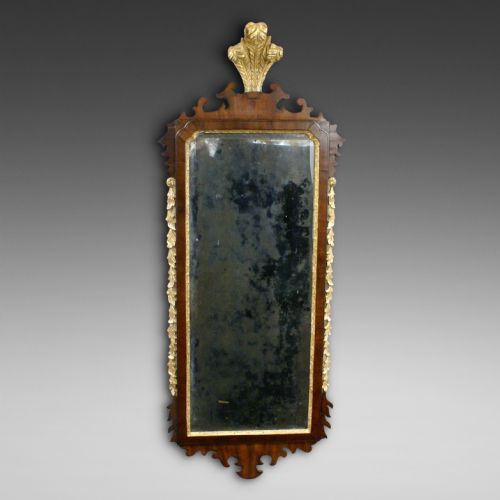
Most examples rely on parcel gilding to highlight carved details like eagles, scrolling foliage, and classical mouldings against the dark mahogany base. Forms vary from monumental classical wall pieces to compact oval looking glasses.
Materials and construction methods
Cabinetmakers utilised solid mahogany for structural frames, shaping the dense timber with hand saws and chisels before applying carved decorative elements. Walnut sometimes appears alongside mahogany in larger floor and wall formats.
Gilding was applied using thin sheets of gold leaf or gesso over prepared wooden surfaces, often burnished to achieve varying levels of sheen. Parcel gilt work required precise hand application to ensure the gold adhered only to specific carved highlights.
Early examples relied on heavy mirror glass held within rebated frames, whilst later pieces incorporated standardised plate glass secured by wooden backs.
Several mirrors keep watch over their rooms accompanied by carved wooden eagles perched proudly at the very top of the frame.
Assessing quality in gold mahogany mirrors
Quality rests primarily in the crispness of the hand-carved woodwork and the depth of the mahogany grain showing beneath the polished surface. Superior pieces exhibit refined proportions where carved motifs like scrolling leaves or eagles integrate naturally with the frame.
The application of the gold leaf dictates much of the visual success, with skilled gilding showing subtle variations in texture rather than flat, uniform paint. Original mirror glass with aged foxing adds authenticity, whereas poorly executed restorations diminish the historical integrity of the piece.
The Gold Mahogany Mirror Glossary
- Parcel Gilt
- Partial gilding where gold leaf highlights specific carved details on a wooden surface. This technique contrasts the bright gold against the dark mahogany grain beneath.
- Gesso
- A plaster-like mixture applied to wood as a base for gilding. It provides a smooth surface for laying gold leaf.
- Pier Mirror
- A tall mirror designed to hang on the wall between two windows, often placed above a matching console table. These pieces maximised natural light in formal rooms.
- Overmantel Mirror
- A wide mirror intended to be positioned directly above a fireplace mantel. Their horizontal proportions complemented the architectural span of the hearth.
- Fretwork
- Openwork ornamentation cut with a fretsaw, commonly seen in Chippendale style frames. This technique created intricate geometric patterns along the outer edges.
Gold Mahogany Mirror: Frequently Asked Questions
Where should I hang a gold mahogany mirror?
These mirrors work effectively above a mantelpiece, sideboard, or console table where they anchor surrounding furniture and reflect natural light.
Ensure the wall fixings match the weight of the timber frame, particularly on larger overmantel and monumental classical designs.
How do I clean a gilded mahogany frame?
Dust the timber and gilded sections gently with a dry, soft cloth to prevent scratching the delicate gold leaf.
Avoid liquid cleaners and polishes, which can damage the gesso and strip the historical finish from the wood.
What is the difference between Georgian and Victorian styles?
Georgian pieces often feature restrained Chippendale fretwork and balanced proportions with careful parcel gilding.
Victorian and later interpretations tend toward heavier proportions, more ornate decorative carving, and bolder neoclassical or Empire influences.
Are these mirrors made from solid mahogany?
Frames are constructed using solid mahogany or walnut timbers, sometimes combined with softer woods for internal framing.
Carved decorative elements like eagles and scrollwork are typically worked directly into the timber or built up in gesso.