


Gold Heart Padlock Link
A gold heart padlock link secures the substantial antique bracelets that define late Victorian and Edwardian wristwear.
Gold Heart Padlock Link
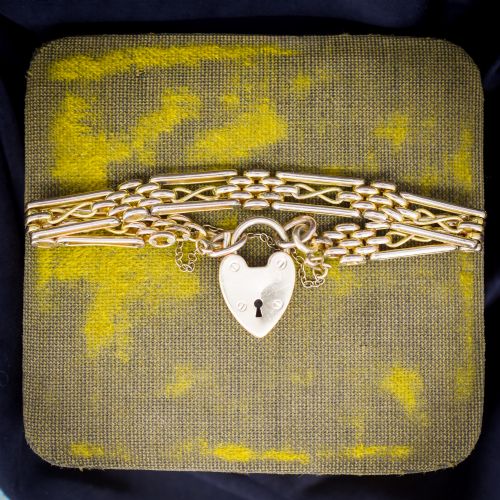
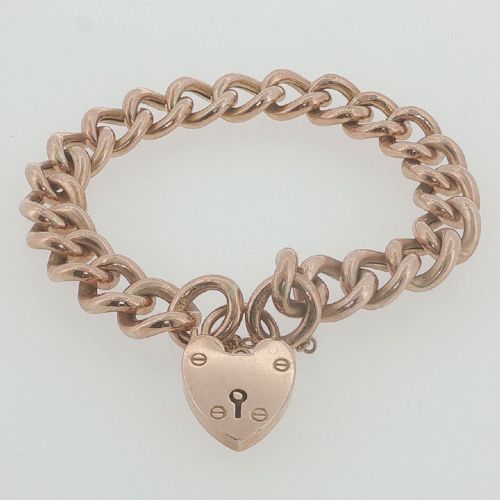
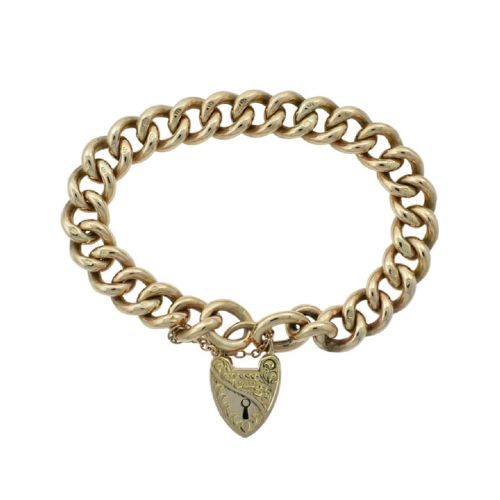
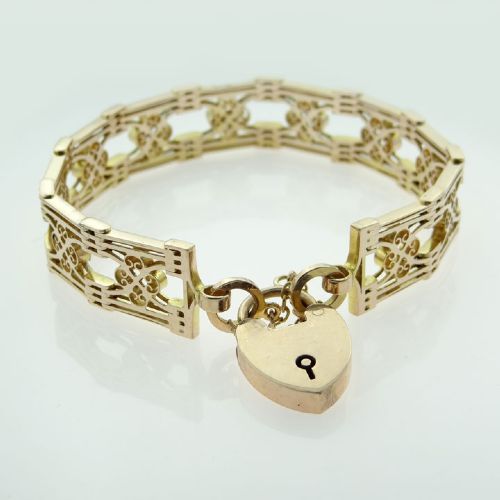
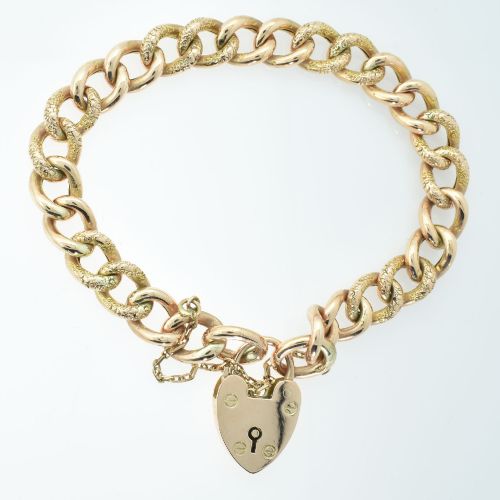
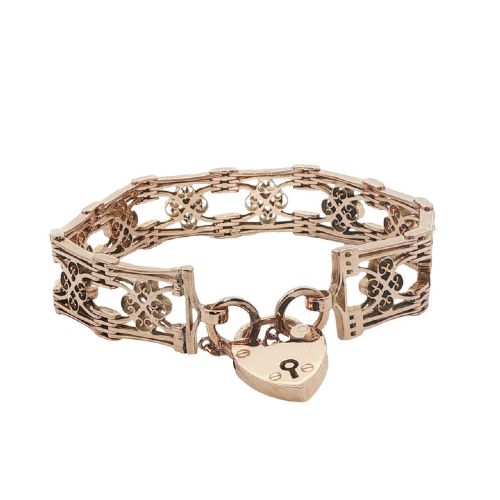
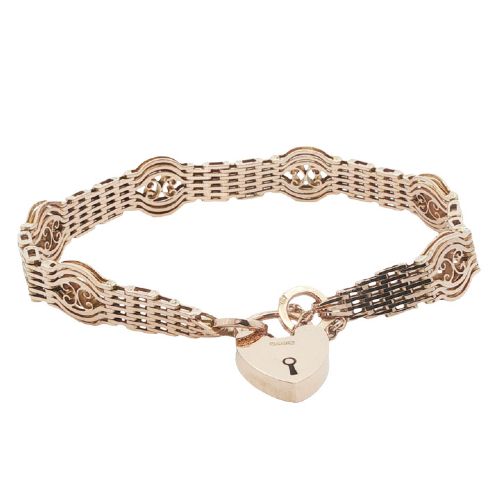
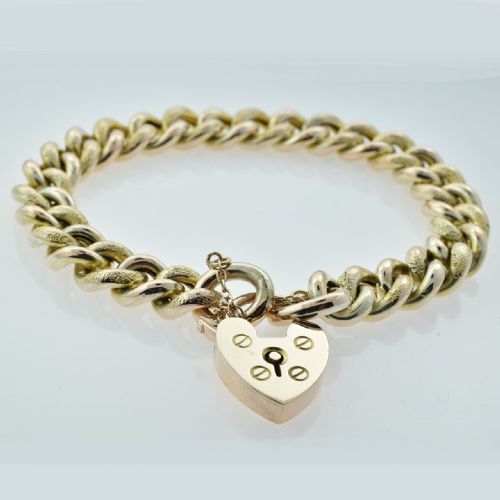
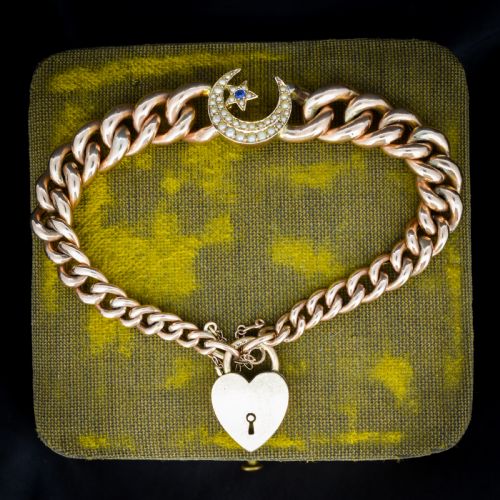
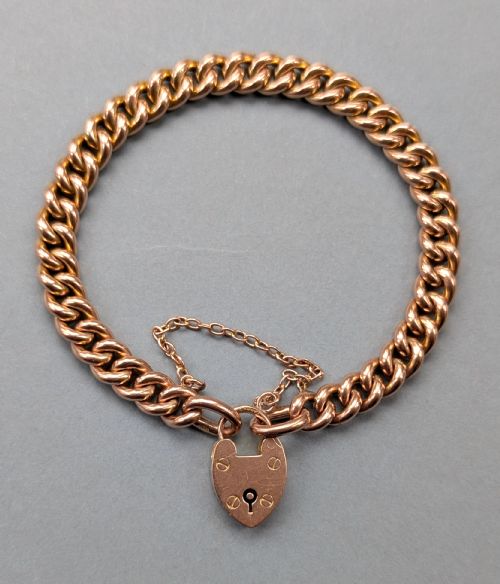
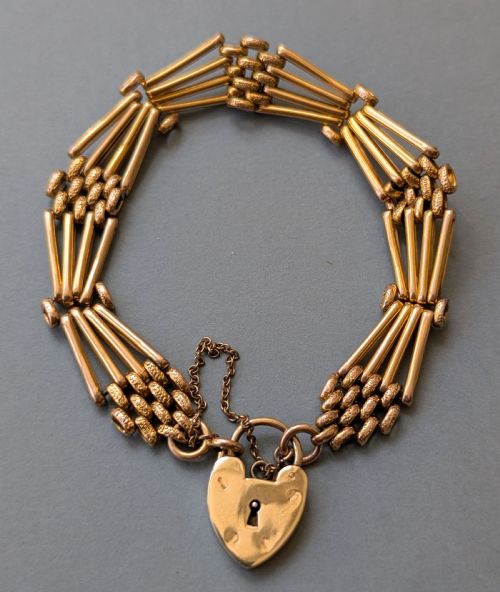
A gold heart padlock link anchors the gate and curb link bracelets that survive from the Victorian and Edwardian eras. These pieces combine secure functionality with sentimental design, functioning simultaneously as a clasp and a decorative focal point.
The most common examples on this page are curb and gate link bracelets in nine-carat rose gold, often finished with hand engraving. They frequently incorporate safety chains alongside the signature heart padlock to ensure secure daily wear.
Earlier Victorian iterations often feature ornate knot links, whilst Edwardian variations introduce gemstones like seed pearls, rubies, and amethysts set directly into the design. The form remains resolutely British, frequently bearing hallmarks from regional assay offices such as Chester and London.
Materials and construction
Goldsmiths utilised nine-carat rose gold and yellow gold as the primary metals for these chains, occasionally employing rolled gold or niello for alternative finishes. The links were formed by hand or punched and soldered into heavy curb and gate patterns that could support the weight of the central padlock.
Gemstone embellishment involved flush or bezel setting seed pearls, amethysts, and rubies into the gold framework, particularly around the padlock or adjacent fancy links. Surface decoration relied on half-engraving and chased patterns applied directly to the rose gold links to catch the light.
Many heart padlocks contain tiny secret compartments originally designed to hold a lock of a loved one's hair.
Distinctions in quality
The distinction between standard examples and the finest pieces rests upon the weight of the gold and the intricacy of the link formation. Substantial fifteen-carat gold variants and those featuring complex gate or fancy link structures demonstrate superior manufacturing ambition.
The inclusion of matched gemstones, such as calibrated rubies, amethysts, and natural seed pearls set into the padlock or links, elevates a piece above plain metal work. Crisp, deep half-engraving that remains sharp across every single curb link indicates a higher grade of contemporary craftsmanship.
The Gold Heart Padlock Link Glossary
- Curb link
- A style of chain formed of interlinked, uniform curbs that lie flat against the wrist. It provides the heavy foundational structure for many antique padlock bracelets.
- Gate link
- A construction consisting of parallel bars joined by vertical links, mimicking the appearance of a physical gate. This airy yet robust form is characteristic of Victorian and Edwardian wristwear.
- Rolled gold
- A material made by bonding a thin sheet of gold to a base metal core. It offers the visual appearance of solid gold while reducing the overall weight and cost.
- Niello
- A black metallic alloy used as an inlay on engraved metal surfaces. It creates high-contrast decorative patterns against the polished gold or silver background.
- Hallmark
- An official stamp indicating the purity of the metal and the place and year of manufacture. British pieces often display marks for assay offices like Chester and London.
Gold Heart Padlock Link: Frequently Asked Questions
How do I open the heart padlock?
Most heart padlocks on these antique bracelets operate via a concealed spring mechanism or a push-pin pivot. You gently press the latch or side to release the bail from the jump ring.
Because these are historic items, springs can occasionally lose tension over decades of use. It is wise to have a jeweller inspect the mechanism before wearing the piece daily.
Are these bracelets solid gold?
The majority of the pieces listed are constructed from solid nine-carat gold, with occasional heavier examples cast in fifteen-carat gold. You will also encounter rolled gold alternatives among the selection.
Checking the hallmarked stamps on the links and the padlock provides definitive proof of the metal composition. Rose gold is the predominant hue seen across Victorian and Edwardian examples.
How do I tell Victorian from Edwardian pieces?
Victorian bracelets, dating up to 1901, often feature heavier curb links, ornate knot work, and deeper hand engraving. The rose gold tends to have a rich, warm coppery tone.
Edwardian pieces from the subsequent decade frequently incorporate delicate gemstone clusters, such as seed pearls and amethysts, alongside lighter gate link formations.
Can I wear my bracelet every day?
These robust curb and gate link chains were built for daily wear, but their antique nature requires some mindfulness. Ensuring the safety chain is fastened provides vital security whilst out and about.
It is best to remove the bracelet during strenuous physical tasks, swimming, or gardening to protect the delicate seed pearl settings and gold engravings from undue wear.