
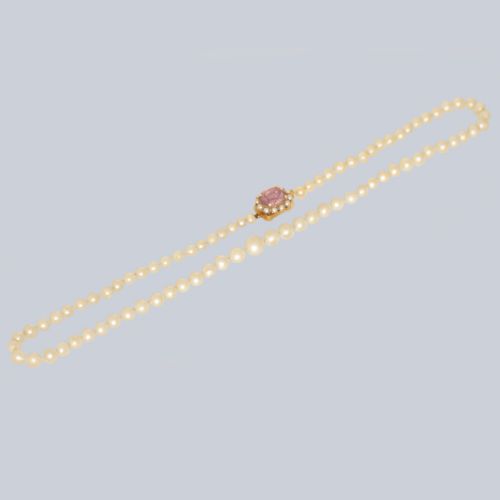
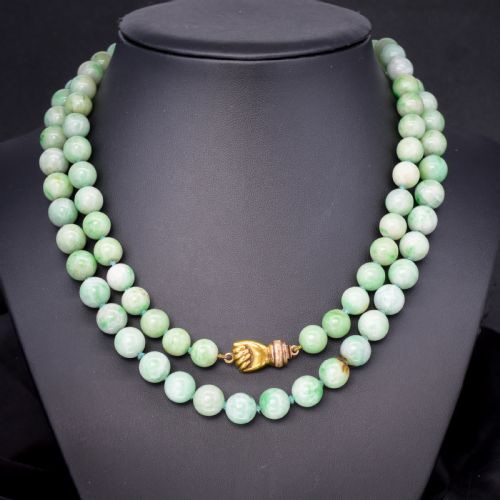


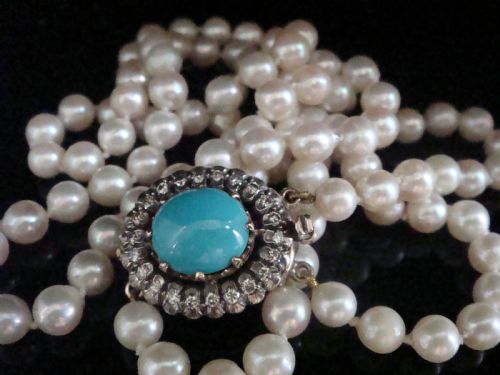
Gold Gemstone Clasp Necklace
A gold gemstone clasp necklace combines strings of pearls or beads with a decorative fastening set in gold.
Gold Gemstone Clasp Necklace
A gold gemstone clasp necklace brings together strands of pearls, jade or beads with a decorative fastening made of gold and set with stones. When searching for a gold gemstone clasp necklace, buyers encounter pieces spanning the Victorian era, Edwardian period, Art Deco and Mid-Century decades.
The most common form on this page is a multi-strand pearl necklace finished with a prominent clasp containing amethysts, diamonds, rubies or tourmalines. These pieces place the main decorative focus on the fastening, which was designed to be worn at the front or side of the neck.
How they were made
These necklaces utilise precious metals including 9ct gold, 18ct gold, platinum and general gold settings to secure the stones. Gemstones such as diamonds, amethysts, garnets, tourmalines and turquoise are set alongside natural, cultured or freshwater pearls.
Construction methods involve stringing beads or pearls into single, double, triple or multi-strand configurations that attach securely to structured metal clasps. Master jewellers combined fine metalwork with secure box, tongue or decorative fastenings designed to bear the weight of the strands.
Listings feature pearls, diamonds, amethysts, 18ct gold, 9ct gold, and cultured pearls across Victorian, Edwardian, Art Deco and Mid-Century styles.
What varies in quality
Quality separates through the selection and matching of the pearls or beads alongside the complexity of the gemstone setting in the clasp. Superior examples feature well-matched pearls with consistent lustre and securely set precious stones in higher carat gold or platinum.
Design sophistication also dictates value, where standard single-strand pearl necklaces with simple clasps differ from multi-strand pieces boasting intricate diamond, ruby and sapphire clusters. The integration between the necklace strands and the mechanical security of the clasp reveals the maker's skill.
The Gold Gemstone Clasp Necklace Glossary
- Clasp
- The fastening mechanism at the back or front of a necklace, which in these pieces doubles as the primary decorative jewel set with gemstones.
- Cultured Pearl
- Pearls formed with human intervention by inserting a nucleus into an oyster, widely seen across mid-century and vintage pearl strands.
- Strand
- A single continuous line of strung pearls, beads or gemstones forming the main body of the necklace.
- Carat
- A unit of weight for gemstones or a measure of gold purity, determining the richness of the metal in the clasp.
Gold Gemstone Clasp Necklace: Frequently Asked Questions
How do I wear a gemstone clasp?
Historically, decorative clasps were often worn visibly at the side or front of the neck rather than hidden at the back. This showcases the gemstones and metalwork as the focal point of the jewellery.
Modern wearers can position the clasp according to personal preference, letting it act as a pendant when brought to the front of a multi-strand pearl necklace.
What periods do these necklaces come from?
The pieces span from the 19th century and Edwardian eras through the Art Deco period and into 1950s and 1960s Mid-Century designs. Each era brings distinct proportions and gemstone combinations to the clasps.
Victorian and Edwardian examples often feature intricate gold work with turquoise or jade, while 1950s and 1960s pieces frequently pair multi-strand pearls with amethysts or tourmalines.
Are these necklaces made with real pearls?
The listings feature both natural pearls and cultured pearls, alongside variations involving jade beads and precious gemstones. Pearl types range from single-strand vintage items to six-strand configurations.
Descriptions specify whether pearls are cultured or natural, often accompanied by certificates from gemmological laboratories for higher-end pieces.
What metals are used in the clasps?
Metal choices span 9ct gold, 18ct yellow gold, and platinum, frequently paired with contrasting gemstones. The choice of metal often reflects the period of manufacture, with platinum favoured in earlier Edwardian and Art Deco designs.
Gold purity marks and hallmarks often appear on the reverse or interior of the clasp mechanism to verify the metal standard.