

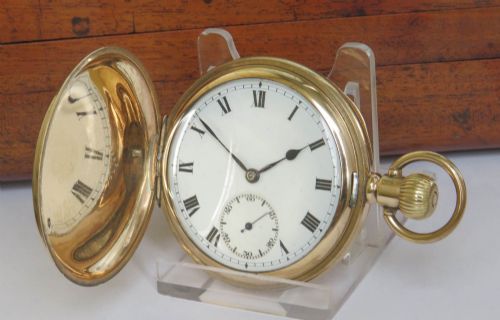
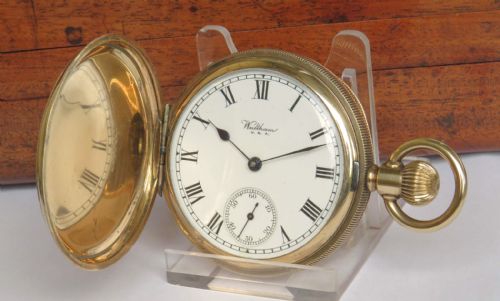
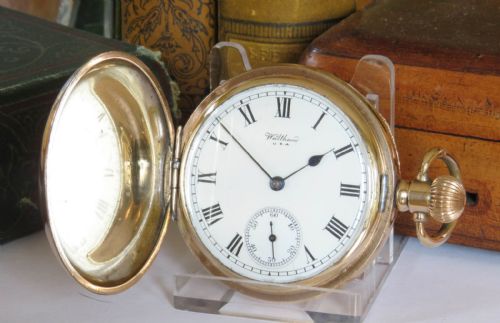
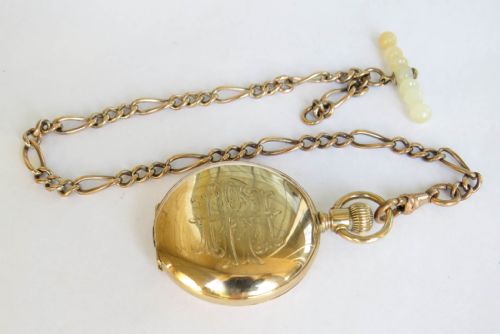
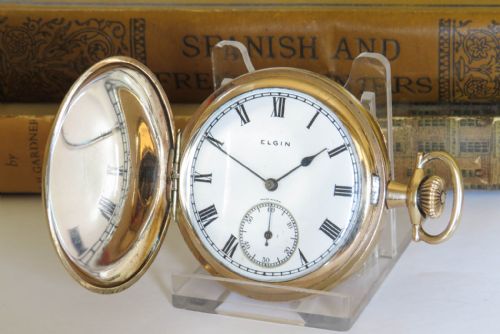
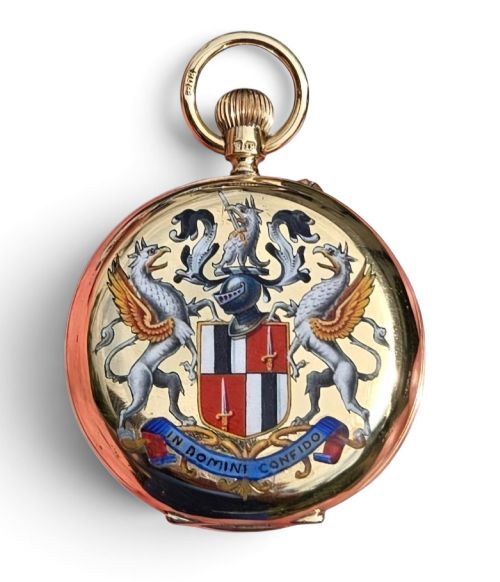
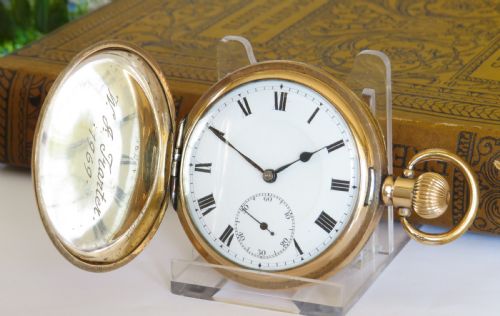


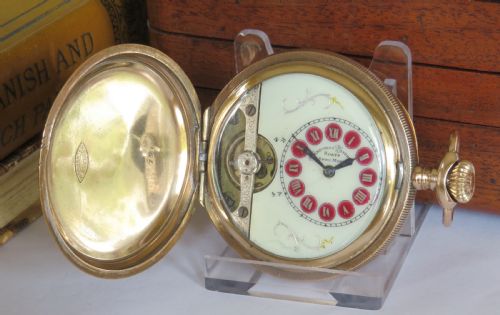


Gold Full Hunter Pocket Watch
A gold full hunter pocket watch protects its dial beneath a sprung metal lid, offering a traditional way to carry time.
Gold Full Hunter Pocket Watch
A gold full hunter pocket watch completely encloses its dial behind a protective metal cover, which springs open via a button in the crown. These timepieces span from the late nineteenth century through the art deco period of the 1930s.
The versions most commonly met on this page range from solid 18-karat and 9-karat gold cases to gold-plated and gold-filled alternatives. They emerge from both English workshops and Swiss movements, bearing signatures from makers like Waltham, Elgin, and JW Benson.
Victorian and Edwardian examples often display intricate hand engraving or engine-turned patterns across the exterior casing. Later pieces from the 1920s and 1930s lean into cleaner geometric styles associated with the turn of the century and art deco periods.
Materials and construction
Watchmakers utilised solid gold, gold-filled layers, and gold plate over base metals to construct the heavy outer cases. Vitreous enamel provides the smooth, white surface of the dial, where delicate glass protects the sweeping hands.
Internal mechanisms rely on steel components, jewelled bearings, and fusee or lever movements. Earlier nineteenth-century pieces employ fusee chains to equalise the mainspring pull, while twentieth-century examples standardise button wind and stem-set calibres.
Gold Full Hunter Pocket Watch Retail Price Guide 2026
Typical asking prices for gold full hunter pocket watch among the pieces listed under this phrase on Sellingantiques today, from the lower quarter to the upper quarter. They describe what is for sale here now, not the wider market.
Listings span from the 19th century through 1930, featuring gold plate, 9ct, 14ct, and 18ct gold materials alongside enamel dials.
Judging the work
The distinction between standard production pieces and exceptional horology lies in the complexity of the movement and the depth of the case decoration. High-tier examples house repeating complications or fusee escapements inside heavy, solid gold hallmarked housings.
Engraving and chasing determine the visual merit of the exterior case. Crisp, hand-cut floral or geometric motifs demonstrate superior craftsmanship compared to shallow, mass-produced machine stamping.
R Stewart Glasgow·Corgémont of Switzerland·J Lyndsey·J Dauer Geneve·JW Benson·Stauffer IWC·Patek Philippe·Longines
The Gold Full Hunter Pocket Watch Glossary
- Full hunter
- A pocket watch with a spring-loaded metal cover that protects the glass and dial from scratches and damage.
- Fusee
- A conical pulley mechanism used in older watches to maintain even tension on the mainspring as it winds down.
- Gold filled
- A construction method where a thick layer of gold is mechanically bonded to a base metal core for durability.
- Vitreous enamel
- A glass-like substance fused to a metal dial substrate at high temperatures to create a permanent white face.
- Repeater
- A complicated mechanism that strikes the hours and minutes on small gongs when a slide or button is activated.
Gold Full Hunter Pocket Watch: Frequently Asked Questions
How do I wind the watch?
Most twentieth-century pieces utilise a stem wind mechanism operated by turning the crown at the top. Earlier Victorian examples occasionally require a separate key inserted into the back dust cover.
Care should be taken not to overwind the mainspring, stopping immediately when resistance increases.
Are these watches waterproof?
Pocket watches from the Victorian and Edwardian eras possess no modern water resistance seals. Humidity and moisture easily infiltrate the case joints and damage the internal steel components.
Owners must keep these timepieces away from rain, water sports, and damp environments to preserve the movement.
How do I date my watch?
Dating relies on hallmarks stamped inside the gold or gold-filled case backs, alongside serial numbers engraved on the movement plates. Maker records from firms like Waltham and Elgin match these serial numbers to specific production years.
Stylistic clues such as dial typography and case engraving also help narrow the manufacturing decade.