


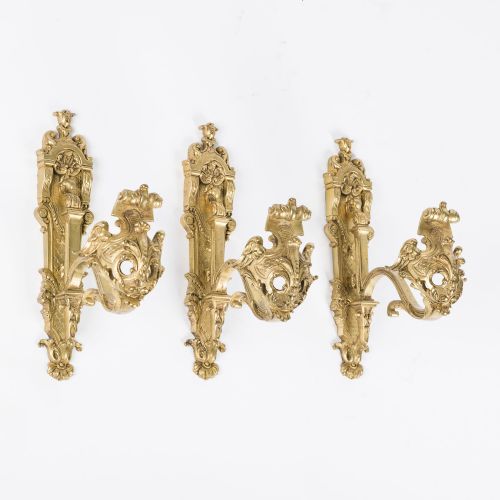


Gold Curtain Hooks
Gold curtain hooks bring ornate metalwork to drapery, offering period detail for dressing windows with French taste.
Gold Curtain Hooks
Gold curtain hooks and tie backs encompass metal drapery hardware created in European workshops from the eighteenth and nineteenth centuries. When searching for gold curtain hooks, collectors encounter hardware designed to hold heavy fabrics back from windows, predominantly featuring French stylistic influences.
The selections on this page span several distinct eras, moving from eighteenth-century examples up to late nineteenth-century productions. Pieces include pairs and sets of curtain tie backs as well as wall hooks, reflecting the varied domestic hardware needs of period interiors.
Materials and construction
These pieces are manufactured primarily from copper alloy foundations such as brass and bronze, which receive surface gilding or ormolu treatment. Enamel elements occasionally appear alongside the metalwork to add contrasting colour and detail.
Techniques rely on cast metal forming, typical of French Baroque, Rococo, and Empire revivals. The application of fire gilding or gold plating creates the characteristic bright surface sheen found across the surviving items.
Current listings feature items spanning from 1750 through the nineteenth century, utilising ormolu, brass, and enamel.
Assessing quality and craftsmanship
Quality reveals itself in the crispness of the cast ornamentation and the depth of the gilding. Finer examples display meticulous detailing in scrollwork and floral motifs, whereas simpler items show softer edges from worn moulds.
The integration of materials also dictates standard, with enamelled components requiring higher precision than plain cast brass. Weight and structural integrity further separate standard utilitarian hardware from decorative works.
The Gold Curtain Hooks Glossary
- Ormolu
- Gilded bronze produced by applying a mercury and gold amalgam to a bronze object, then heating it to drive off the mercury. This technique creates a durable, luminous golden finish characteristic of French decorative arts.
- Gilt brass
- Brass that has been coated with a thin layer of gold leaf or gold paint to simulate solid gold or ormolu. It provides a bright metallic appearance at a more accessible production cost.
- Curtain tie back
- A mechanical fixture mounted to the wall beside a window to hold fabric drapes open. They are often decorative objects styled to match the room's interior scheme.
- French Rococo Revival
- A nineteenth-century design movement mimicking the asymmetrical scrolls, shell motifs, and natural curves of the eighteenth-century French style. It dominates many of the ornamental tie backs from this period.
Gold Curtain Hooks: Frequently Asked Questions
What are gold curtain hooks?
Gold curtain hooks are decorative metal fixtures used to secure window draperies in historic interiors. They function as both structural anchors and ornamental elements.
Most examples date from the eighteenth and nineteenth centuries, often originating from French workshops employing brass, bronze, and ormolu.
How were curtain tie backs used?
Curtain tie backs were mounted directly onto window frames or walls to hold heavy fabric curtains away from the glass. This allowed more light into the room while framing the window.
Pairs were standard for dressing a single window symmetrically, though sets of three or four also appear in larger rooms.
How do I date these hooks?
Dating relies on stylistic clues such as Baroque symmetry or Rococo asymmetry, alongside manufacturing traits like cast ormolu versus stamped brass. Eighteenth-century pieces often incorporate enamel work.
Nineteenth-century revivals frequently mimic these earlier motifs, requiring careful inspection of the metal casting and wear patterns.
Are these pieces French?
Many surviving decorative curtain fixtures originate from France, reflecting popular nineteenth-century revivals of Louis XVI, Baroque, and Rococo styles. French makers produced extensive lines of gilt bronze hardware.
English and other European makers also adopted these continental fashions for grand domestic interiors.