


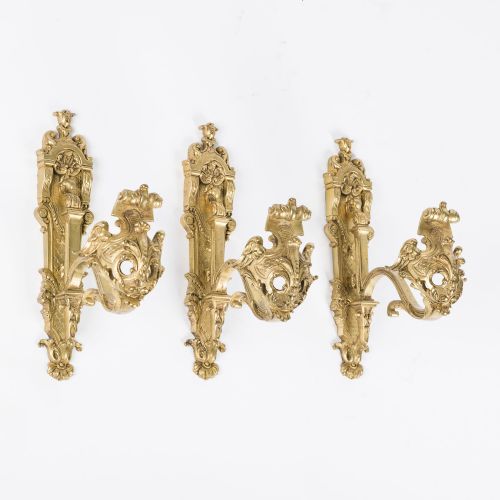


French Gilt Curtain Tiebacks
French gilt curtain tiebacks hold back heavy drapery with rich metals and classical or revival motifs.
French Gilt Curtain Tiebacks
French gilt curtain tiebacks are decorative hardware designed to hold back heavy drapery beside a window. When you search for French gilt curtain tiebacks, you meet wall hooks and curtain tie backs shaped in metal.
These items emerge most frequently from the nineteenth century, including pieces dated around eighteen eighty and the Victorian era, alongside eighteenth-century examples. Styles span French Rococo Revival, Louis XVI, French Empire Revival, and Gothic Revival.
The forms function primarily as wall-mounted hooks to secure fabric in grand interiors. Pairs and sets of four appear among the listings alongside individual hooks.
How they were made
Maker utilise metals such as ormolu, gilt bronze, gilded bronze, gilt brass, gilt metal, copper, and brass. Enamel also appears as a decorative element on eighteenth-century examples.
The fabrication relies on metal casting and gilding techniques to achieve a bright golden surface finish. Master founders shaped bronze, brass, and copper into intricate scrolls, dragons, and classical motifs.
Listings feature materials including ormolu, gilt bronze, brass, gilded bronze, enamel, gilt metal, copper, and gilt brass.
What varies in quality
The refinement of the casting and the depth of the chased detail separate ordinary hardware from exceptional work. Crispness in the foliage, scrolls, or figural elements demonstrates superior craftsmanship by the founder.
The quality of the gilding itself dictates visual richness, with fire-gilded ormolu showing a deep, warm lustre compared to thinner applied finishes. The choice of base metal, moving from basic brass to heavy gilt bronze, alters the substantial feel of the object.
Henri Picard
The French Gilt Curtain Tiebacks Glossary
- Ormolu
- Gilded bronze produced by applying a mercury and gold amalgam to a bronze base and heating it. This historic technique creates a durable, luminous golden surface.
- Gilt brass
- Brass that has been coated with a thin layer of gold or a gold-coloured finish. It provides a bright metallic appearance with a lighter weight than bronze.
- Rococo Revival
- A nineteenth-century design movement imitating the ornate, asymmetric scrolls and natural motifs of the eighteenth-century French Rococo style. This aesthetic dominates many curtain tiebacks.
- Gothic Revival
- An architectural and decorative style drawing inspiration from medieval forms, pointed arches, and fantastical creatures such as dragons. It offers a striking contrast to classical French designs.
- Tie back
- A device fixed to a wall beside a window to gather and hold fabric curtains open. They range from simple brass hooks to elaborate gilded sculptures.
French Gilt Curtain Tiebacks: Frequently Asked Questions
How do I mount French gilt curtain tiebacks?
These hardware pieces fix directly into the wall beside a window frame using appropriate screws through the backplate or stem. Ensure the fixing can support both the weight of the metal hook and the pull of the fabric.
Position the tieback at a height that gathers the curtain gracefully, typically one-third to halfway down the drop of the window dressing.
What styles do French gilt curtain tiebacks come in?
The selection includes French Rococo, Louis XVI, French Empire Revival, and Gothic Revival designs. Motifs range from asymmetric floral scrolls to mythical dragons and classical ornaments.
Eighteenth-century examples often feature enamel work, while nineteenth-century pieces lean towards heavier ormolu casting.
Are these tiebacks sold in pairs?
Many listings offer matching pairs or sets of four to accommodate standard windows requiring one tieback on each side. Single hooks also appear occasionally.
Checking the description helps confirm whether you are purchasing a single wall hook or a matched set for a pair of curtains.
How do I clean gilt bronze hardware?
Dust the surface gently with a soft, dry cloth to prevent the accumulation of dirt within the chased crevices. Avoid abrasive cleaners or harsh chemical polishes that can strip away the historic gilt layer.
Professional care is recommended if deeper cleaning is required to preserve the original ormolu or gilt brass finish.