

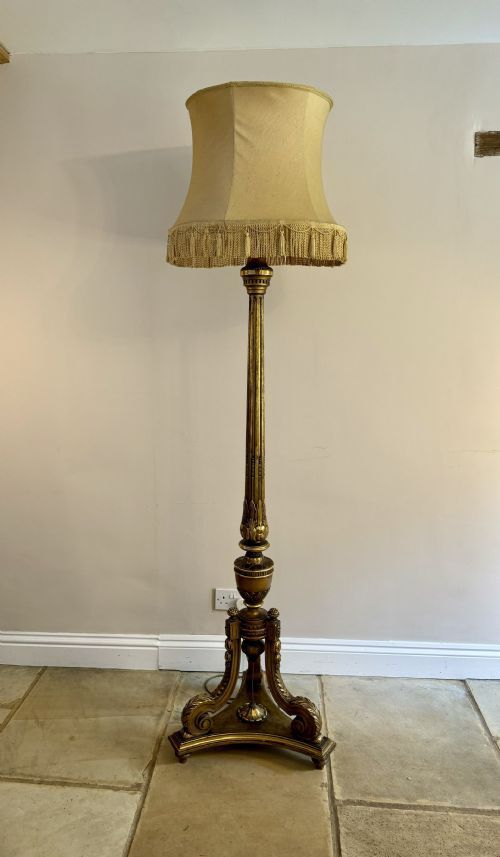
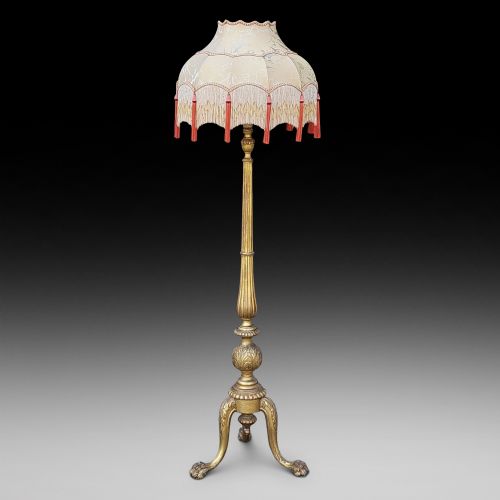
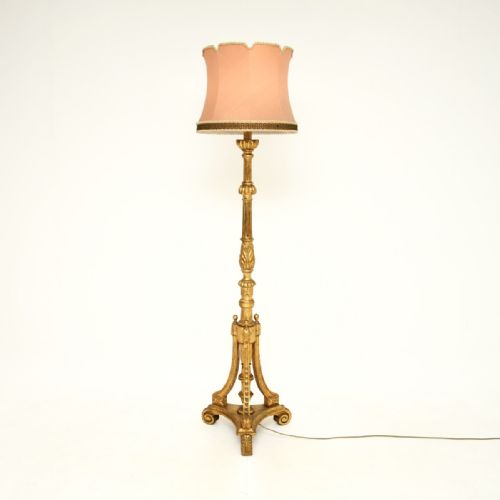


Gold Carved Floor Lamp
These gold carved floor lamp pieces bring period warmth and height to a room, channelling historic European design through carved wood and gilt surfaces.
Gold Carved Floor Lamp
A gold carved floor lamp is a tall standing light fixture designed to illuminate a corner or reading space while adding a decorative vertical element to an interior. When searching for a gold carved floor lamp, buyers encounter pieces spanning from the mid nineteenth century through the early twentieth century, reflecting various European aesthetic movements.
The selection here encompasses forms referred to as floor lamps or standard lamps, drawing heavily on Italian Baroque, Venetian, French Chateau, and Neoclassical Revival styles. These tall fittings range from ornate figures on stands with original polychrome paint to classical giltwood columns echoing the Adam manner.
Origin and period heavily dictate the character of each piece, moving from Victorian interpretations down to nineteen thirties vintage examples. Buyers frequently meet Italian Florentine craftsmanship alongside French boudoir designs, each bringing a distinct sculptural presence to the domestic interior.
Materials and construction methods
Makers utilised carved wood and gesso as the foundational base for these fixtures, applying gold leaf, parcel gilt, or giltwood finishes to achieve a luminous surface. Bronze also appears in specific Edwardian variants, adding metallic weight to the construction.
Decorative surfaces often incorporate polychrome paint alongside the primary gilding, particularly on Venetian figural works that rely on hand-applied pigments over gesso. Fabric elements complete the upper assembly where shades are fitted.
Gold Carved Floor Lamp Retail Price Guide 2026
Typical asking prices for gold carved floor lamp among the pieces listed under this phrase on Sellingantiques today, from the lower quarter to the upper quarter. They describe what is for sale here now, not the wider market.
Periods represented span from the nineteenth century through the nineteen thirties, encompassing Venetian and French influences.
Distinguishing quality in carved lighting
Quality rests in the crispness of the wood carving and the depth of the gilding, where hand-applied gold leaf or gesso displays superior handling compared to flat paint. The integrity of the underlying carved wood structure determines how well the tall shaft maintains its stability over decades.
Surface preservation defines the upper tier of pieces, particularly where original polychrome paint or delicate parcel gilt details remain intact without excessive restoration. Finer examples show intentional proportions and harmonious detailing that reflect their specific stylistic period, whether Neoclassical or Italian Baroque.
The Gold Carved Floor Lamp Glossary
- Giltwood
- Wood that has been coated with gold leaf or gold paint over a prepared surface. This finish gives the lamp body a rich, metallic sheen.
- Gesso
- A plaster mixture applied to wood as a base for carving and gilding. It allows for crisp, detailed ornamentation before gold leaf is laid down.
- Polychrome
- The practice of decorating architectural elements or sculpture in a variety of colours. It is seen on figural lamp bases from Venetian workshops.
- Neoclassical
- A style reviving classical Roman and Greek forms, prominent in standard lamps through symmetrical columns and restrained ornamentation.
- Parcel Gilt
- A surface treatment where only specific portions of an object are gilded while other areas show painted or natural wood.
Gold Carved Floor Lamp: Frequently Asked Questions
How do I date a gold carved floor lamp?
Dating relies on the combination of stylistic cues, material preparation, and construction methods visible in the timber and gesso. Pieces span from the mid nineteenth century through the nineteen thirties, with revival styles often echoing earlier Baroque or Neoclassical periods.
Examining the wear patterns on the gold leaf and the underlying wood helps confirm the age of the piece. Workshops of different eras employed distinct carving depths and finishing techniques.
What is the difference between giltwood and gold painted?
Giltwood involves the application of actual gold leaf over a prepared gesso and bole layer on carved timber. This technique produces a warm, reflective surface that patinates gently over time.
Gold painted surfaces utilise liquid metallic pigments applied directly to the wood. This finish generally appears flatter and lacks the dimensional quality of traditional leafing.
How do I care for antique gilt surfaces?
Dust giltwood and carved surfaces gently with a soft, dry cloth to prevent accumulation. Avoid liquid cleaners and modern polishes, which can strip delicate gold leaf or damage underlying gesso.
Keep these lamps away from direct heat sources and strong sunlight to protect the finish and the timber core. Gentle handling preserves the original patination of the piece.