

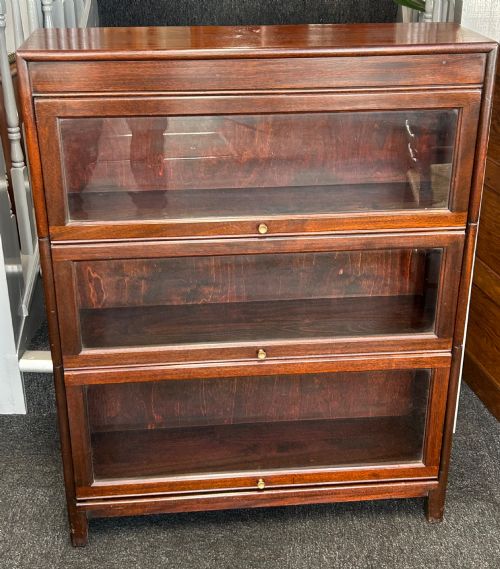
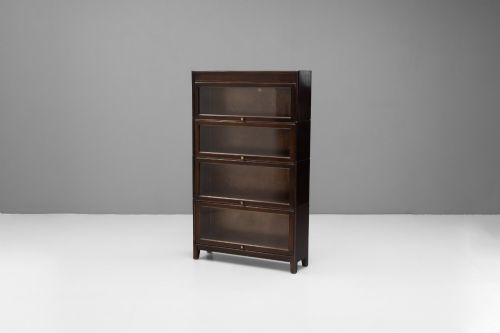
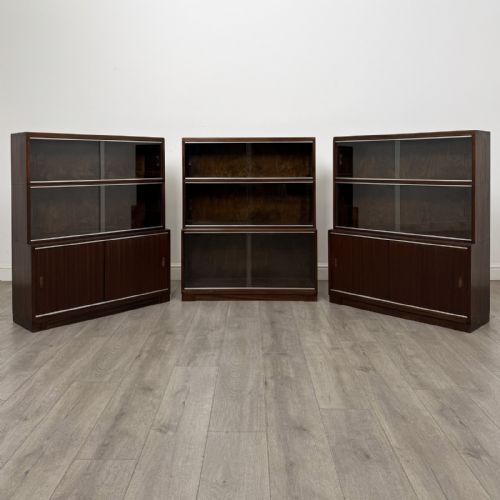
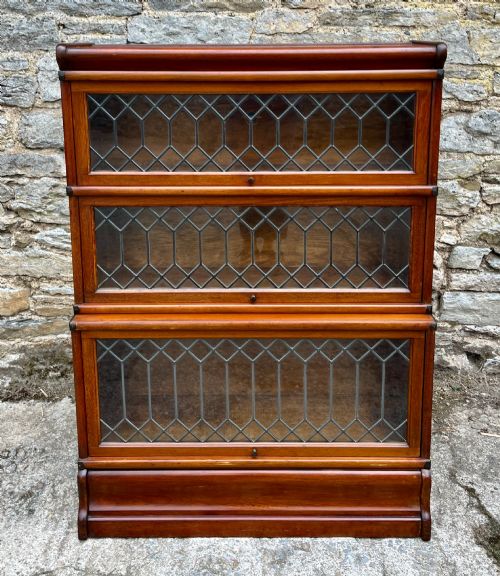
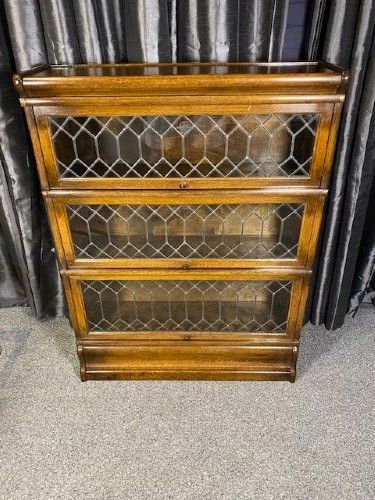
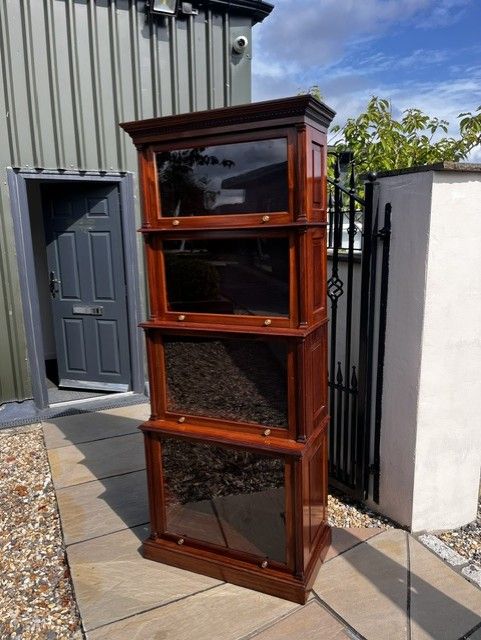
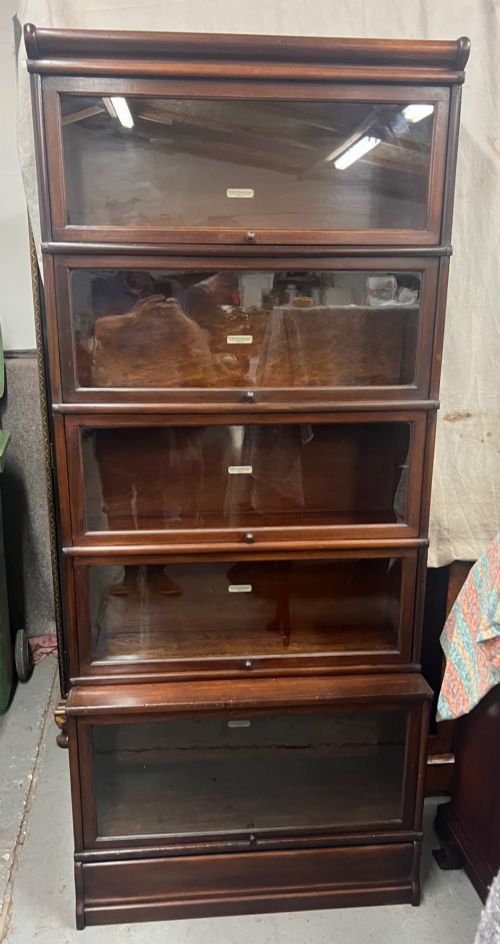


Glazed Mahogany Stacking Bookcase
These glazed mahogany stacking bookcase options offer modular storage with lift-and-slide glass doors, suiting collectors who need flexible display space.
Glazed Mahogany Stacking Bookcase
A glazed mahogany stacking bookcase comprises multiple modular sections that stack vertically to form a unified cabinet. The form appears most frequently in Edwardian and 1920s pieces, alongside 1900, 1910, and 1930 examples.
Makers construct these modular units from solid mahogany or mahogany veneers, fitted with glass panels or leaded glass. Individual tiers allow owners to rearrange or expand the shelving capacity as collections grow.
The objects serve primarily to protect volumes from dust while providing clear visibility through glazed fronts. Buyers encounter configurations ranging from three-tier to five-tier setups.
How they were made
Cabinet makers utilise solid mahogany and timber framing to build individual tiers, incorporating brass and metal hardware for structural joints. Woodwork techniques prioritise precise joinery so that separate sections align securely when stacked.
Glazing methods involve fitted glass or leaded glass panels set into wooden frames. Doors often feature up and over mechanisms that slide smoothly into the upper recess of each tier.
Glazed Mahogany Stacking Bookcase Retail Price Guide 2026
Typical asking prices for glazed mahogany stacking bookcase among the pieces listed under this phrase on Sellingantiques today, from the lower quarter to the upper quarter. They describe what is for sale here now, not the wider market.
Early travelling lawyers appreciated stacking bookcases because their law libraries could travel intact inside a wagon without tumbling out.
What varies in quality
The choice of timber underpins the integrity of the piece, with solid mahogany sections achieving greater permanence than veneered alternatives. Finer examples display consistent grain patterns across all stacked tiers.
The mechanical action of the glass doors dictates daily utility. Smooth sliding hardware and well-fitted brass components separate standard commercial output from superior workshop production.
Gunn Furniture·Macey·Globe Wernicke·Heal's·AMYL
The Glazed Mahogany Stacking Bookcase Glossary
- Sectional
- A cabinet built from separate, removable tiers that stack vertically. This design allows the entire unit to be disassembled for transport.
- Up and over
- A door mechanism where the glass panel lifts and slides horizontally into the recess above the shelf. This system is typical of barrister bookcases.
- Leaded glass
- Small panes of glass joined together by lead cames within the door frame. It adds decorative subdivision to the viewing area.
- Tier
- An individual stackable box or section containing a shelf and a glass door. Multiple tiers combine to form the complete bookcase.
Glazed Mahogany Stacking Bookcase: Frequently Asked Questions
How do sectional bookcases work?
Each tier operates as an independent wooden box with its own glass door and base. Sections simply rest on top of one another without permanent fixings.
This modular construction allows owners to add or remove shelves easily. The complete stack stays stable through precise weight distribution and interlocking mouldings.
What is a barrister bookcase?
A barrister bookcase is a specific type of stacking cabinet designed with glass doors that lift and slide inside the case. Lawyers originally used them to transport law books safely between courts.
The enclosed glass protects valuable volumes from dust and dampness. Individual tiers kept books organised during transit.
Can stacking bookcases be separated?
Yes, individual tiers lift apart completely once the top cornice and base plinth are removed. Each section functions as a standalone box.
This separation makes moving heavy furniture up stairs manageable. Owners can reconfigure the height by taking away or adding tiers.
How do I date a mahogany bookcase?
Dating relies on stylistic clues, hardware materials, and maker marks stamped on the timber or brass fittings. Edwardian and 1920s examples often feature specific patented door mechanisms.
Construction methods and timber selection also indicate the era of production. Art Deco pieces from the 1930s display distinct geometric framing.