


Glazed Earthenware Dog Statue
These glazed earthenware dog statue examples bring character to a mantelpiece, ranging from Victorian spaniels to Japanese temple lions.
Glazed Earthenware Dog Statue
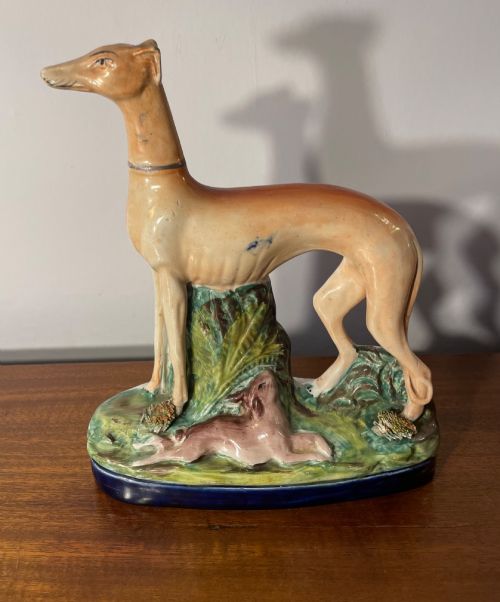
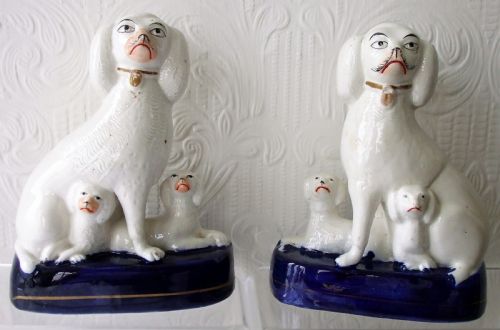
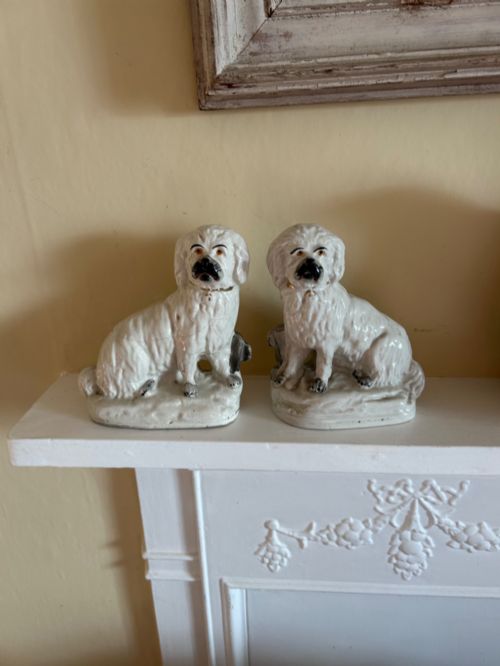
A glazed earthenware dog statue represents a tradition of ceramic animal figures spanning the nineteenth and early twentieth centuries, encompassing British pottery alongside Asian ceramic models. Buyers seeking a glazed earthenware dog statue will most frequently encounter pairs of Victorian Staffordshire spaniels, poodles, greyhounds, and pugs modelled with hand-painted details.
The selection extends from early nineteenth-century hound and hare groups to Edwardian figures and Japanese Meiji or Qing dynasty Buddhist lions. These ornamental pottery figures served as decorative mantel ornaments or functional desk accessories such as quill holders.
Materials and construction
These figures rely on earthenware pottery bodies shaped by moulding or hand-modelling before receiving lead glazes, enamels, and occasionally gold leaf or gilt highlights. The firing process sets the porous clay base beneath vitreous surface coatings that provide the characteristic sheen.
Listings feature earthenware and ceramic pieces spanning the Georgian, Victorian, and Edwardian eras, alongside Japanese Meiji and Qing dynasty items.
Assessing quality in ceramic figures
Quality rests upon the crispness of the moulding and the skill of the hand-painted brushwork defining the animal's expression and coat. Firings that yield clean glaze surfaces without heavy pooling distinguish finer studio and factory output.
Matched pairs display greater symmetry in modelling and decoration than assembled groups. The precision of facial detailing and the application of enamel colours and gilt determine the standing of individual pieces within the range.
Wedgwood and Co Ltd·Beswick
The Glazed Earthenware Dog Statue Glossary
- Earthenware
- Porous pottery fired at lower temperatures than stoneware or porcelain, requiring a glaze to achieve impermeability. It forms the core material for the majority of nineteenth-century Staffordshire animal figures.
- Lead glaze
- A glossy coating containing lead oxide applied to pottery before firing to produce a smooth, reflective finish. This technique seals the porous earthenware body.
- Enamel
- Opaque glass-like pigments applied over the fired glaze and subjected to a lower temperature fix. It provides the bright surface colours seen on coats and collars.
- Gilt
- A thin layer of gold or gold-coloured material applied to surface details for adornment. It highlights collars, lockets, and base lines on Victorian figures.
- Staffordshire pottery
- Ceramic wares produced in the English county of Staffordshire, renowned for domestic figures and utilitarian vessels. This region manufactured the bulk of the British dog models found in this category.
Glazed Earthenware Dog Statue: Frequently Asked Questions
What are Staffordshire dogs?
Staffordshire dogs are ceramic figures of spaniels, poodles, and other breeds produced by potteries in the English Midlands during the nineteenth century. They were typically modelled in pairs to flank fireplace mantels.
These earthenware sculptures feature hand-painted markings and gilt highlights, reflecting the popular domestic pets of the Victorian era.
How do I date a ceramic dog figure?
Dating relies on stylistic markers, clay characteristics, and glaze types, comparing pieces to documented examples from the Georgian, Victorian, and Edwardian periods. Earlier figures often show heavier potting and simpler enamel palettes.
Later Victorian and Edwardian pieces incorporate refined moulding techniques and brighter transfer-printed or hand-painted details.
How do I care for glazed earthenware?
Glazed earthenware requires gentle dusting with a dry, soft cloth to prevent the accumulation of dirt on the ceramic surface. Avoid using water or chemical cleaners, which can penetrate hairline crazing in the glaze.
Keep the figures away from direct sunlight and areas subject to sudden temperature fluctuations.