

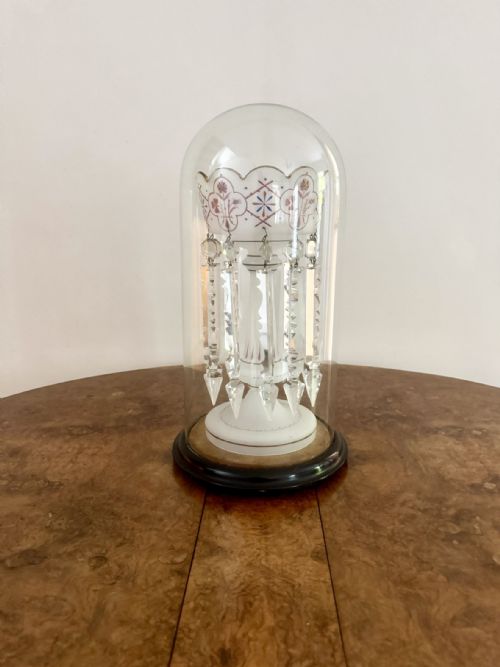


Glass Prism Vase
These glass prism vase examples are Victorian mantel lustres and table lustres that bring brilliant refraction and colour to a room.
Glass Prism Vase
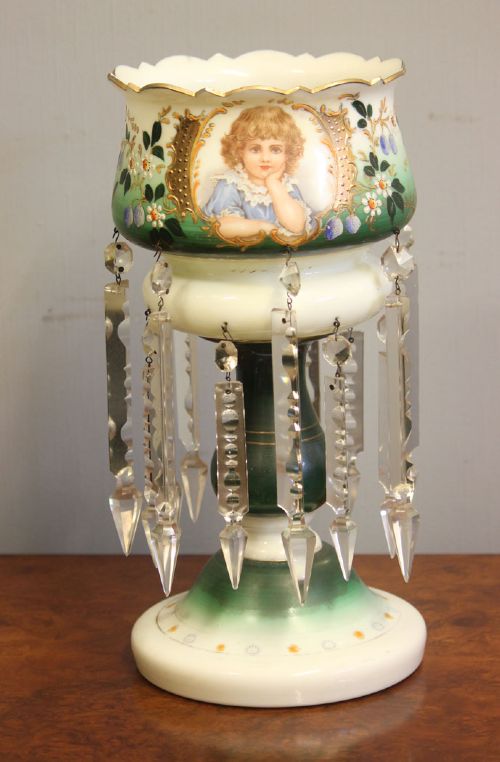
When you search for a glass prism vase, you are looking at mantel lustres and table lustres dating from the nineteenth century. These decorative vessels serve as centrepieces on mantelpieces and tables, designed with hanging pendants that catch and reflect candlelight or daylight.
The versions you are most likely to meet on this page come from the Victorian period, spanning the late nineteenth century from eighteen sixty to nineteen hundred. They appear as single pieces or balanced pairs, often formed with a central trumpet or flared vase shape supported by a stepped foot.
Origin and regional style vary across the selection, featuring English, French, and Bohemian pieces. English and Bohemian makers excel in coloured glass production, while French workshops provide opaline variants that dominate the table lustre category.
Materials and production methods
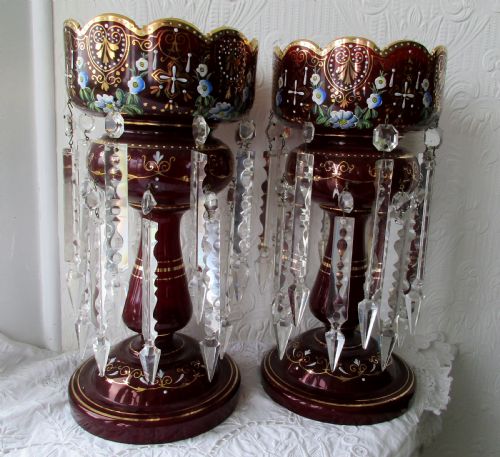
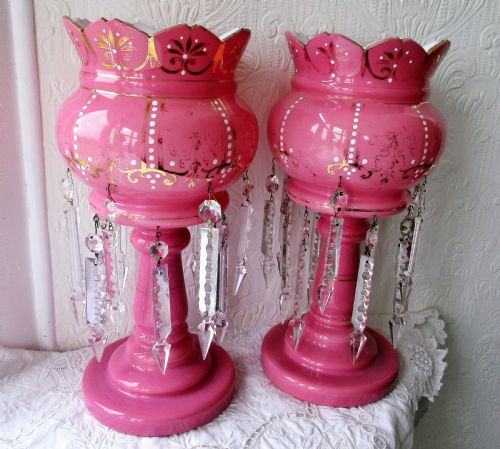
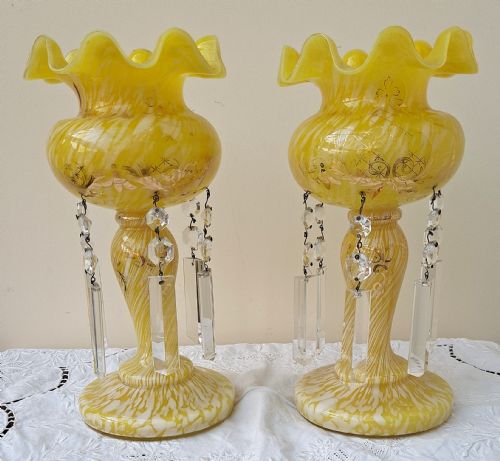
Production relies heavily on heavy lead crystal and coloured glass, including ruby glass, cranberry glass, green glass, pink glass, and yellow glass. Artisans shape these materials through hot glass blowing and moulding techniques before applying enamel or gold leaf details.
The characteristic prisms are cut from crystal glass to maximise light refraction and suspended from the rim using brass pins or wire loops. Overlay glass and flash glass techniques involve layering different coloured glass bodies before cutting back the top layer to reveal contrasting hues beneath.
A Victorian mantle lustre jingles softly whenever footsteps cross the floor, reminding everyone that glass can sing.
Factors that define quality
Quality depends on the depth and saturation of the coloured glass body, alongside the crispness of the hand-cut facets on both the vase and the hanging prisms. Lustres with rich ruby, cranberry, or overlay glass show superior thermal control and pigment dispersion during manufacture.
The presence and preservation of original hand-painted enamel decoration and gold leaf gilding elevate the piece. The completeness and matching nature of the prism set also determine the integrity of the object, as replacement prisms alter the visual balance.
The Glass Prism Vase Glossary
- Lustre
- A decorative glass vase fitted with hanging crystal prisms designed to catch and refract light. These pieces originate primarily from the nineteenth century and sit upon mantelpieces or tables.
- Prism
- A cut crystal pendant suspended from the rim of a lustre to refract light. They are traditionally attached via small metal loops fitted into drilled holes.
- Overlay glass
- A glass-making technique where a layer of coloured glass is fused over a clear or contrasting base layer. Artisans cut through the top layer to create intricate patterns.
- Flash glass
- A thin layer of coloured glass applied over a clear or different coloured glass body during the blowing process. This method allows deep colour saturation without excessive weight.
- Opaline glass
- An opaque or translucent pale glass developed in France during the nineteenth century. It provides a milky surface finish frequently utilised for table lustres.
Glass Prism Vase: Frequently Asked Questions
What is a glass prism vase?
A glass prism vase is a nineteenth-century mantel or table lustre featuring a central glass body hung with cut crystal pendants. They were placed on mantelpieces to catch and multiply candlelight.
Today they function as decorative centrepieces that add rich colour and historical character to a room.
How do I date a lustre?
Dating relies on examining the manufacturing traits, glass colours, and cutting styles recorded in Victorian production. Nineteenth-century pieces often exhibit hand-cut facets and polished pontil marks on the base.
Earlier examples from eighteen sixty to eighteen eighty tend to feature deep ruby or cranberry hues with dense enamel and gilding.
Were these made in pairs?
Many nineteenth-century lustres were produced and sold as balanced pairs to flank clocks or candelabra on mantelpieces. Single examples also appear frequently across the listings.
Pairs maintain higher symmetry for formal display spaces.
How should I clean my lustre?
Cleaning requires gentle washing of the glass body and individual prisms using lukewarm water and mild soap. Prisms should be removed carefully before cleaning to prevent chipping against the main body.
Allow all components to dry completely before reattaching the crystal pendants.
Where were these pieces made?
The listings show production originating from English, French, and Bohemian workshops during the Victorian era. Each region developed distinct colour palettes and decorative styles.
Bohemian makers are particularly known for overlay glass techniques, while French makers produced opaline variants.