


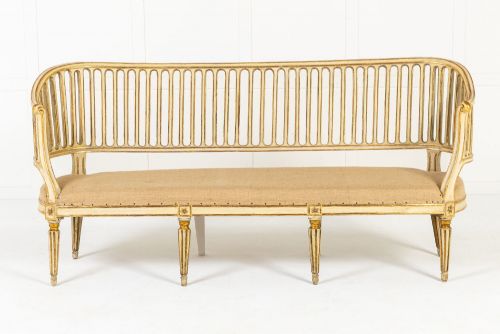

Giltwood Upholstered Settee
A giltwood upholstered settee brings grand French and English seating styles into a room, offering gilded timber frames and soft textile seats.
Giltwood Upholstered Settee
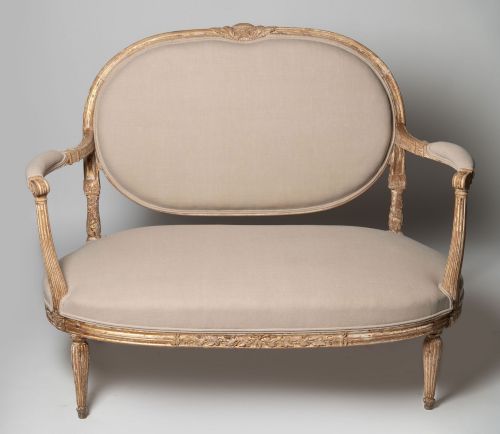
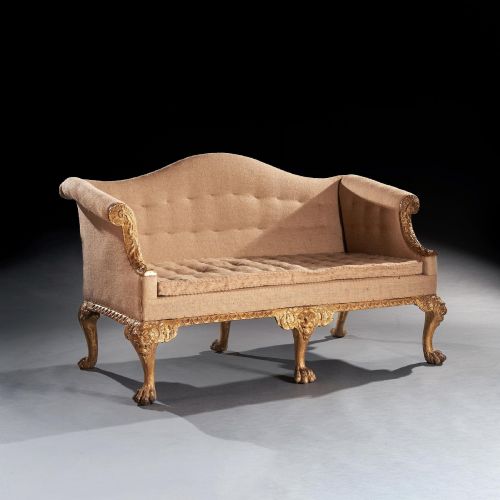
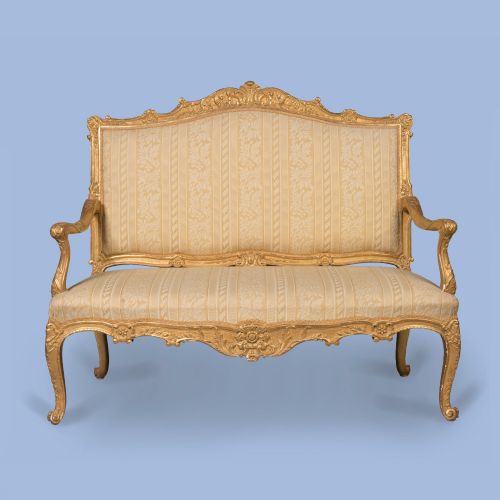
A giltwood upholstered settee is a formal two or three-seat sofa characterised by a carved wooden frame finished with gold leaf or paint. These seating pieces appear in various historical iterations, ranging from eighteenth-century George II designs to nineteenth-century French Louis XV and Louis XVI styles.
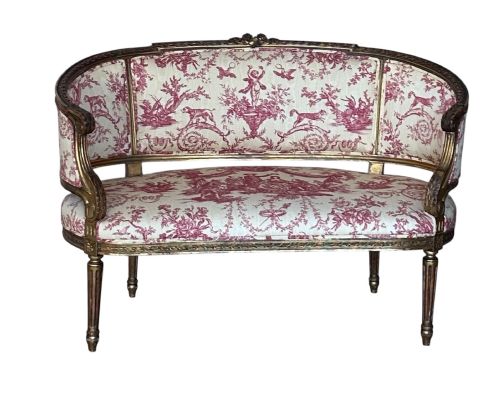
Most examples found here date from the nineteenth century or the early twentieth century, reflecting revival tastes in France, England, Italy, and Sweden. Forms span from substantial salon canapés to smaller boudoir love seats, window seats, and matching pieces from larger salon suites.
The aesthetic leans heavily on continental European design vocabulary, including rococo curves, neoclassical symmetry, and painted polychrome finishes. Buyers select these settees to anchor formal reception rooms or to introduce a classical architectural presence into domestic interiors.
How they were made
Makers shaped the structural frames from timber such as beech or general hardwoods, carving intricate decorative details directly into the wood before applying surface finishes. Gilding involved the application of fine gold leaf over a prepared base, while alternative examples received cream or polychrome painted treatments.
Upholstery techniques relied on traditional stuffing methods contained within textiles like silk, linen, and velvet. Brass elements and structural joints secured the frames, while carved motifs such as lion mask hairy paw feet appeared on specific English eighteenth-century commissions.
Listings feature eighteenth, nineteenth, and early twentieth-century pieces, spanning English, French, Italian, and Swedish stylistic revivals.
What varies in quality
The refinement of the wood carving dictates the initial visual merit of the piece, separating hand-chiseled depth from mechanical or softer shaping. Crisp leaf scrolls, well-defined structural members, and balanced proportions reveal the confidence of the original workshop.
The integrity of the gilt surface and the preservation of the underlying timber ground also determine overall character. Pieces retaining their original gilded finish without heavy overpainting demonstrate superior historical survival compared to those subjected to repeated modern refinishing.
Giles Grendey
The Giltwood Upholstered Settee Glossary
- Giltwood
- Timber decorated with gold leaf or gold powder applied over a prepared gesso and bole ground. It provides the signature metallic sheen seen on formal continental and English seating.
- Canapé
- A French term for an upholstered sofa or settee, typically featuring an exposed carved wooden frame. These forms often align with specific royal design periods such as Louis XV or Louis XVI.
- Neoclassical
- A style rooted in the revival of classical Roman and Greek art, emphasising straight lines, symmetry, and restrained ornamentation. It frequently shapes late eighteenth and nineteenth-century furniture.
- Polychrome
- Painted in several colours, often applied to wood surfaces to imitate more costly materials or to achieve a specific decorative palette. This technique appears on Italian and continental European seating.
- Salon Suite
- A matched set of seating furniture, which can include settees, canapés, and armchairs designed for formal reception rooms. They share identical frames, textiles, and decorative finishes.
Giltwood Upholstered Settee: Frequently Asked Questions
Where should I place a giltwood upholstered settee?
These settees suit formal reception spaces, drawing rooms, or large hallways where their decorative frames can be viewed from multiple angles. They function well as statement seating against plain walls or paired with complementary antique armchairs.
Avoid positioning antique gilded frames in direct, intense sunlight to protect both the delicate metallic leaf and the vintage textile upholstery from fading over time.
Can I reupholster a vintage settee?
Many antique settees have undergone reupholstery during their long lifespans to suit changing interior tastes. Choosing new fabric that respects the period style of the frame ensures the piece retains its historical visual harmony.
Consult a skilled upholsterer experienced in traditional stuffing methods to preserve the integrity of the internal frame and webbing during the process.
How do I distinguish Louis XV from Louis XVI styles?
Louis XV furniture is defined by asymmetrical curves, cartouche-shaped backs, and flowing cabriole legs inspired by rococo forms. The overall aesthetic feels organic, fluid, and curved.
Louis XVI design marks a return to straight lines, geometric symmetry, fluted columns, and oval or rectangular backs reflecting neoclassical ideals.
Are these settees comfortable for daily use?
These seating pieces were constructed primarily for formal entertaining rather than relaxed lounging. The upright backs and firm traditional upholstery encourage an upright, formal posture.
If utilised in daily living areas, adding supportive scatter cushions can increase comfort without altering the historic character of the furniture.