
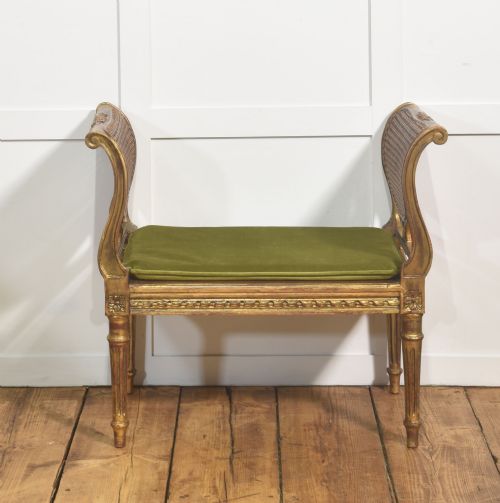
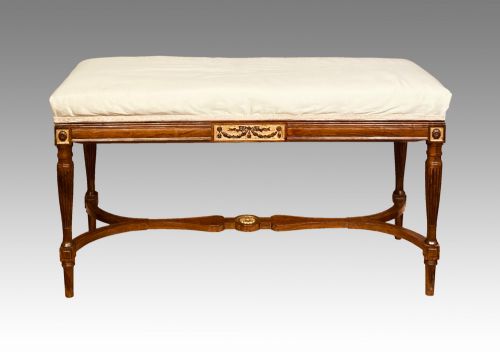


Gilt Wood Window Seat
These gilt wood window seat examples bring French and Italian neoclassical elegance to a room, offering both formal seating and classic decorative presence.
Gilt Wood Window Seat
A gilt wood window seat combines a long, low seating form with gilded wooden frames, often drawing on French and Italian design traditions. These long stools and benches appear in forms ranging from simple rectangular frames to X-shaped curule structures and oval shapes.
The pieces on this page span the nineteenth century and the early twentieth century, taking inspiration from Regency, Louis XVI, and Neoclassical styles. They function primarily as decorative benches positioned beneath windows or at the foot of beds.
How they were made
Craftsmen shaped these frames from woods such as rosewood or painted timber, applying a thin layer of gold leaf or gesso to achieve the characteristic gilded surface. Carved wooden details often define the neoclassical and rococo revival motifs seen across the frames.
Upholstery techniques vary across the selection, utilising velvet, various textiles, and woven cane panels inset into the wooden seats. These materials support the frame structures while providing the traditional seating surface.
Styles recorded across the listings range from Regency and Italian Rococo to French Neoclassical and Louis XVI Revival.
What varies in quality
The crispness of the carved ornamentation on the wooden frame separates standard examples from finer works, particularly where gesso and gold leaf meet the carved surface. Deeper hand-carving in styles like Italian Rococo or French Neoclassical indicates greater artisan involvement.
The integrity of the underlying structure, whether cane panels or upholstered textile surfaces, determines the overall durability of the piece. Surviving examples with original gilding and intact cane retain a higher degree of historical authenticity.
Charles Nosotti
The Gilt Wood Window Seat Glossary
- Giltwood
- Wood covered with a thin layer of gold leaf or powder. This finish provides the bright, reflective surface characteristic of these decorative seats.
- Curule
- An X-shaped stool design derived from ancient Roman magistrate seats. These frames often feature scrolled legs meeting in a central X formation.
- Neoclassical
- A style drawing on classical antiquity featuring symmetrical forms and restrained ornamentation. It dominates many nineteenth-century Italian and French seating designs.
- Cane
- Woven rattan material used to form light, porous seat panels. It appears frequently in combination with giltwood frames.
- Gesso
- A plaster-like mixture applied to wood surfaces to prepare them for gilding. It allows for sharp, detailed carving beneath the gold leaf.
Gilt Wood Window Seat: Frequently Asked Questions
Where should I place a gilt wood window seat?
These pieces suit positions beneath large windows, in hallways, or placed at the foot of a bed. Their low profile ensures they do not block natural light.
They serve as accent seating rather than primary lounge chairs, functioning well in traditional drawing rooms and bedrooms.
How do I identify French styles on these seats?
French styles like Louis XVI appear through straight tapered legs, carved fluting, and symmetrical neoclassical motifs. The woodwork often exhibits crisp, refined proportions.
Italian variants tend to display more exuberant rococo carving or distinct curule frame structures.
What materials are used for the seats?
Seating surfaces consist of woven cane, velvet, plain textiles, or traditional upholstery over wooden frames. Giltwood and painted wood form the primary structural materials.
Some examples incorporate rosewood within the frame construction alongside the gilded finish.
How do 19th-century and 20th-century pieces differ?
Nineteenth-century examples often draw directly on Regency and neoclassical traditions with heavy hand-carved detailing. Early twentieth-century pieces frequently adopt revival styles inspired by earlier French periods.
Both eras utilise traditional gilding and joinery techniques suited to decorative interior use.