

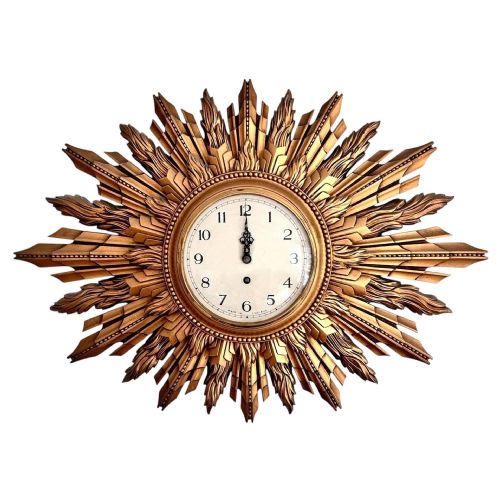

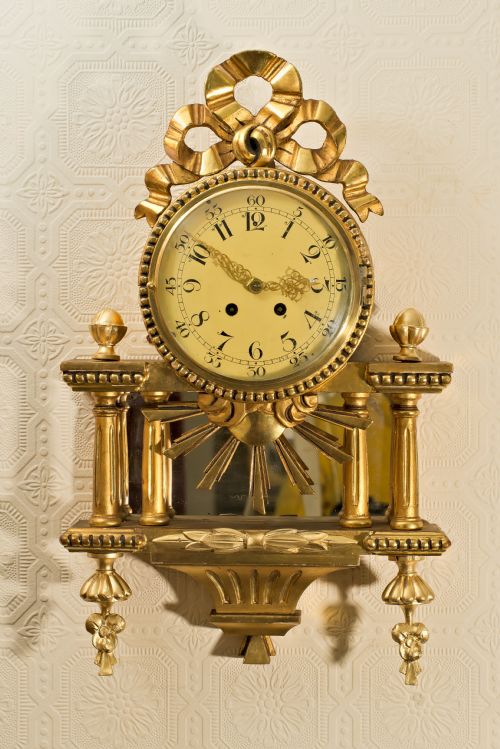


Gilt Wood Wall Clock
A gilt wood wall clock brings warmth and reflected light to a room, ranging from grand French cartel designs to lively starbursts.
Gilt Wood Wall Clock
When you search for a gilt wood wall clock, you enter a field spanning the eighteenth, nineteenth, and twentieth centuries, featuring distinct regional styles. These pieces combine timekeeping with decorative woodwork, finished in gold leaf or gilt metal over materials such as oak and carved timber.
The selection on this page demonstrates remarkable variety, from early Georgian and Swiss bracket clocks to French Neo-Classical cartel models and mid-century sunbursts. You are most likely to encounter starburst forms from the twentieth century alongside classic eighteenth-century carved giltwood wall clock examples.
Regional pieces add considerable character to the category, including Dutch Frisian stoelklok designs, Staart clocks, and Scandinavian Rococo interpretations. Each period brings its own aesthetic, uniting functional timepieces with sculptural gilt frames.
How they were made
Maker workshops shaped timber bodies from oak or softer woods before applying layers of gesso to create a smooth surface for gilding. Craftsmen then laid gold leaf or used gilt metal finishes to catch the light, often pairing these frames with brass movements and enamel dials.
Carved details define the best examples, requiring skilled handwork for motifs ranging from swirling Rococo foliage to geometric Art Deco rays. Glass protects the face while brass and ormolu mounts provide structural contrast to the gilded wood.
Listings feature movements ranging from eighteenth-century automaton mechanisms to twentieth-century eight-day Swiss calibres.
What varies in quality
The depth and crispness of the wood carving dictate the visual impact of a piece, separating heavy, dull mouldings from sharply defined hand-carved ray or scrollwork. Original surfaces retain a warmer, softer gold patina compared to later, flat re-gilding.
The integrity of the movement, whether an eight-day Swiss mechanism or an early English chain-driven system, matches the standard of the exterior case. Maker signatures on dials or backplates elevate the historical importance of the clock.
Smiths·Wetterstrands·Perivale of England·Henri Dasson
The Gilt Wood Wall Clock Glossary
- Cartel clock
- A wall clock housed in an ornate frame, typically made of giltwood or metal, developed in France during the Baroque and Rococo periods. These pieces hang directly on the wall without a supporting bracket.
- Sunburst clock
- A design featuring rays extending outward from a central circular dial, popularised during the Art Deco era and mid-twentieth century. They are frequently carved from wood and finished in gilt.
- Stoelklok
- A traditional Dutch wall clock featuring a characteristic chair-like wooden bracket and painted wooden dial backplates. They often include lead figures or cast brass ornaments.
- Ormolu
- Finely ground high-carat gold mercury-gilded onto a bronze base, utilised for mounts and decorative accents on nineteenth-century pieces. The finish produces a rich, warm metallic lustre.
- Automaton
- A mechanical feature incorporated into clock faces that moves in time with the mechanism, seen in eighteenth-century picture clocks. These depict animated scenes such as rolling water or figures.
Gilt Wood Wall Clock: Frequently Asked Questions
How do I hang a heavy giltwood clock?
These clocks require secure wall anchors suited to their substantial timber and metal weight, preferably fixed directly into masonry or wall studs.
Ensure the mounting bracket or suspension loop is fully rated for the total weight of the case and movement before hanging.
Are starburst clocks mid-century or older?
Star and sunburst wall clocks appear across both the early twentieth century and the 1950s, evolving from earlier French cartel traditions.
Art Deco examples often display geometric ray formations, while later pieces adopt bolder, more abstracted atomic silhouettes.
How should I clean a gilded wood frame?
Dust giltwood gently with a very soft, dry brush to prevent damage to the delicate gold leaf layer. Avoid all liquid cleaners and chemical solvents, which strip the historic finish from the carved timber beneath.
What is the difference between a cartel and a bracket clock?
A cartel clock attaches directly to the wall via its own integrated frame, whereas a bracket clock traditionally sits upon a separate wall shelf.
Cartel designs lean towards French decorative symmetry, while bracket clocks often reflect English or Dutch domestic timekeeping traditions.