


French Sunburst Clock
These French sunburst clock pieces bring striking gilded rays and classic dial work into a room.
French Sunburst Clock
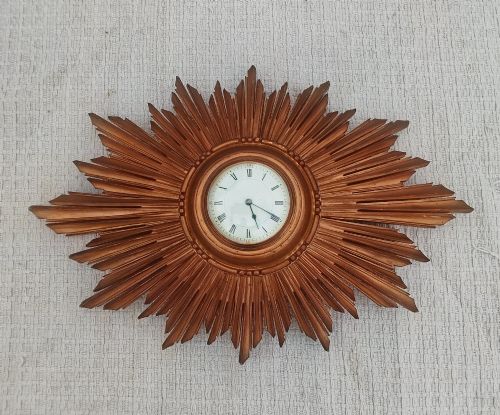
A French sunburst clock captures the dramatic radiance of gilded rays or starburst timber frames surrounding a central timepiece. When searching for a french sunburst clock, a buyer encounters wall clocks and wall-hanging designs rendered in giltwood and gilded wood.
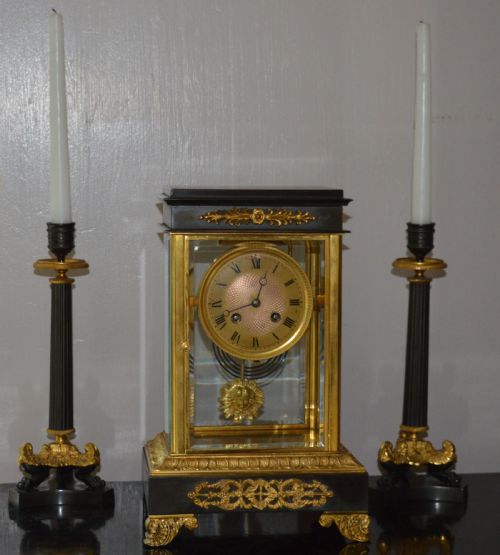
The selection spans periods from the nineteenth century into the twentieth century, alongside related forms like portico clocks and lyre clocks in marble and ormolu. These decorative items range from provincial interpretations to grander Louis XVI style revivals.
Makers and retail houses such as Maple & Co Paris sit alongside unsigned examples, reflecting both high-end cabinetmaking and vernacular workshop production. The forms vary from carved timber sunbursts to mantel pieces featuring sunburst pendulums.
How they were made
Makers utilised carved timber and gilded wood to construct the radiant frames of wall timepieces, applying gold leaf or gilt finishes over the carved rays. Ormolu mounts and cast brass details were chased and fire-gilded to adorn marble and metal bodies.
Dials were formed from enamel or painted metal, often featuring hand-painted numerals and delicate hands driven by mechanical movements. Portico and lyre clocks incorporated contrasting pink marble, glass panels, and bronze plinths to support the intricate brass mechanisms.
Some clocks hide their mechanisms inside musical instrument shapes, turning timekeeping into a plucked lyre.
What varies in quality
Quality reveals itself in the crispness of the carved timber rays and the depth of the gilding on the sunburst frame. Finer examples show hand-chased ormolu mounts and clean, hand-painted enamel dials rather than mass-produced metal stampings.
The choice of materials dictates the standing of the piece, with solid marble bases, heavy bronze plinths, and robust mechanical movements marking out superior workshop output.
Maple & Co
The French Sunburst Clock Glossary
- Ormolu
- Gilded bronze, where finely ground gold is amalgamated with mercury and applied to cast bronze before heating. This technique creates a durable, rich golden surface typical of nineteenth-century decorative work.
- Giltwood
- Wood that has been prepared with gesso and bole before receiving thin leaves of gold. It provides the shimmering finish characteristic of sunburst frames.
- Portico clock
- A architectural mantel clock supported by columns resembling a classical temple facade. They are frequently framed in marble and mounted with ormolu.
- Lyre clock
- A timepiece shaped like the ancient musical instrument, often featuring a symmetrical frame with glass panels or a central pendulum visible through the body.
- Four glass clock
- A mantel clock enclosed by bevelled glass panels on all sides, allowing the movement to be seen from multiple angles.
French Sunburst Clock: Frequently Asked Questions
How do I hang a sunburst wall clock?
These wall clocks require a secure fixing into solid masonry or a wall stud because the timber frames carry significant weight. Ensure the hanging bracket matches the weight of the gilded wood structure before mounting.
Position the clock at eye level where the radiating rays can catch natural light and act as a focal point in the room.
Where should I place a marble mantel clock?
Marble and ormolu timepieces need a stable, level surface such as a mantelpiece, sideboard, or sturdy table to protect the stone and brass components. Keep them away from direct sunlight and damp walls to preserve the marble and delicate dial work.
Allow sufficient clearance around the piece so the form and mountings can be viewed clearly from all angles.
How do I wind an antique mechanical clock?
Use the correct winding key gently on the arbors, turning it slowly until you feel resistance without forcing the spring. Regular, careful winding keeps the movement running reliably.
Consult a professional horologist if the clock loses time or if the mechanism feels stiff during winding.