
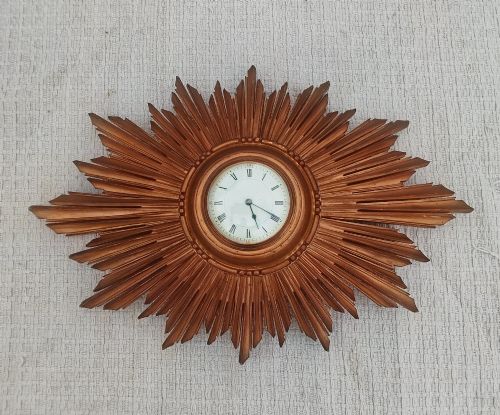
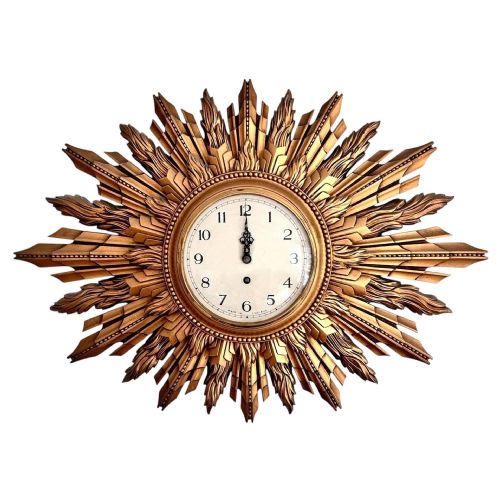
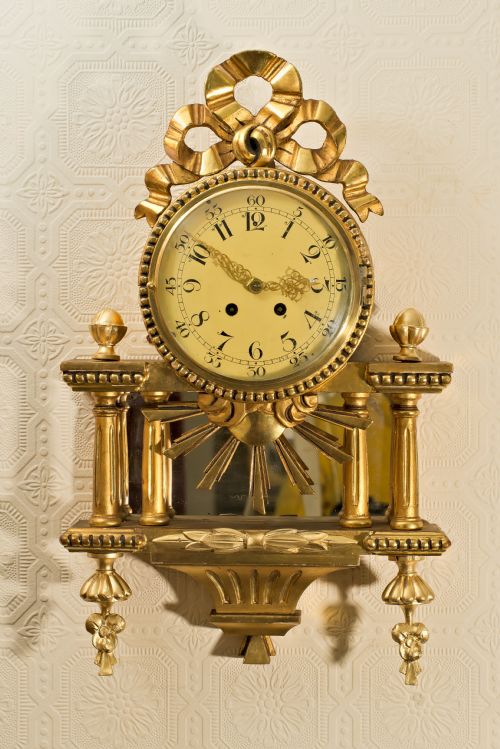




Gold Carved Wall Clock
A gold carved wall clock brings warmth and architectural focus to a room, offering both practical timekeeping and centuries of decorative craft.
Gold Carved Wall Clock
A gold carved wall clock combines gilded woodwork or metalwork with accurate timekeeping mechanisms designed to hang prominently in a domestic interior.
The selections span distinct historical periods including the 17th century, Georgian era, 19th century, and early 20th century.
Forms vary significantly, encompassing classic starburst designs, traditional cartel clocks, automaton picture clocks, and lantern clocks.
Stylistic influences range from Rococo Revival and French Neo-Classical to Art Deco, Gustavian Neoclassical, and Jacobean.
Materials and construction
The primary visual impact relies on giltwood and gilded wood, which provide the reflective golden surfaces characteristic of these wall pieces.
Glass, mirror glass, brass, steel, iron, and plaster are utilised alongside wood to form the dials, movements, structural mounts, and protective covers.
Maker signatures and regional origins, such as English and specific workshops, reflect the traditional methods applied by historical horologists and gilders.
Materials represented across the collection include giltwood, mirror glass, brass, steel, iron, and plaster.
Evaluating craftsmanship and execution
Quality rests in the crispness and depth of the wood carving, where finer examples display intricate detail that holds the golden leaf evenly without masking the underlying form.
The sophistication of the movement and the integrity of the original gilt surface distinguish standard production from exceptional historical examples.
Smiths·Wetterstrands·Perivale of England·William Webster
The Gold Carved Wall Clock Glossary
- Cartel clock
- A wall clock housed in an ornate, usually giltwood or metal case designed specifically to be hung on a wall. These originated in France and often feature scrolling foliage.
- Giltwood
- Wood that has been coated with a thin layer of gold leaf or gold paint. It provides a luminous surface that catches natural light in a room.
- Lantern clock
- An early form of domestic mechanical clock made mostly of brass, traditionally hung on a wall by a bracket and loop. They date back to the 17th century.
- Starburst clock
- A decorative clock design featuring rays or points radiating outwards from a central dial, popular during the Art Deco and mid-century periods.
- Automaton
- A mechanical figure or scene that moves when the clock strikes, adding a theatrical element to historical picture clocks.
Gold Carved Wall Clock: Frequently Asked Questions
How do I hang a heavy giltwood clock?
Wall clocks require secure fastening directly into wall studs or the use of appropriate heavy-duty wall anchors capable of supporting the combined weight of the timber case and metal movement.
Ensuring the bracket matches the weight distribution of the specific piece prevents strain on the hanging loop or backboard.
Where should I place a wall clock?
Choose a prominent wall space away from direct sunlight, excessive moisture, and temperature fluctuations that might affect delicate wood gilding and mechanical components.
Height matters for both visibility and winding access, placing the dial comfortably at or slightly above eye level.
How do I wind a mechanical wall clock?
Use the appropriate key provided with the mechanism, turning it gently until resistance indicates the mainspring is fully tensioned.
Avoid over-winding, as this can damage historical springs and gears inside the movement.
How do I tell an 18th century clock apart from a 20th century piece?
Examination of the timber construction, joinery methods, wear patterns, and the tooling of the brass movement reveals the manufacturing period.
Earlier examples often show hand-cut components and patination consistent with centuries of use, whereas later pieces reflect industrial standardisation.