

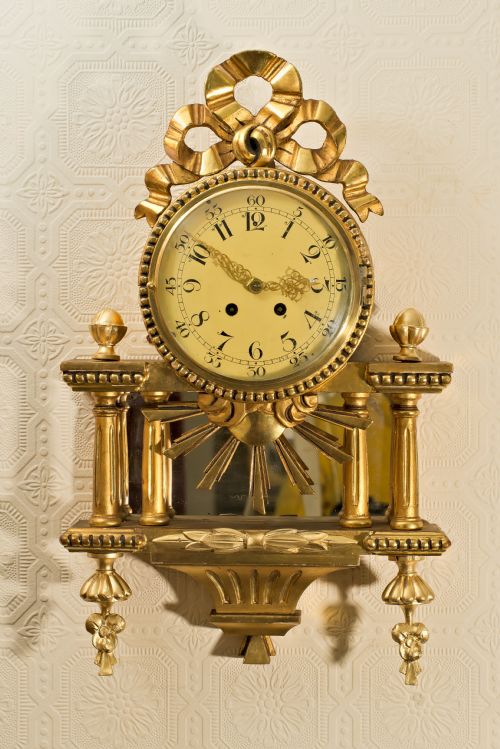


Gilt Cartel Clock
A gilt cartel clock mounts to the wall with asymmetric flourishes and shining metal, bringing 18th-century French and Swedish elegance directly to your room.
Gilt Cartel Clock
A gilt cartel clock is a wall-mounted timepiece framed in gilded bronze, brass, or carved wood designed to be hung directly on a wall rather than placed on a mantel or floor. When you examine this selection, you will encounter pieces spanning from the 18th century through the Victorian era up to the 1920s.
The dominant style on this page is French Rococo and Louis XVI, characterised by scrolling asymmetrical or restrained neoclassical symmetry, alongside Swedish giltwood and eglomise examples. These wall clocks range from modest domestic pieces to large, substantial statements involving heavy cast metal or carved frames.
Makers and origins vary from Parisian workshops like Henri Marc and Japy Freres to English makers such as William Webster and Perivale of England, as well as Scandinavian iterations. Most survivors cluster in the 19th century revival periods, channelling earlier court tastes into domestic interiors.
Materials and construction
The construction relies heavily on fire-gilded bronze, known as ormolu, cast in intricate moulds that depict scrolls, foliage, and sometimes animal or mythological motifs. Alternatively, carvers shaped wooden frames from timber like pine or oak before applying thin layers of gold leaf or giltwood finishes.
Movement assembly involved brass gear trains, often paired with white enamel dial plates marked with Roman or Arabic numerals. Glass panels frequently protect the face, while specialised variations incorporate reverse-painted eglomise glass panels within the wooden or metal bodies.
Assessing quality and execution
Quality separates through the sharpness of the casting and the depth of the hand-chiselling on metal mounts, where superior examples retain crisp leaf edges and varied matte and polished gilding surfaces. In wooden versions, the finesse of the hand-carved gesso and timber mouldings dictates the level of craftsmanship.
The sophistication of the internal movement and the reputation of the signing horologist also elevate a piece above standard production. Original matched components and intact fire gilding represent the upper tier of surviving horology.
Henri Marc of Paris·Wetterstrands·Perivale of England·William Webster London·Japy Freres·Raingo Freres·Samuel Marti
The Gilt Cartel Clock Glossary
- Cartel clock
- A wall clock housed in an ornate frame made of gilt metal, brass, or wood. These pieces originated in France during the Baroque and Rococo periods.
- Ormolu
- Gilt bronze created by applying a mercury and gold amalgam to a bronze base and heating it to drive off the mercury. This technique produces a durable, rich golden surface.
- Eglomise
- The process of cold painting and gilding on the reverse side of glass. It appears frequently in Swedish and continental decorative frames.
- Rococo
- An 18th-century artistic style defined by elaborate ornamentation, asymmetry, scrolls, and naturalistic plant motifs. It heavily influences the majority of these clock designs.
- Louis XVI
- A neoclassical design period characterised by straight lines, symmetry, urns, and classical architectural details. It followed the more curved Rococo phase.
Gilt Cartel Clock: Frequently Asked Questions
Were these clocks always meant for domestic rooms?
Originating in grand 18th-century European reception rooms and salons, they served as both functional timekeepers and status symbols for the wealthy elite.
Later 19th-century revival pieces brought this aesthetic into broader middle-class drawing rooms and libraries, maintaining the decorative ambition of earlier courts.
How do I tell Louis XV style from Louis XVI?
Louis XV style pieces rely on asymmetrical Rococo curves, cascading C-scrolls, and exuberant naturalistic foliage without rigid geometry.
Louis XVI pieces shift toward neoclassical balance, featuring straight vertical lines, symmetry, ribbons, and architectural motifs inspired by antiquity.
What maintenance do antique clock movements need?
Mechanical brass movements require periodic cleaning and lubrication by a professional horologist to prevent wear on the gear teeth and pivots.
Keeping the clock level on the wall ensures the pendulum swings evenly and the escapement maintains accurate timekeeping.