
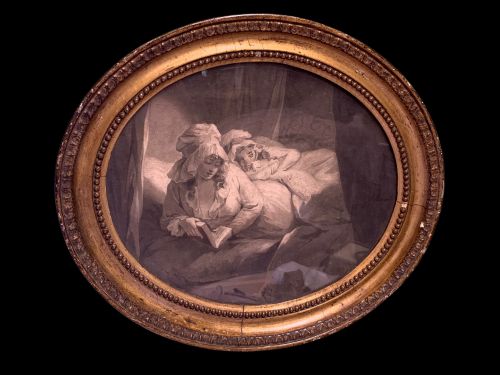
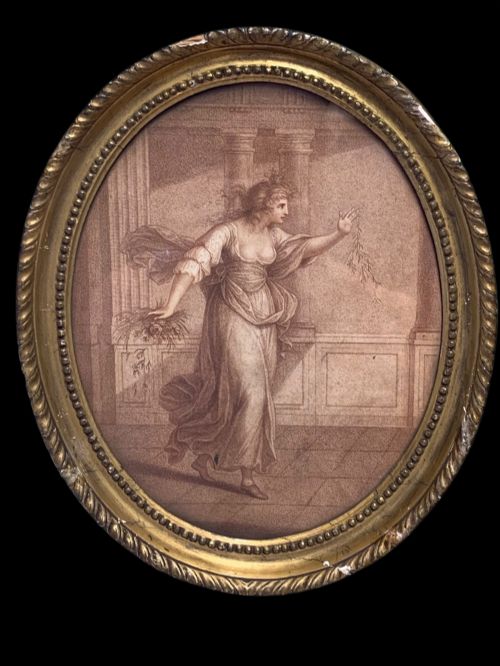
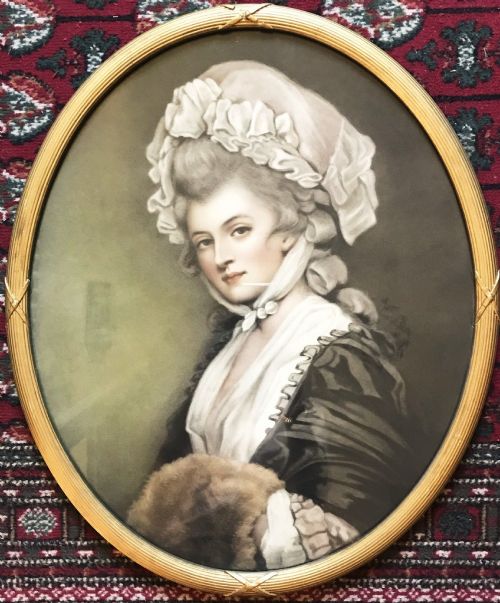
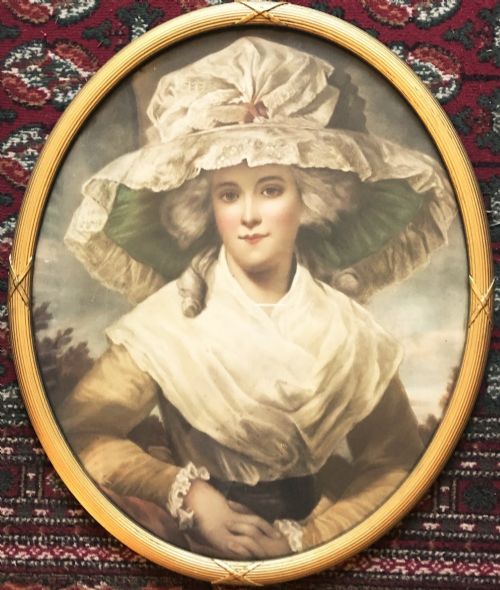
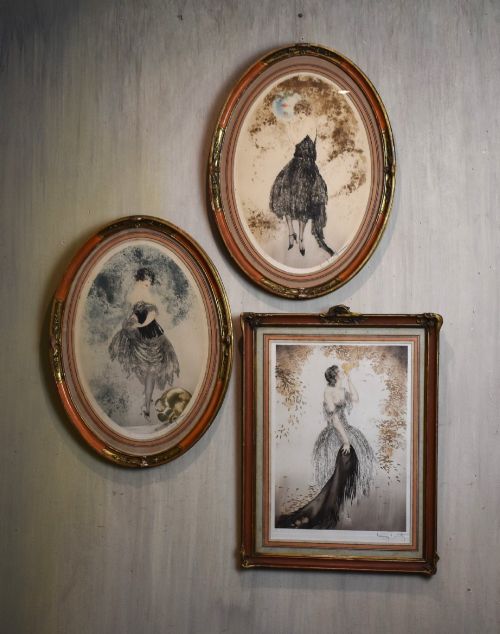


Gilt Oval Framed Prints
These gilt oval framed prints offer classical wall art held inside curved wooden surrounds with bright metallic finishes.
Gilt Oval Framed Prints
These gilt oval framed prints bring together framed art, portrait miniatures, and wall art produced across the eighteenth, nineteenth, and early twentieth centuries. You find depictions ranging from romantic portraits and young ladies in bonnets to botanical studies of birds, butterflies, and waterfowl.
The selection includes single pieces alongside matched pairs and larger sets. Works span various historical aesthetics, including Georgian neoclassical, Victorian, Edwardian, and Art Deco periods, housed within distinctive curved enclosures.
Makers and artists represented in this grouping include Louis Icart, Sir Thomas Lawrence, Bartolozzi, Élisabeth Louise Vigée Le Brun, and the Reverend B. Morris. Many works reproduce earlier oil paintings or present detailed engravings, stipple-engravings, etchings, and watercolours.
Materials and Construction
Makers constructed the enclosures using wood, ebonised wood, and giltwood, applying layers of gilt to achieve a bright metallic surface. Some examples feature moulded gesso detailing on the wooden foundations to create ornate decorative relief.
The artworks themselves utilise paper, silk, and glass components, often protecting the delicate surface behind a glazed front or a dome-fronted glass panel. Backings occasionally incorporate velvet linings alongside the primary paper or fabric medium.
Current listings feature items from the eighteenth, nineteenth, and early twentieth centuries, including Georgian, Victorian, Edwardian, and Art Deco periods.
Evaluating Quality and Execution
Quality rests upon the crispness of the printing technique, whether handling a fine stipple-engraving, a hand-coloured waterfowl plate, or a detailed etching. The fidelity of the printed image to its original oil painting source determines much of the visual success.
The physical housing also dictates the standard of the piece, with well-preserved gilding on carved wood or moulded gesso frames holding higher visual weight. Matched pairs and complete sets demonstrate greater uniformity in original presentation than isolated single works.
Louis Icart·Sir Thomas Lawrence·Bartolozzi·Élisabeth Louise Vigée Le Brun
The Gilt Oval Framed Prints Glossary
- Giltwood
- Wood that has been coated with gold leaf or a metallic substitute. This material forms the bright reflective border typical of these decorative frames.
- Stipple-engraving
- A printmaking technique where an image is modelled by means of dots rather than continuous lines. This method creates soft tonal gradations well suited to portraiture.
- Mezzotint
- A printmaking process of the drypoint family where the plate is roughened to produce dark tones and subtle shifts in light. It yields rich velvety darks ideal for reproducing paintings.
- Ebonised wood
- Timber treated with a chemical stain or finish to imitate ebony. This dark surface provides a sharp contrast against bright gilded internal sight edges.
Gilt Oval Framed Prints: Frequently Asked Questions
How do I hang an oval frame?
Oval frames usually require a single secure fixing point at the top centre rather than two side brackets to hang straight.
Ensure your wall fixing matches the weight of the wood, glass, and plaster composition of the specific piece.
Are these prints originals?
Many examples are period engravings, etchings, or watercolours printed in the eighteenth or nineteenth centuries. Others reproduce earlier oil paintings as stipple-engravings or later Medici prints.
Read the individual listing details to identify whether the item is a contemporary period print or a reproduction of an earlier work.
How should I clean the glass?
Apply a mild glass cleaner to a soft cloth rather than spraying the liquid directly onto the frame. This prevents moisture from seeping under the wooden rebate or damaging the gilt surface.
Keep moisture away from any exposed paper or silk portions visible within the mount.
What periods do these pieces span?
The selection covers items from the eighteenth and nineteenth centuries, extending into Edwardian and Art Deco periods. You will encounter Georgian neoclassical examples alongside Victorian and Regency works.
Each period brings distinct framing profiles and printing methods to the category.