
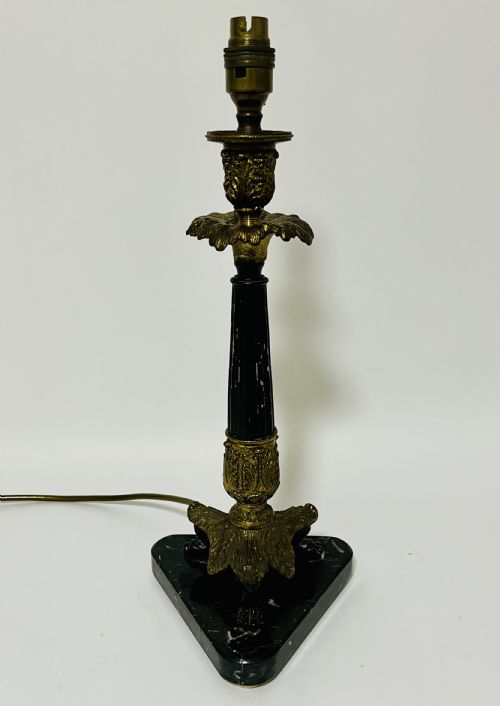


Gilt Metal Reading Lamp
These gilt metal reading lamp examples bring period illumination to a desk or table, prized for their heavy cast metal frames and classical silhouettes.
Gilt Metal Reading Lamp
A gilt metal reading lamp provides focused illumination while introducing classical decorative form to an interior. The selection on this page draws primarily from table lamps and floor lamps spanning the Victorian era through the early decades of the twentieth century.
The dominant aesthetic draws heavily upon continental European design, particularly French Empire, Louis XVI, and Rococo Revival styles. Buyers encounter pieces utilising brass, bronze, gilt metal, and ormolu, frequently paired with marble bases or toleware shades.
Dating ranges from the late nineteenth century up to the 1930s, encompassing both strict neoclassical revivals and flowing Art Nouveau contours. Many examples incorporate twin branches or heavy cast bronze construction suited for task lighting at a desk or table.
How they were made
Construction relies upon heavy cast metals including bronze, brass, and gilt metal, often combined with natural materials like marble for stability. Ormolu mounts and gilt finishes provide the characteristic metallic sheen that defines the surface appearance.
Designers incorporated functional elements such as adjustable arms and twin branches, while decorative details drew directly from French neoclassical and Empire vocabularies. Painted toleware and fabric components complete the construction of the shade and body assemblies.
What varies in quality
The crispness of the metal casting dictates the refinement of the decorative details, separating finely chased ormolu from simpler moulded surfaces. Heavier gauge bronze and substantial marble bases indicate a higher grade of manufacture.
Cohesion of style determines the success of the piece, where authentic French Empire or Swedish Neoclassical proportions are executed with genuine architectural balance rather than generic revival styling.
The Gilt Metal Reading Lamp Glossary
- Ormolu
- Gilded bronze, where a finely ground high-carat gold mercury amalgam is applied to a bronze object before heat volatilises the mercury. This technique produces a durable, rich golden surface typical of fine French lighting.
- Bouillotte lamp
- A traditional French table lamp featuring a central shaft, an adjustable painted metal toleware shade, and a shallow dish base designed to hold game counters. They were originally used for the card game of the same name.
- Toleware
- Enamelled or lacquered sheet metal, frequently painted in black or dark colours with gilt accents. It appears commonly on the shades and bodies of nineteenth century desk lamps.
- Empire style
- A neoclassical design movement spanning the early nineteenth century characterised by military motifs, classical antiquity, and heavy use of gilt bronze. It imparts a formal, monumental presence to lighting fixtures.
- Neoclassical revival
- A renewed interest in classical Greek and Roman architecture and ornament popular across the nineteenth and early twentieth centuries. This style informs the symmetrical proportions and urn motifs seen on many table lamps.
Gilt Metal Reading Lamp: Frequently Asked Questions
What is a bouillotte lamp?
A bouillotte lamp is a traditional French desk lamp featuring a central light source and an adjustable painted toleware shade. The shallow base tray was originally designed to hold small items.
These pieces provide directional task lighting while serving as a decorative centrepiece on a desk or side table.
How do I date a gilt metal lamp?
Dating relies upon examining the manufacturing techniques, cast metal quality, and stylistic motifs. Pieces from the nineteenth century often feature heavier hand-chased bronze work and traditional French styling.
Twentieth century examples from the 1920s and 1930s sometimes incorporate simpler geometric lines or transitional revival forms while retaining classical proportions.
Where should I place a floor lamp?
An antique floor lamp works best in a corner or beside seating where it can provide ambient or task illumination. Ensure the base sits on a stable surface to support the heavy cast metal construction.
These taller fixtures anchor a room's lighting scheme and complement table-mounted lamps of similar period design.
What materials make up these lamps?
Construction primarily involves cast metals such as bronze, brass, and gilt metal, frequently accented with ormolu gilding. Many examples incorporate heavy marble plinths for stability.
Secondary materials include fabric, painted toleware for shades, and occasionally wooden elements integrated into the central shaft.