





Gilt Metal Candelabra
These gilt metal candelabra bring the warm, reflective glow of nineteenth-century drawing rooms and formal dining spaces into modern interiors.
Gilt Metal Candelabra
When searching for gilt metal candelabra, buyers encounter a range of multi-branched lighting fixtures designed for table placement, wall mounting, or integration into garniture sets alongside mantel clocks. The selection spans the eighteenth, nineteenth, and early twentieth centuries, reflecting diverse European aesthetics from French Rococo Revival to Italian Baroque and Victorian sensibilities.
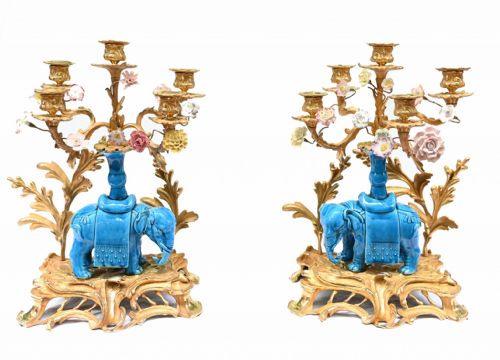
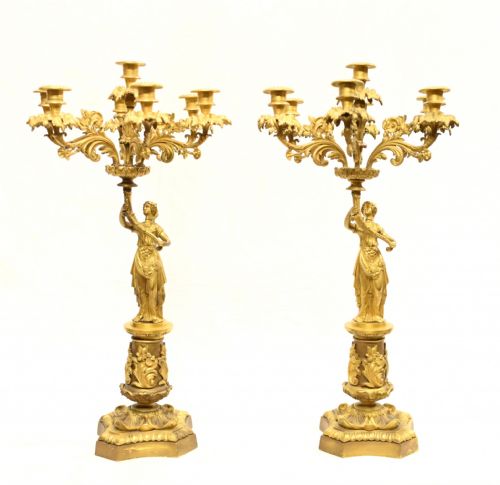
Table-standing pairs dominate the inventory, frequently featuring two to eight branches or candles. Examples often incorporate figural elements such as maidens, cherubs, or elephants, alongside functional adaptations where period pieces have been converted to table lamps.
Wall lights and sconces also appear alongside altar candelabra and central chandelier forms, demonstrating how domestic and ecclesiastical lighting shared similar decorative vocabularies across the decades.
Materials and Construction
The fabrication of these pieces relies heavily on metal casting, utilising bronze, brass, and general gilt metal finished with mercury gilding or modern electroplating to achieve the distinctive golden surface. Artisans frequently combined these metallic components with contrasting natural materials such as white marble, slate, alabaster, and glass inserts to add weight and visual texture.
Decoration often involved intricate hand-chasing, applied enamel work in the champlevé style, and porcelain elements integrated into the main body or base. Components were typically cast in modular sections and secured with internal threaded rods or pins, allowing for complex multi-branch configurations.
Several nineteenth-century specimens feature tiny, watchful porcelain elephants supporting candle nozzles on their backs.
Assessing Quality and Execution
The richness and durability of the gilding further distinguish finer items from simpler production pieces. Weight and structural stability also indicate standard, as substantial bronze or brass cores support multi-branched arms more securely than thin, hollow alloy castings.
The Gilt Metal Candelabra Glossary
- Ormolu
- Finely ground high-carat gold applied to a bronze base using a mercury amalgamation technique, yielding a warm, durable metallic finish.
- Garniture set
- A decorative matching group typically consisting of a central clock flanked by a pair of candelabra or vases designed for mantel display.
- Champlevé
- An enamelling technique where troughs are dug into a metal surface and filled with vitreous paste before firing.
- Sconce
- A wall-mounted lighting fixture designed to hold candles or electric bulbs and project illumination outward into a room.
- Regency
- A British design period spanning the early nineteenth century characterised by classical restraint, neoclassical motifs, and bold metallic contrasts.
Gilt Metal Candelabra: Frequently Asked Questions
How are these candelabra powered today?
Most retain their original configuration for wax candles, though several historical examples have been professionally adapted to function as table lamps with internal wiring.
Buyers intending to use them for electrical lighting should consult a qualified electrician to inspect any retrofitted components for safety compliance.
Can these be polished safely?
Original gilt surfaces require minimal intervention and should only be dusted gently with a soft, dry cloth to prevent wearing away the thin layer of gold.
Avoid commercial chemical dips or abrasive metal cleaners entirely, as these substances strip the historic finish down to the base brass or bronze.
What rooms suit these fixtures best?
These pieces function effectively as focal points on dining tables, sideboards, or mantelpieces where their reflective metallic surfaces catch natural and artificial light.
Wall-mounted variants suit hallways and drawing rooms, providing ambient illumination while serving as sculptural wall art.
How do I identify the period?
Dating relies on stylistic clues such as the symmetry of French Empire design versus the elaborate asymmetry of Rococo Revival or the inclusion of specific stone bases like marble and slate.
Construction methods, casting seams, and fastener types also provide reliable indicators of whether a piece dates to the eighteenth, nineteenth, or early twentieth century.