

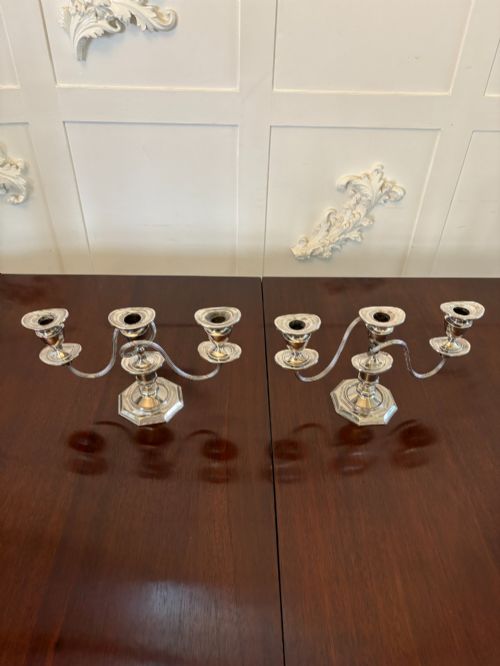


Triple Arm Candelabra
These triple arm candelabra pieces bring balanced illumination and period presence to a room, offering three branches of light in brass, silver plate, giltwood, and bronze.
Triple Arm Candelabra
When you search for triple arm candelabra, you find branched lighting fixtures designed for table display or wall mounting. These objects hold three distinct candles or light points across symmetrical arms extending from a central shaft or backplate.
The selections available here span several distinct periods including the Georgian era, the nineteenth century, and the early twentieth century around 1900 to 1920. You will encounter both freestanding table candelabras and wall-mounted versions often styled as sconces or wall lights.
Origin and design vocabulary lean heavily towards continental European aesthetics, with French and Italian pieces appearing alongside British examples. Styles represented across these listings include Rococo Revival, Italian Baroque, Florentine, and Neoclassical designs.
How they were made
The physical construction of these pieces relies on metalworking and woodworking traditions suited to supporting multiple heavy branches. Workshops utilised cast bronze, polished brass, silver plate, and Old Sheffield Plate alongside carved giltwood for wall lights.
Decorative surfaces often combine gilt finishes with patinated metal, contrasting bright gold leaf or plating with darker bronze or brass bodies. Glass and crystal elements appear on select French wall lights to catch and refract the candle illumination.
Triple Arm Candelabra Retail Price Guide 2026
Typical asking prices for triple arm candelabra among the pieces listed under this phrase on Sellingantiques today, from the lower quarter to the upper quarter. They describe what is for sale here now, not the wider market.
Materials documented across the inventory include silver plate, brass, metal, glass, giltwood, wood, gilt bronze, and patinated metal.
What varies in quality
Quality in these branched light fittings rests on the crispness of the casting work and the depth of the chased or carved detail. Finer examples display sharp relief in foliate scrolls and figural motifs, whereas simpler items show softer, less defined edges.
The choice of primary material also establishes the tier of the piece, moving from standard brass or silver plate up to heavier gilded bronze and carved giltwood. Construction integrity where the arms join the central shaft determines the structural stability of the object.
The Triple Arm Candelabra Glossary
- Candelabra
- A branched candlestick holding multiple lights. Larger versions stand on tables or floor surfaces.
- Wall Sconce
- A decorative light fixture fixed to a wall rather than resting on a surface. These often feature an ornate backplate supporting the extending arms.
- Giltwood
- Timber that has been coated with a thin layer of gold leaf. This technique was widely used on Italian and Florentine wall lights.
- Old Sheffield Plate
- An early form of composite metal made by fusing a sheet of silver to a copper base. This method creates a durable material found on Georgian pieces.
- Rococo Revival
- A nineteenth-century design style reviving the asymmetrical scrolls and naturalistic ornament of the mid-eighteenth century. It dominates many of the French items on this page.
Triple Arm Candelabra: Frequently Asked Questions
What is a triple arm candelabra?
A triple arm candelabra is a lighting fixture featuring three distinct branches or nozzles for holding candles. These objects are configured either as freestanding table pieces or as wall-mounted lights.
They serve both a practical illumination purpose and a decorative function within a room interior.
How do I mount wall lights?
Wall lights and sconces attach directly to a wall surface through a backplate or fixing bracket. Depending on the era of the piece, they were originally designed for hanging candles rather than electrical wiring.
Modern placement usually requires consultation with a qualified electrician if you intend to convert them for electrical use.
How do I date a candelabra?
Dating relies on identifying the prevailing design style, manufacturing materials, and construction techniques visible on the object. Georgian items display different casting methods compared to nineteenth-century Rococo Revival or early twentieth-century Edwardian pieces.
Comparing the specific patination and assembly marks helps narrow down the period of origin.
Can I use real candles in them?
These pieces were originally constructed to hold traditional wax candles for interior illumination. Many collectors continue to use wax candles for dining tables or decorative display.
Care should be taken to catch dripping wax to protect the metal or giltwood surfaces from potential damage.