


Gilt Hall Mirror Table
These gilt hall mirror table pieces combine glass, marble and giltwood to anchor a grand hallway.
Gilt Hall Mirror Table
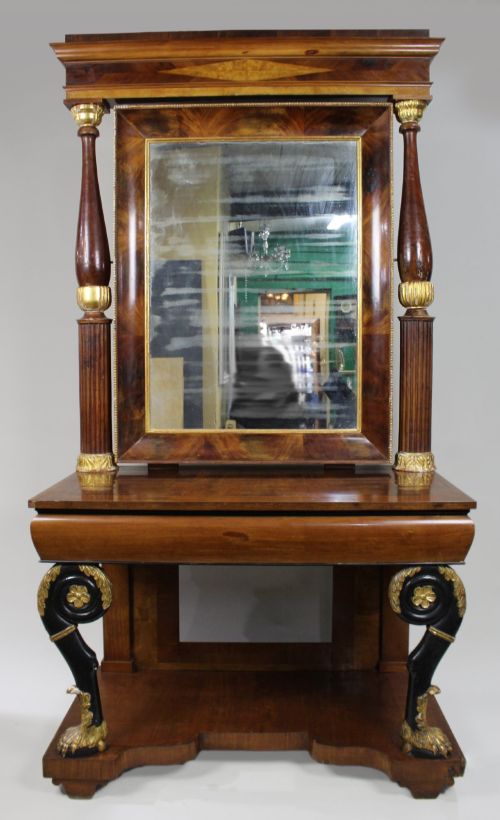
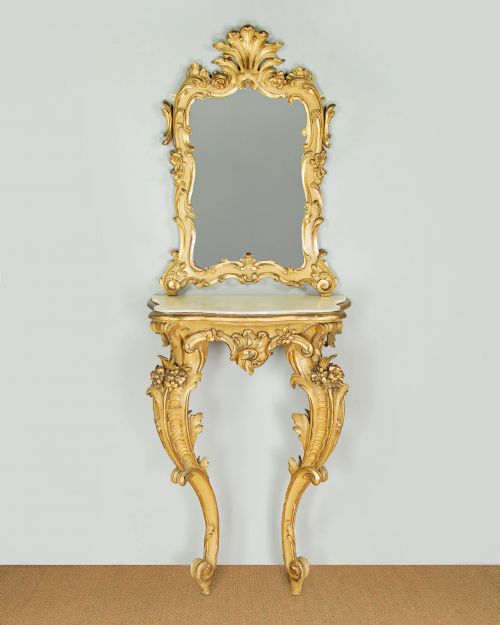
A gilt hall mirror table brings together a console table and a matching wall mirror, designed to sit together in an entrance hall or reception room. These combinations most often appear from the 19th century, drawing on Regency, Victorian and various Rococo revival styles.
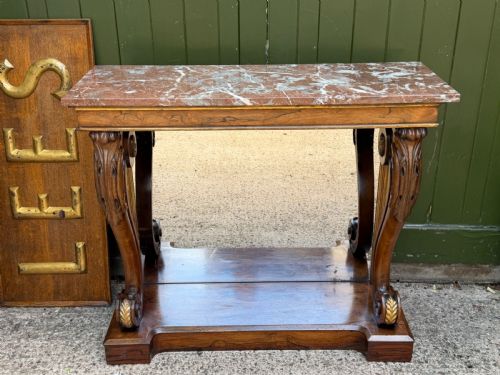
The form pairs a marble-topped or wooden console table with a tall pier mirror or wall mirror, frequently finished in giltwood and gesso. You will find both unified sets designed for a specific wall and assembled pairings of console tables and mirrors from the same period.
Origin influences the decorative vocabulary, ranging from restrained English Regency rosewood and mahogany designs to more exuberant French and Italian Rococo or Venetian interpretations. The underlying structure relies on solid woods like mahogany, rosewood and carved wood beneath the gilded surface.
Materials and construction
Carvers shaped the decorative frames from giltwood and gesso, building up intricate relief work before applying gold leaf. Tables frequently feature figured marble tops, resting on bases constructed from woods including mahogany, rosewood and general timber.
Mirror glass was set into tall frames, often designed to reflect light through a hallway and amplify the sense of space. Parcel-gilt details highlight specific carved elements against darker wood grounds in Regency and later 19th-century examples.
Mirrors were deliberately proportioned to bounce candlelight down dark 19th-century corridors long before electricity arrived.
Distinctions in quality
Depth and crispness of the carved ornamentation separate standard production from finer work, particularly where gesso is hand-tooled rather than cast. The quality of the marble top, its thickness, and the grain of underlying timbers such as rosewood also mark the tier of a piece.
Cohesion between the console table and its mirror dictates the success of the ensemble, whether they were conceived as a single suite or matched later. Surviving original mirror glass and well-preserved gilding without extensive modern overpainting preserve the integrity of the object.
The Gilt Hall Mirror Table Glossary
- Console table
- A table designed to stand against a wall, traditionally supported by front legs or brackets while fixed to the wall for stability.
- Pier mirror
- A tall mirror specifically proportioned to hang on the wall space between windows, frequently placed directly above a console table.
- Giltwood
- Wood that has been coated with gold leaf or gold powder over a prepared gesso ground, standard for decorative frames of the 18th and 19th centuries.
- Parcel-gilt
- A finish where only specific carved details or raised elements are gilded, leaving the underlying wood visible elsewhere.
- Gesso
- A plaster-like mixture applied to wood frames to provide a smooth base for carving and gilding.
Gilt Hall Mirror Table: Frequently Asked Questions
Where should I place a gilt hall mirror table?
These sets suit entrance halls, grand landings or reception rooms where a wall-mounted mirror can sit directly above the console table.
Position them opposite a light source to maximise the reflective glass and brighten the space.
Are the console table and mirror always sold together?
Many examples were manufactured as matching pairs or unified suites, particularly within French and Victorian designs.
Other listings pair tables and mirrors from the same period that share stylistic traits and materials like marble and giltwood.
How do I care for the marble top?
Marble requires gentle cleaning with warm water and a soft cloth, avoiding acidic cleaners that can etch the polished surface.
Use coasters or mats to protect the stone from moisture and heavy objects.
How can I tell a Regency piece from a Victorian one?
Regency examples often utilise rosewood or mahogany with restrained parcel-gilt details and classical Neoclassical restraint.
Victorian and later revival pieces tend towards heavier carving, exuberant French Rococo curves and extensive gilding.