


Gilt Bronze Nightstands
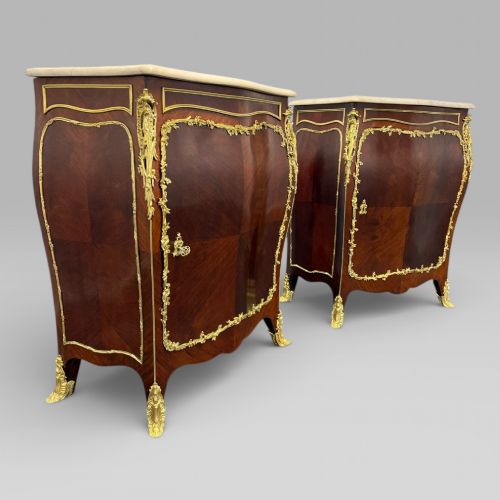
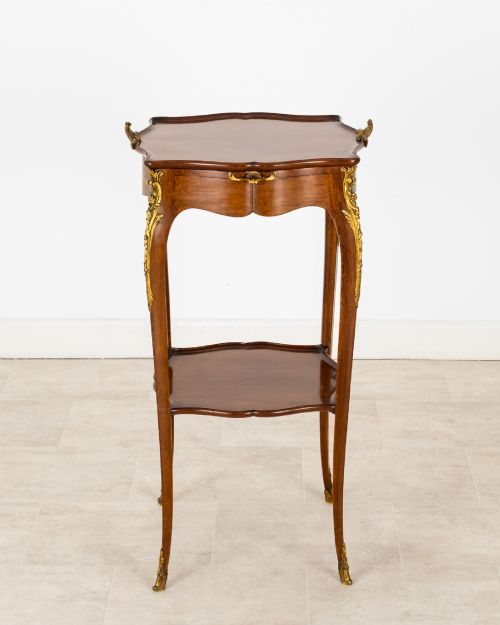
These gilt bronze nightstands and small bedside tables bring French revival elegance and rich ormolu mounts to the bedroom.
Gilt Bronze Nightstands
Buyers seeking gilt bronze nightstands will find a selection of French bedside cabinets, commodes, and small lamp tables dating across the nineteenth and early twentieth centuries. These pieces predominantly reflect Louis XV, Louis XVI, and Empire revival styles, often pairing compact proportions with decorative mounts.
Origins heavily lean towards French workshops, spanning the eighteen-seventies through to nineteen-thirty, with cabinet pieces frequently incorporating exotic timbers beneath their metallic ornamentation.
Materials and Construction
Cabinetmakers utilised dense hardwoods such as mahogany, walnut, rosewood, and kingwood as the structural foundation, frequently applying intricate marquetry, parquetry, or Chinoiserie lacquer across the surfaces. Tops were commonly finished with fitted slabs of marble, including breche d'alep varieties.
Cast ormolu and gilt bronze mounts, handles, and sabots were meticulously chased and applied to corners, friezes, and drawer fronts to accentuate the revival contours.
Listings feature woods such as mahogany, walnut, rosewood, and kingwood alongside ormolu, brass, and marble.
Assessing Quality and Craftsmanship
The standard of an ormolu mount relies upon the crispness of the chasing and the depth of the fire gilding, where superior examples exhibit sharp relief and a warm, deep lustre rather than a flat, uniform shine. Cabinetwork quality is demonstrated by the precision of the veneer matching, the tightness of the marquetry inlays, and the stability of carcass construction.
The integration of materials also defines the tier of a piece, distinguishing standard production from items featuring finely fitted marble tops, porcelain plaques, or signed cabinetwork.
E. Kahn·François Linke
The Gilt Bronze Nightstands Glossary
- Ormolu
- Gilded bronze achieved through a mercury-gilding process that produces a durable, rich metallic finish. It was widely utilised for decorative mounts on nineteenth-century French furniture.
- Bombe
- A swelling, outwardly curved contour found on the front and sides of commodes and cabinets. This curvaceous profile is a defining characteristic of Louis XV revival design.
- Parquetry
- Geometric wood-mosaic work used for decorative surface patterns. Craftsmen arranged contrasting timbers like kingwood and mahogany in precise grids or diagonal arrangements.
- Etagere
- An open piece of furniture with multiple tiers or shelves for displaying small objects. These lightweight stands often served as bedside or occasional tables.
- Breche d'alep
- A type of quarried breccia marble featuring a complex mixture of mottled tones and angular fragments. It frequently forms the heavy, decorative tops of commodes and lamp tables.
Gilt Bronze Nightstands: Frequently Asked Questions
What periods do these tables represent?
The pieces span from the late nineteenth century through to the early twentieth century, capturing distinct revival phases of French design.
Most items draw heavily upon Louis XV and Louis XVI aesthetics, reflecting historicist revivals popular across European cabinetmaking workshops.
How were these cabinets originally used?
These small tables and cabinets functioned as bedside storage for personal items, holding chamber lamps, books, or small commodities within the sleeping quarters.
Their compact footprints allowed them to fit neatly beside period beds while offering enclosed drawer or cupboard space.
How do I care for marble tops?
Marble surfaces require simple dusting with a soft cloth and immediate wiping of any liquid spills to prevent staining or etching into the stone.
Avoid using acidic or abrasive household cleaners, opting instead for mild soapy water when deeper cleaning becomes necessary.
Are these pieces strictly for bedrooms?
While many were built as bedside chests or lamp tables, their versatile sizes make them equally suitable as occasional tables in living areas.
They function well beside seating or in hallways where surface space and subtle storage are required.
How do I distinguish Louis XV from Louis XVI style?
Louis XV style pieces are characterised by asymmetrical curves, serpentine lines, and flowing, organic ormolu mounts without rigid symmetry.
Louis XVI style shifts toward neoclassical restraint, featuring straight fluted legs, rectangular proportions, and geometric parquetry patterns.