

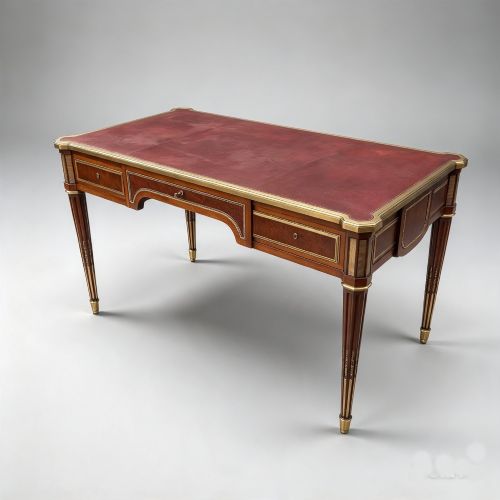
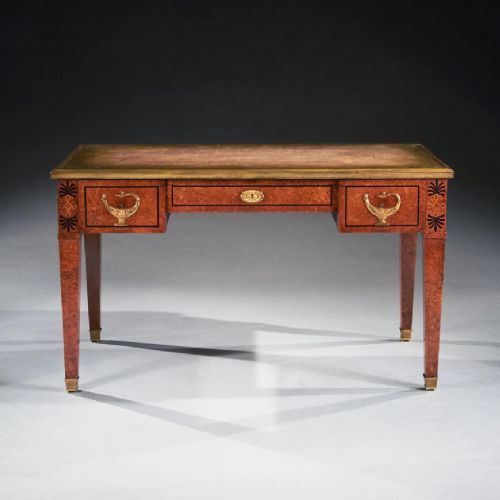
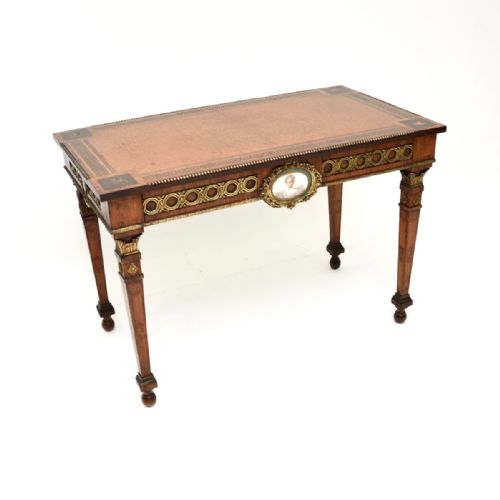
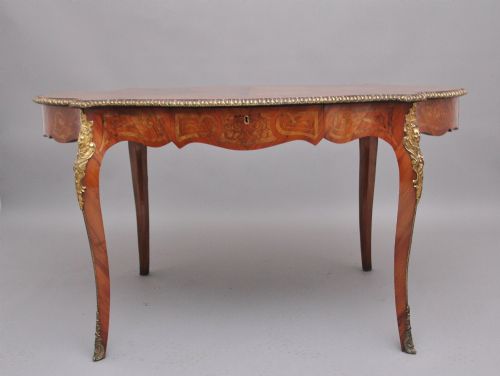






Gilt Bronze Library Table
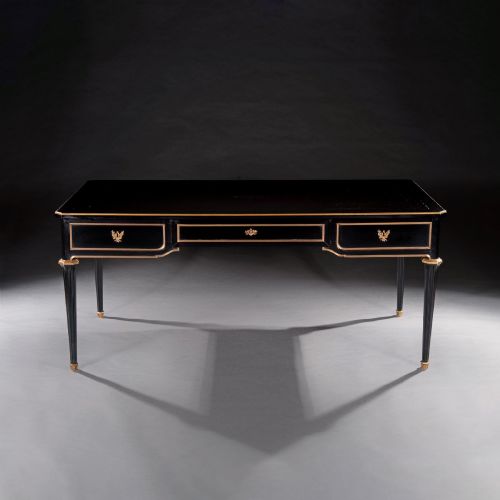
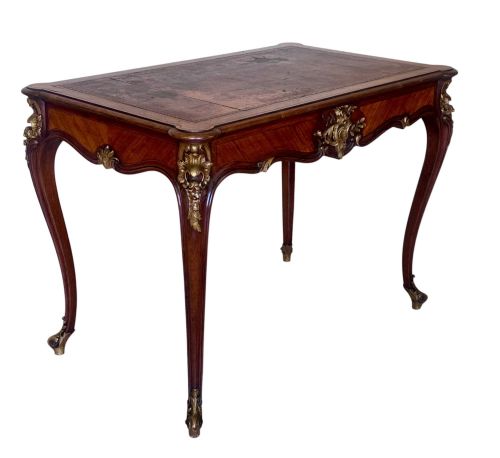
A gilt bronze library table brings French revival grandeur and fine surface craftsmanship into a room.
Gilt Bronze Library Table
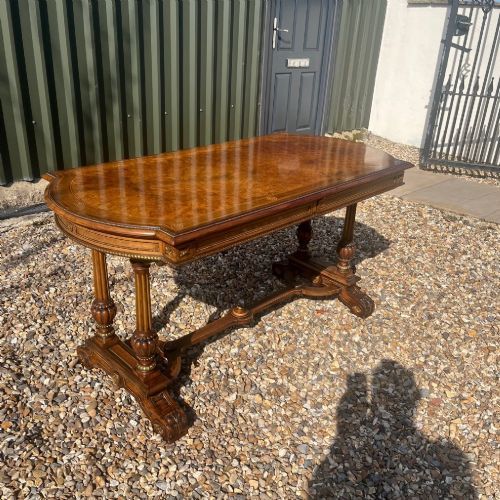
When you search for a gilt bronze library table, you are looking at substantial freestanding writing desks and centre tables created mostly during the nineteenth century. These pieces follow historical French design idioms, drawing heavily on Louis XV and Louis XVI revival aesthetics. They are designed to sit in the middle of a room rather than against a wall.
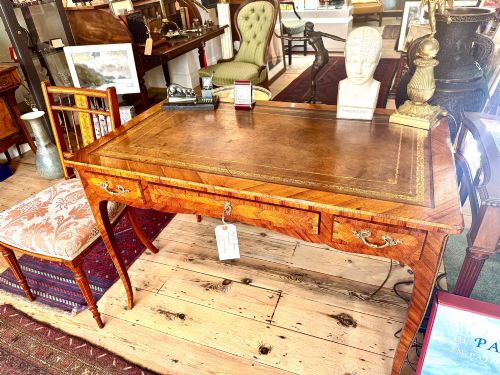
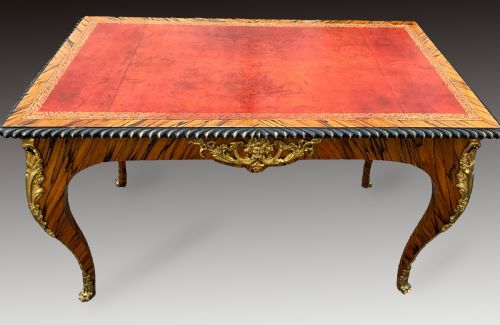
The most common forms on this page include the bureau plat and the freestanding centre table, often paired with leather writing surfaces. Workshops constructed them using timbers such as mahogany, kingwood, rosewood, and ebonised wood. Ormolu mounts and gilt bronze details define the visual vocabulary of nearly every piece.
Makers working in nineteenth-century France and Britain produced these grand library tables to satisfy an enduring demand for aristocratic European styling. Their scale ranges from intimate writing desks to large exhibition-quality centre tables. Each piece combines structural timber work with elaborate metal ornamentation.
How they were made
Cabinet makers built the carcasses of these tables using dense hardwoods such as mahogany and walnut, frequently applying veneers of kingwood, rosewood, or zebrawood in parquetry and marquetry patterns. Complex techniques like Boulle marquetry, incorporating tortoiseshell and brass, appear on the most elaborate examples. Ebonised finishes provide a contrasting dark ground for metal mounts.
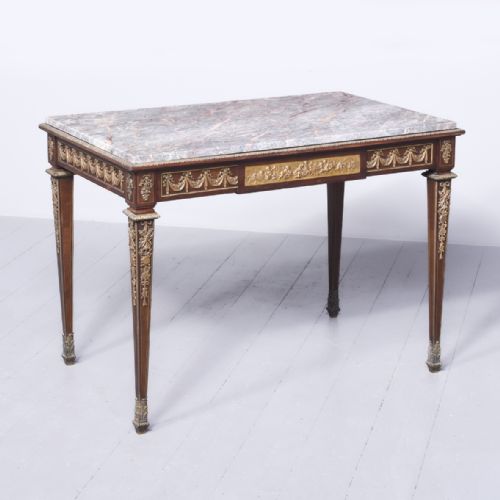
The characteristic gilt bronze and ormolu mounts were cast separately, chased by hand to sharpen the detail, and then fire-gilded or electrogilt before being screw-fixed to the timber frames. Leather writing inserts, often tooled with gold leaf, were carefully inset into the timber tops. Marble slabs also feature on certain revival centre tables.
Master workshops employed specialised artisans for the joinery, the marquetry cutting, and the bronze casting. This division of labour ensured that the structural carcase supported the heavy metal mounts without warping or sagging over time. Original leather tops and precise bronze fitting indicate high workshop standards.
Gilt Bronze Library Table Retail Price Guide 2026
Typical asking prices for gilt bronze library table among the pieces listed under this phrase on Sellingantiques today, from the lower quarter to the upper quarter. They describe what is for sale here now, not the wider market.
Listings feature pieces spanning the eighteenth to the twentieth centuries, with a strong concentration of nineteenth-century French revival furniture.
What varies in quality
The crispness and depth of the ormolu casting dictate the visual success of the piece. Lower-quality tables feature soft, cast-flat metal mounts with minimal hand-chasing, whereas superior pieces display sharply defined foliage and figures finished by skilled metalworkers. The weight and thickness of the gilt bronze signal the maker's investment in materials.
Inlaid surfaces reveal differences in the precision of the parquetry and marquetry cutting. Fine examples show tight joints between contrasting veneers of kingwood, rosewood, and fruitwoods, without excessive filler. The structural integrity of the oak or mahogany secondary woods further separates standard production from master workshop output.
Francois Linke·Edwards and Roberts·CH Jeanselme and Co·Henry Dasson·Zweiner
The Gilt Bronze Library Table Glossary
- Bureau plat
- A flat-topped freestanding writing table, typically fitted with drawers in the frieze. This form originated in France and remained popular throughout the nineteenth-century revival periods.
- Ormolu
- Gilded bronze, where finely ground gold is applied to a bronze base using mercury amalgamation or modern electroplating. It provides a durable, rich golden finish to furniture mounts.
- Parquetry
- Geometric wood-mosaic work used for flooring and furniture veneers. Makers arrange contrasting timbers like kingwood and rosewood in repeating patterns.
- Marquetry
- Decorative veneer work forming pictorial or scroll designs using various coloured woods, shells, or metals. It requires meticulous hand-cutting of individual elements.
- Boulle work
- A type of ornate marquetry named after French cabinet maker André-Charles Boulle. It uses contrasting inlays of tortoiseshell and brass.
- Frieze
- The horizontal section of a table situated immediately below the top. On these library tables, the frieze commonly houses one or more pull-out writing drawers.
Gilt Bronze Library Table: Frequently Asked Questions
What is a bureau plat?
A bureau plat is a freestanding writing desk featuring a flat top, often inset with leather, and drawers built into the frieze. These tables were designed to sit in the centre of a room rather than against a wall.
Originating in France, the form was revived extensively during the nineteenth century with rich ormolu mounts and exotic veneer patterns.
How do I tell Louis XV from Louis XVI style?
Louis XV style furniture is characterised by curved cabriole legs, asymmetrical rococo scrolls, and flowing organic lines. Ormolu mounts on these pieces emphasise natural forms like acanthus leaves and floral sprays.
Louis XVI style shifts toward neoclassical symmetry, featuring straight fluted legs, geometric veneers, and architectural mounts such as urns, ribbons, and classical wreaths.
Were these tables used for writing or display?
These tables served primarily as formal writing desks and library furnishings for correspondence and reading. Their finished backs allowed them to occupy prominent positions in the middle of studies and salons.
Over time, many functioned equally well as centre tables for holding decorative objects, lamps, and clocks.
How do I care for an ormolu mounted table?
Keep gilt bronze and ormolu mounts free of dust using a soft, dry microfibre cloth. Avoid abrasive cleaners and modern metal polishes, which can strip the remaining gold gilding.
Maintain stable room humidity to protect the underlying timber carcase and delicate veneer inlays from splitting.