
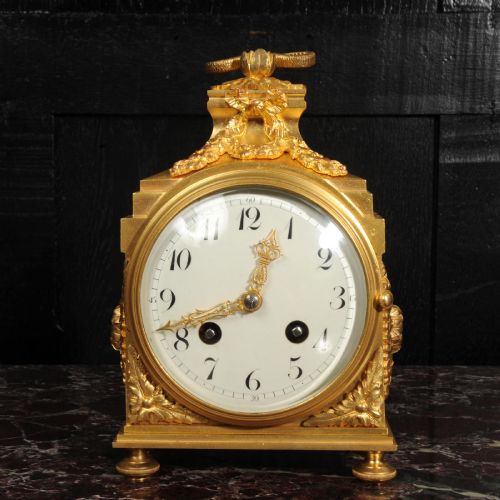
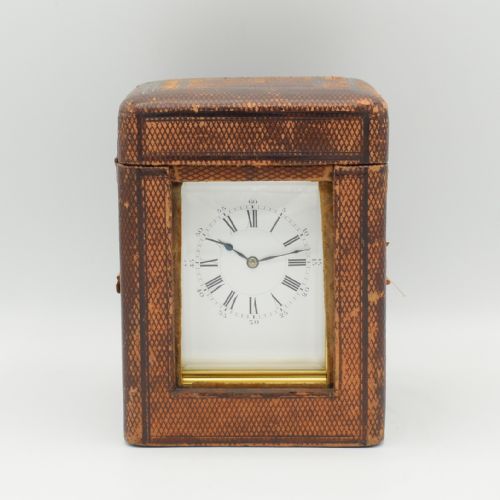


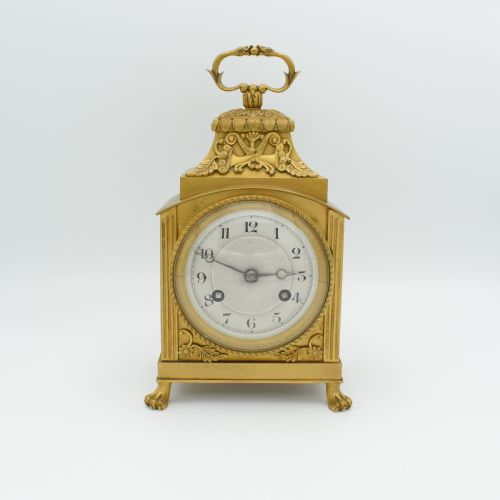


Gilt Brass Officer Clock
These gilt brass officer clock pieces offer precise French timekeeping housed in gleaming metal cases.
Gilt Brass Officer Clock
A gilt brass officer clock is a portable timepiece developed for travel and military campaigns during the nineteenth century. These clocks combine functional reliability with decorative metalwork housed in protective glass panels.
Buyers encounter carriage clocks and mantel clocks originating from Victorian Britain and nineteenth century France. The most common form on this page is the French carriage clock featuring a visible escapement through the upper glass.
Examples date from the mid-nineteenth century through to nineteen hundred, encompassing styles such as French Empire and French Classical. Makers produced these pieces for officers, travellers, and domestic interiors.
How they were made
Craftsmen built these clocks using brass, gilt brass, or gilt bronze to form the structural cases. Ormolu applications and engraved detailing embellished the metal frames to suit high-status interiors.
Makers integrated glass panels into the sides and top of the cases to display the internal movements. Enamel dials provided clear numerical markings while steel components governed the mechanical gear trains.
Listings span the Victorian era, eighteen fifty to nineteen hundred, utilising brass, gilt bronze, glass, enamel, and leather.
What varies in quality
Quality depends on the complexity of the movement, with standard timepieces differing from those featuring striking mechanisms or alarm functions. Simpler eight-day movements contrast with sophisticated examples offering repeaters and calendar complications.
The finish of the metalwork and the precision of the engraving dictate the tier of the piece. Heavy gorge cases and signed maker dials distinguish higher-grade examples from standard production items.
Henri Jacot·J. F. Bautte Et Cie·Le Roy et Fils·Bourdin·Tiffany·Drocourt·Dent·Joseph Soldano
The Gilt Brass Officer Clock Glossary
- Gorge case
- A stepped brass carriage clock case style featuring a distinctive rounded top moulding. This design is typical of nineteenth century French workshops.
- Grande sonnerie
- A striking mechanism that chimes the hours and quarters automatically on every quarter hour. It represents a high level of horological complexity.
- Pendule d'officier
- A traditional French officer clock style originally designed for military campaigns. These clocks often feature robust leather travel cases.
- Escapement
- The mechanical linkage that regulates the movement of the clock by controlling the release of power from the gear train. It is frequently visible through the upper glass panel.
- Ormolu
- Finely ground high-carat gold applied to a bronze or brass base object. This technique creates a bright metallic finish seen on French decorative pieces.
Gilt Brass Officer Clock: Frequently Asked Questions
What is a gilt brass officer clock?
A gilt brass officer clock is a portable nineteenth century timepiece housed in a metal frame with glass panels. These clocks were originally designed for travel and military use.
Today they function as decorative and collectible timepieces appreciated for their mechanical complexity and polished metal cases.
How do you wind a carriage clock?
Winding requires a dedicated key inserted into the winding arbours located on the underside or backplate of the movement. Care must be taken not to overwind the mainspring.
Most examples run for eight days on a single wind, regulating time through an internal escapement mechanism.
Were these clocks actually used by officers?
The initial design of the pendule d'officier was commissioned for military officers requiring reliable time on campaign. Over time, the form evolved into a luxury domestic accessory.
Many surviving pieces retain their original leather travel cases, pointing to frequent movement between locations.
How do you date a French carriage clock?
Dating relies on maker signatures, serial numbers, case styles, and the evolution of the escapement type. Pieces from the mid-nineteenth century display different framing proportions compared to those from eighteen ninety.
Accurate attribution often requires examining the internal movement plates for maker stamps.
How do you care for a vintage clock?
Keep the clock away from direct sunlight, moisture, and extreme temperature fluctuations. Placing it on a stable surface ensures the pendulum or balance wheel beats evenly.
Professional servicing every few years maintains the mechanical health of the brass gears and springs.