


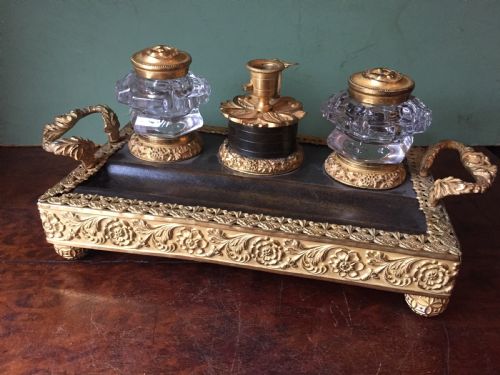


Gilt Brass Inkwell
These gilt brass inkwell pieces combine heavy metalwork with stone and glass to hold a desk's writer's tools.
Gilt Brass Inkwell
A gilt brass inkwell is a desk accessory designed to hold liquid ink for writing, often formed as part of a larger stand or desk set. Collectors searching for a gilt brass inkwell will find examples ranging from simple single wells to elaborate figural desk stands with mounted stone bases.
The pieces on this page span the eighteenth, nineteenth, and early twentieth centuries, with a strong representation of nineteenth-century French manufacture. Forms vary from compact travelling containers to substantial marble-mounted desk sets incorporating lions, cats, or portrait busts.
Most entries combine cast metal mounts with fitted glass inserts for the ink itself, occasionally accompanied by letter holders or matching clocks. The origin is predominantly French, though English Victorian and Edwardian variations also appear.
Materials and construction
The primary construction relies on cast brass, ormolu, or gilded bronze, often combined with heavy stones such as Sienna marble, vert marble, or mahogany and coromandel wood bases. Metal components are cast and subsequently fire-gilded or polished to achieve a bright golden surface finish.
Decoration frequently includes champlevé enamel work, ceramic inserts, and hand-carved figural elements like stags or cats with glass eyes. Glass ink inserts sit within the metal housings to contain the ink without damaging the surrounding metalwork.
Gilt Brass Inkwell Retail Price Guide 2026
Typical asking prices for gilt brass inkwell among the pieces listed under this phrase on Sellingantiques today, from the lower quarter to the upper quarter. They describe what is for sale here now, not the wider market.
Objects range from simple nineteenth-century travel containers to large desk sets featuring built-in clocks and figural animals.
Assessing quality
Quality in these desk accessories rests upon the crispness of the bronze casting and the depth of the gilding. Superior examples show sharp, defined details in figural elements like lions or cats rather than soft, worn edges from secondary casting moulds.
The choice and execution of secondary materials also divide standard pieces from finer ones. Solid marble bases with precise mounts, intact original glass liners, and complex enamel work elevate a desk stand far above a basic brass container.
Elkington·Moser·Paris Maker
The Gilt Brass Inkwell Glossary
- Ormolu
- Gilded bronze, typically produced by applying a mercury and gold amalgam to cast bronze and heating it until the mercury vaporises. This technique creates a durable, warm golden finish seen on many nineteenth-century French desk pieces.
- Encrier
- The French term for an inkstand or inkwell. You will often see this used in descriptions of continental desk accessories.
- Champlevé enamel
- A technique where troughs or cells are hollowed out of the metal surface and filled with enamel powder before firing. The resulting coloured glass designs sit flush with the surrounding metal borders.
- Vert marble
- A dark green ornamental marble commonly used for the heavy bases of nineteenth-century French desk sets. It provides a stable, contrasting foundation for gilded metal mounts.
Gilt Brass Inkwell: Frequently Asked Questions
How do I clean a gilt brass inkwell?
Dust the metal gently with a soft dry brush to remove surface particles. Avoid liquid cleaners or metal polishes, which can strip the remaining gold gilding.
Lift out the glass insert to wash it separately in warm soapy water. Ensure the glass is completely dry before placing it back into the metal housing.
Were these used for travel or desks?
Most of these pieces are stationary desk stands meant to stay in one place upon a writing table. Their heavy marble bases and integrated letter holders suit a permanent domestic study.
Travelling versions exist with secure leather cases and screw-top lids designed to prevent spills on the move.
How do I spot a French Empire style piece?
French Empire style relies on classical motifs, symmetry, and heavy ormolu mounts paired with dark marbles. Look for architectural lines and military or laurel leaf decorations.
These pieces usually date from the early nineteenth century and possess a formal, imposing presence on a desk.