


Gilded Tapestry Fauteuil
A gilded tapestry fauteuil brings French salon elegance and woven historic scenes directly into a room.

Gilded Tapestry Fauteuil
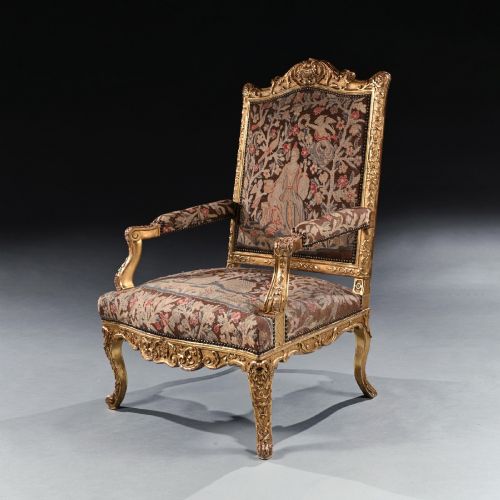
A gilded tapestry fauteuil is an open-armed seating form designed for formal reception rooms, combining decorative wooden framing with textile upholstery. These chairs range from grand 18th Century Regence pieces to nineteenth-century revivals and suites.
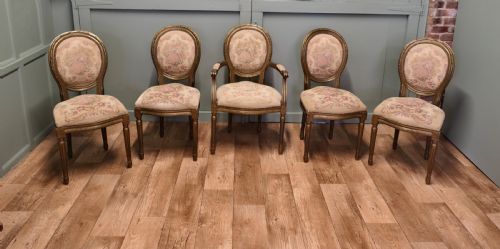
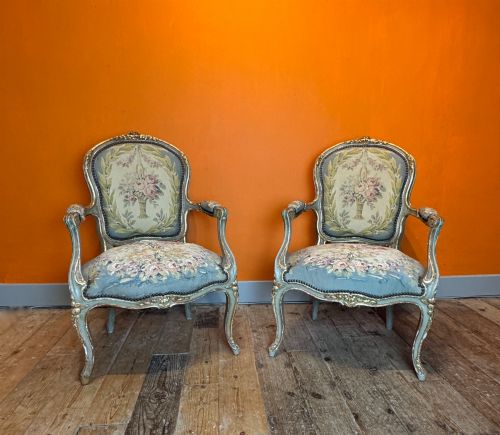
The version most commonly met on this page is the 19th Century revival armchair, often rendered in carved giltwood or painted beechwood. Makers of these later pieces drew heavily on French Louis XV, Louis XVI, and Baroque styles to satisfy demand for chateau-style interiors.
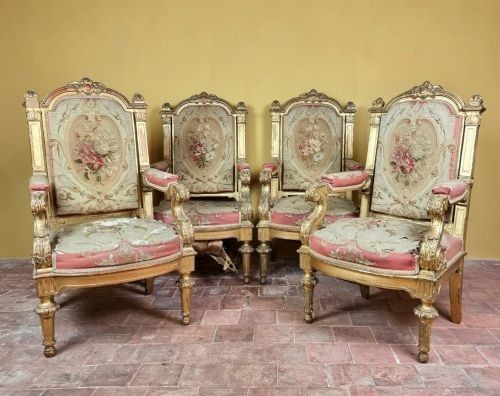
Buyers also encounter larger salon suites consisting of multiple armchairs together with matching seating forms. These matching sets demonstrate how these chairs were originally deployed to furnish cohesive entertaining spaces.
How they were made
The structural framework of a fauteuil relies principally on hardwoods such as beech and timber that receives an application of gold leaf or giltwood finish. Master carvers shaped these wooden frames with decorative motifs before the application of surface gilding or paint.
Upholstery completed the piece, utilising tapestry work secured with brass tacks along the wooden borders. This combination of carved gilded timber and pictorial textile weaving created the distinctive dual character of the chair.
Listings feature 19th Century and 18th Century periods alongside 1900, employing giltwood, tapestry upholstery, and painted beechwood.
What varies in quality
The refinement of the wood carving marks the primary distinction between standard production and top-tier examples. Crisp, deeply undercut foliage and scrollwork demonstrate superior craftsmanship compared to shallow or mechanical moulding.
The quality of the tapestry upholstery and the integrity of the original gilt surface dictate the standing of an individual piece. Retaining genuine gold leaf alongside finely detailed woven panels elevates a chair far above later repainted or rewoven counterparts.
Holland & Sons
The Gilded Tapestry Fauteuil Glossary
- Giltwood
- Timber treated with a thin layer of gold leaf or gold paint across a prepared gesso surface. It provides the brilliant metallic sheen characteristic of formal European seating.
- Regence
- A transitional stylistic period in French art bridging the Baroque and Rococo eras. Furniture from this phase displays curved lines and restrained ornamentation.
- Louis Philippe
- A mid-nineteenth-century French aesthetic characterised by comfortable proportions and simplified revivals of earlier royal styles. Pieces from this period focus on domestic utility alongside traditional elegance.
- Tapestry upholstery
- A heavy hand-woven or jacquard textile featuring pictorial scenes used to cover furniture seats and backs. These fabrics transform functional chairs into decorative works of art.
Gilded Tapestry Fauteuil: Frequently Asked Questions
What is a fauteuil?
A fauteuil is an open-armed wooden armchair designed in France for formal reception rooms and salons. Unlike fully upholstered armchairs, it leaves the carved and gilded wooden frame exposed along the sides and arms.
These seats were built to accommodate the voluminous court dress of past centuries while providing an upright and dignified posture for conversation.
How were these chairs used?
These armchairs served as principal seating in formal drawing rooms, parlours, and reception halls. They were frequently arranged in symmetrical groupings around a room to facilitate social interaction and display status.
In larger settings, individual armchairs formed part of expansive salon suites that included matching sofas and side chairs for entertaining guests.
How do I live with a gilded chair?
Living with a gilded chair involves placing it away from direct sunlight and high-traffic zones to protect the delicate gold leaf and woven tapestry. Positioning the chair as an accent piece in a study or drawing room allows it to function as a focal point without sustaining heavy daily wear.
Gentle dusting with a soft, dry cloth helps preserve the carved wooden surfaces and the integrity of the metallic finish over time.
How do I tell periods apart?
Differentiating periods relies on observing the shifts in carving style, from the robust symmetry of seventeenth-century Baroque through the fluid asymmetry of Rococo to later nineteenth-century revivals. Earlier pieces display hand-carved depth and structural integration, while revival pieces often interpret historical motifs through nineteenth-century workshop practices.
Examining the underlying timber, joinery techniques, and the wear pattern of the gilding provides further clues to a chair's true age and origin.