

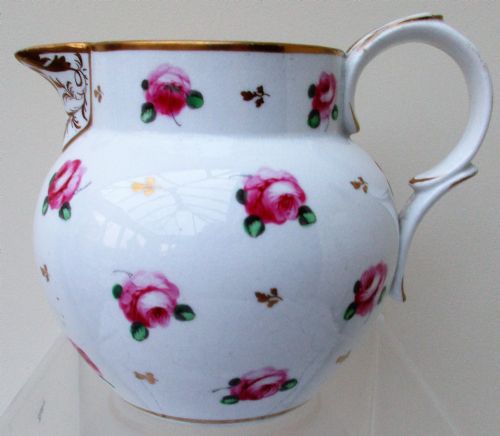


Gilded Porcelain Creamer Jug
These gilded porcelain creamer jug examples bring together handpainted detail and gold enrichment for the table.
Gilded Porcelain Creamer Jug
A gilded porcelain creamer jug is a small pouring vessel designed for milk or cream during tea service, shaped with handles, spouts, and decorative bodies. The pieces found here span the eighteenth, nineteenth, and twentieth centuries, originating from English factories and continental makers.
Forms include traditional cream jugs, milk jugs, miniature ewers, and sauce boats, often appearing alongside tea sets or as standalone table ceramics. Makers utilise porcelain, bone china, and hard-paste porcelain, finished with gold leaf, enamel, and handpainted motifs.
Stylistic influences range from Georgian and Regency designs to Rococo curves, Chinese Export patterns, and Victorian revivals. Buyers encounter everything from early Meissen and Worcester vessels to later Royal Worcester fruit-painted pieces.
How they were made
Potters shaped these vessels using porcelain, hard-paste porcelain, and bone china, firing the clay bodies at high temperatures to achieve a dense, white base. Artisans then applied enamel colours and gold leaf or gilding by hand before a secondary firing to fuse the metallic decoration.
Gilded Porcelain Creamer Jug Retail Price Guide 2026
Typical asking prices for gilded porcelain creamer jug among the pieces listed under this phrase on Sellingantiques today, from the lower quarter to the upper quarter. They describe what is for sale here now, not the wider market.
Listings feature hard-paste porcelain, bone china, and gold leaf spanning the eighteenth to the twentieth centuries.
What varies in quality
The standard of painting determines much of the distinction between pieces, particularly in the precision of handpainted birds, insects, and fruit panels. Crisp brushwork and detailed enamel execution separate master-painted studio pieces from standard factory output.
The application and preservation of the gold gilt or gold leaf also dictate value, with thick, burnished gilding showing superior craftsmanship compared to flat or rubbed metallic finishes. The sophistication of the moulded porcelain form, from simple ribbed bodies to complex Rococo scrolls, adds further distinction.
Meissen·H and R Daniel·Royal Worcester·Royal Davenport·Chamberlain Worcester·Minton·Rockingham·Masons·Derby
The Gilded Porcelain Creamer Jug Glossary
- Gilding
- The application of gold leaf or liquid gold to the surface of porcelain. It provides a metallic border or highlight that catches the light during tea service.
- Armorial
- A design featuring a family coat of arms or crest painted onto the porcelain. These bespoke commissions denote specific historical ownership.
- Hard-paste porcelain
- A durable ceramic composition fired at high temperatures using kaolin and petuntse. It creates a ringing, vitreous body resistant to scratching.
- Kakiemon
- A Japanese enamel style featuring asymmetric floral and animal motifs, adopted by European factories in the eighteenth and nineteenth centuries.
- Ewer
- A large jug with a wide spout and curved handle, often modelled on classical forms for decorative display or pouring.
Gilded Porcelain Creamer Jug: Frequently Asked Questions
How do I use a antique cream jug safely?
These historical vessels suit careful handling during modern tea service or display within a cabinet. Hand washing in warm water preserves the delicate enamel and gold leaf.
Avoid abrasive sponges and dishwashers, as harsh detergents and high heat degrade nineteenth-century gilding and handpainted details over time.
Can I date these jugs by their marks?
Factory stamps, painted numerals, and impressed ciphers on the base often indicate the approximate decade of production. Stylistic clues like gadroon borders or armorial crests narrow down the manufacturing period.
Comparing the paste type and weight of the porcelain further helps distinguish eighteenth-century pieces from later Victorian revivals.
What is the difference between porcelain and bone china?
Hard-paste porcelain contains natural kaolin clay and petuntse, fired at extreme heat to create a dense, translucent body. Bone china incorporates calcined animal bone into the mixture.
Both materials accept gilding and enamel painting well, but bone china tends to have a slightly warmer tone and softer translucency than hard-paste porcelain.
Were these jugs always part of tea sets?
Many cream jugs originated as components of larger tea and coffee services alongside teapots, sugar bowls, and cups. Others were produced individually as replacement pieces or decorative table wares.
Matching jugs often share identical armorial crests, floral panels, or gilt borders with their corresponding teapots and saucers.